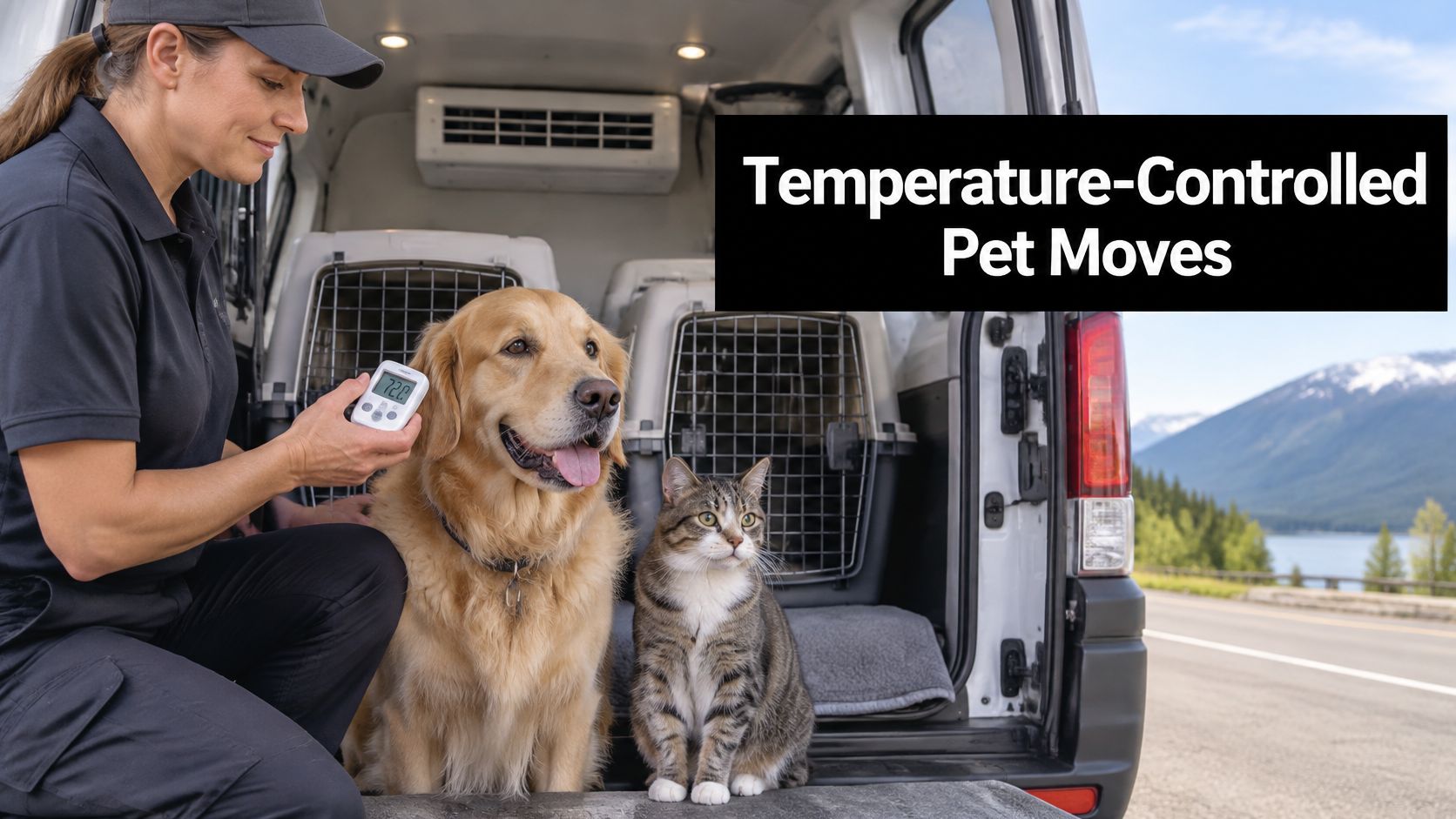
You're at the airport, the move is underway, and your family's pets have just been turned away. Now your three dogs need another way across the country. That's the situation that prompted our founders to build a ground pet transportation service, and it captures why your pet's comfort shouldn't be left to chance. Heat and cold exposure deserve a practical plan, especially when delays stretch a journey. When comparing temperature controlled transport companies, look beyond an air-conditioning claim. You need verifiable answers about climate management, staff credentials, animal-care routines, route coverage, and what happens when the original plan changes. Start with the travel kennel, but evaluate the entire journey before booking.
Table of Contents
1. Petmate Sky Kennel

Best suited to preparing for an airline journey, not replacing a climate-controlled transport service. This durable, well-ventilated kennel is among our recommendations for airline pet travel and is trusted by professional pet transporters. Properly assembled with metal hardware and airline-compliant accessories, it's suitable for domestic and international flights.
The distinction matters: a kennel is containment equipment, not temperature-control equipment. Its suitability for your trip depends on the animal's fit, the assembly, and the accepting airline's requirements. A good crate can still be placed in an unsuitable environment, so evaluate the kennel and transporter separately.
What the Kennel Does and Doesn't Solve
A travel kennel gives your pet a defined space during handling and transportation. Ventilation openings must remain unobstructed, and the vehicle layout should allow staff to observe the animal without unnecessarily opening the enclosure. Don't cover ventilation openings with luggage or use heavy coverings to make the space feel secluded.
Before purchasing, measure your pet and review our international pet travel kennel requirements. Confirm the selected configuration with the airline handling the journey rather than treating a product description as approval for every itinerary.
- What works: Correct sizing, secure assembly, unobstructed ventilation, and gradual familiarization before departure.
- What doesn't: Assuming a sturdy shell controls temperature or guarantees airline acceptance.
- The trade-off: A kennel chosen for flight requirements may not be the enclosure a ground transporter uses. Confirm arrangements before buying duplicate equipment.
Practical rule: Choose the enclosure for the animal and the journey. Choose the transporter for how they manage conditions around that enclosure.
Compare Climate Management, Not Cooling Claims
The useful distinction is between air conditioning that exists and conditions that staff actively manage. The WHO temperature-controlled transport guidance defines temperature-controlled transport around predefined limits, a useful technical principle even though its pharmaceutical guidance isn't an animal-welfare standard.
For a pet move, request an explanation of the intended cabin conditions, how staff check them, and what changes during stops. A dashboard setting doesn't establish what an animal experiences farther back in the vehicle. The explanation should cover the occupied compartment, not just the driver's seat.
Compare providers using the same practical scenario: traffic stops moving on a hot afternoon, and the planned care stop is delayed. The stronger answer identifies who checks the animals, how cooling continues, where the vehicle can safely stop, and when staff will change the route.
Backup planning matters as much as normal operation. Request details about vehicle failure, loss of cooling, and access to an alternative climate-controlled location. Don't assume any provider has redundant systems unless they describe them clearly.
Readings Must Represent Where Your Pet Rides
Temperature monitoring is useful only when the readings represent the occupied space. A sensor near a cooling outlet can tell a different story from one beside a kennel exposed to sunlight. Request sensor-location details and clarification about whether staff can see changes during the trip or only retrieve records afterward.
The federal transportation standards for dogs and cats generally prohibit exposure above 85°F or below 45°F for more than four consecutive hours and require auxiliary ventilation or air conditioning when the animal cargo space reaches 85°F. Those are regulatory boundaries, not a recommended comfort setting for your pet.
- Sensor placement: Look for readings representative of occupied kennel locations, not just an easily reached wall.
- Monitoring continuity: Establish whether loading, care stops, and overnight arrangements are included.
- Response responsibility: Identify who receives an alert and who can authorize a change.
- Documentation: Clarify what journey information the company retains and can share.
A reassuring temperature reading isn't enough if nobody can explain where it was measured or what happens when it changes.
Avoid judging a service by the sophistication of its tracking screen alone. Location tracking can show where the vehicle is, but it doesn't establish cabin conditions, animal observations, or corrective action.
Match the Care Plan to Your Pet
Your pet's daily routine belongs in the transport plan alongside the route. Write down feeding preferences, leash behavior, toileting needs, medication instructions, and any handling concerns. For health-sensitive animals, have your veterinarian explain the conditions that should trigger a call or a change in travel plans.
The USDA's pet air-travel care guidance addresses temperature exposure and acclimation considerations, but regulatory limits don't replace individual welfare planning. A senior dog, an anxious cat, and a flat-faced dog shouldn't automatically receive an identical plan because they share a destination.
Our ground service uses climate-controlled vans with sanitized kennels and bottled water. Dogs receive regular walks, cats receive litter-box access, and pets are fed according to their normal home schedules. Our drivers remain with the animals overnight, so care arrangements extend beyond driving hours.
Send the home routine before departure, not during the pickup handoff. Include food preparation details and relevant veterinary instructions in writing. Familiar routines are easier to follow when the coordinator and driver receive the same information.
Compare Private Rides, Shared Rides, and Flight Coordination
Private and shared ground rides solve different scheduling needs. A private arrangement may suit owners prioritizing an individualized itinerary, while a shared ride requires coordination around other pickups and deliveries. Compare the proposed journey rather than assuming either label guarantees a particular travel time.
We offer private and shared door-to-door ground transportation for dogs and cats across the continental United States. Our team plans pickup, routing, care stops, and delivery. Pricing depends on the route, travel dates, number and size of pets, and service requested.
For international moves, our planning is customized to the pet's needs, destination requirements, and owner preferences. Selected services may include flight arrangements, travel kennels, veterinary paperwork, and destination assistance.
- Ground-only move: Compare the planned route, care stops, overnight arrangements, and delivery handoff.
- Ground-to-air move: Establish responsibility for airport delivery, airline acceptance, and disruption planning.
- International move: Confirm which paperwork and destination services are included rather than assuming coordination covers everything.
Say you're relocating from Maryland while your household belongings travel separately. Keeping a flexible delivery contact and supplying clear receiving instructions can make the pet's handoff more manageable than trying to synchronize every moving service.
Verify Credentials and the Written Scope
Credentials answer different questions. USDA licensing, association membership, and individual training aren't interchangeable, and none should substitute for a clear description of the actual service. Request the credential name and holder, then match it to the work being performed.
Precious Pets Transport Services, LLC has provided ground pet transportation since 2004 and has been an IPATA member since 2015. Co-owner Linda Allison holds an IATA Live Animals Regulations certificate. Our professional drivers are background-checked and trained in pet first aid.
A useful written estimate should let you distinguish transportation from coordination and identify the services included. We review quote requests, contact customers to discuss transportation options and pricing, and provide a written estimate for each pet's trip.
Booking test: If you can't explain who is responsible for your pet during each handoff, the service scope needs clarification before you commit.
The kennel remains a useful preparation tool, but it shouldn't dominate the booking decision. The stronger choice is the service whose route, care responsibilities, and climate-management procedures you can understand before departure.
At a Glance
| Item | Climate Control | Certifications & Training | Best For |
|---|---|---|---|
| Petmate Sky Kennel | Well-ventilated; no climate control specified | Not specified | Airline travel, including domestic and international flights |
Choosing the Right Climate-Controlled Transporter
Compare temperature controlled transport companies by the answers they put in writing, not by the most reassuring slogan. An established USDA-licensed, IPATA-member ground transporter offering door-to-door climate-controlled vans and written estimates should make its credentials and service scope straightforward to verify. Membership and licensing still don't tell you how a particular trip will run.
Use this checklist before committing:
- Cabin monitoring: How are temperatures measured near occupied kennels, and what happens when conditions change?
- Staff credentials: Which certifications do drivers and coordinators hold, and who handles an animal-care concern?
- Daily care: How will walks, feeding, hydration, and litter access fit your pet's home routine?
- Route planning: Where are care stops and overnight stays planned, and how are delays handled?
- Written scope: What's included, what remains your responsibility, and who receives your pet?
For our estimate, submit pickup and delivery locations, preferred dates, and pet details through the Pet Transport Quote Request form. We'll review those details and discuss suitable options rather than treating every move as interchangeable.
Keep household logistics separate from animal care. If you also need to find covered auto transport, coordinate that booking around your move without assuming its schedule or protections apply to your pet's journey.
Precious Pets Transport Services, LLC offers domestic door-to-door ground transportation and customized international pet relocation planning, with attention to comfort, care routines, and travel requirements. Visit Precious Pets Transport Services, LLC to request a written estimate with your pickup location, destination, preferred dates, and pet details so we can discuss the right transportation options for your move.
Leave a Reply