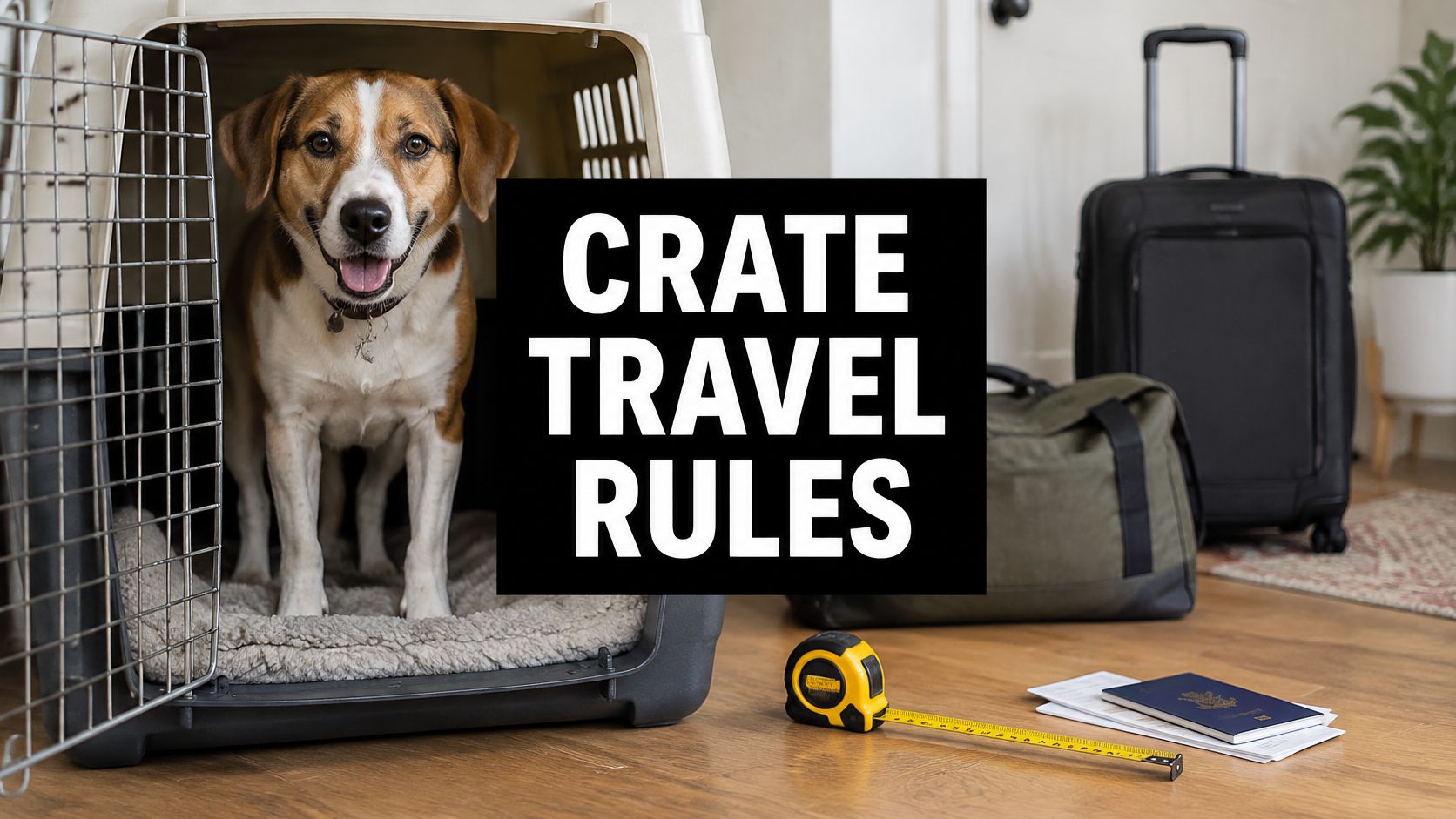
The most popular advice about a “USDA approved dog crate” sounds reassuring: find the label, buy the crate, and you're ready to travel. But a label on a box can't tell you whether your dog can stand and turn inside once bedding is added, or whether the carrier will accept that crate on your route.
The search often starts during moving week, after flights or relocation dates are already set. Think of pet logistics like working with a travel agent: the crate is only one piece of a trip that also involves carrier acceptance, health documents, and the way your dog will manage the journey.
The practical question isn't just what the product label says. It's how to identify a suitable crate, measure your dog rather than shop by breed or weight, and confirm the rules for the actual route. Cargo air, cabin travel, and climate-controlled ground transport don't necessarily use the same container.
Table of Contents
- Why the USDA Approved Dog Crate Label Misleads
- What USDA Rules and IATA Standards Each Cover
- Hard-Sided Crate Features Handlers Actually Check
- How to Size a Dog Crate from Body Measurements
- When Breed Shape and Shared Crates Change the Fit
- How to Choose Ground or Air Pet Transport
- Your Next Step Before the Crate Inspection
Why the USDA Approved Dog Crate Label Misleads
A pet parent comparing hard-sided crates the week before a move may see “USDA approved” and treat it like a safety stamp. That reaction makes sense. The label looks specific, and the purchase feels like one task you can check off before the moving truck arrives.
But a product label doesn't prove that the crate fits your dog or meets the rules for your trip. “USDA approved dog crate” is commonly used as a shopping phrase, not a universal certification that guarantees acceptance by every airline, transport company, or international route.
The confusion often appears at the counter. An owner has a sturdy crate, but the dog can't sit naturally with the bedding in place, or the carrier has a route-specific requirement the listing never mentioned. The animal, the crate, the paperwork, and the carrier's rules all have to line up.
The label is a starting point, not a travel clearance.
A useful way to think about pet logistics is to treat each journey like a trip with several connected decisions. The crate must suit the dog's posture and the handler's needs. Health documents must match the destination and itinerary. The airline or ground operator must agree to the type of container and route.
Before you spend money, identify whether you need a rigid cargo crate or a soft-sided in-cabin carrier. Those are different categories, and a listing that sounds suitable for airline travel may describe only one of them. Confirm the category with the operator before shopping.
This guide will clarify what people usually mean by the label, which construction details handlers look for, how to prove fit with your dog's measurements, and which documents and carrier rules sit alongside the crate. The false comfort to avoid is the idea that one universal certification settles every part of the trip.
What USDA Rules and IATA Standards Each Cover
The main misconception is that USDA rules and airline crate rules are the same thing. They aren't. USDA animal-welfare requirements concern handling and transport, while airlines and international shipping may apply separate container standards and route-specific acceptance checks.
There's no single USDA approval label that blesses one crate for every trip. A travel benchmark owners may encounter is the IATA Live Animals Regulations. These standards focus on the container and the dog's ability to maintain natural postures inside it. Requirements can still vary by airline and route, so a general label can't replace direct confirmation.

Three labels that sound alike
A retailer's “airline approved” tag describes the product's marketing or the retailer's understanding of airline use. It doesn't guarantee that a specific carrier will accept that crate for your route. A USDA-licensed transporter, meanwhile, describes the transport provider's licensing status, not a federal certification of a particular crate. An IATA-style shipping container refers to a crate designed around animal air-transport standards.
A crate can match a store checklist and still fail inspection if the dog can't stand erect, sit naturally, turn around normally, or lie naturally once the bedding is inside. It may also be the wrong container category for the trip. A rigid cargo crate and a soft-sided in-cabin carrier aren't interchangeable just because both are sold for air travel.
Here's the map: the dog needs room to move naturally; the crate needs to provide appropriate space and construction; USDA rules cover animal-welfare handling; IATA standards set container guidance for air transport; and the airline or ground operator decides what it will accept on its route.
For international journeys, compare the crate requirements with the broader international pet travel kennel requirements. Keep travel protection separate from crate compliance. For example, Spot Pet Insurance provides customizable accident and illness coverage for dogs and cats, with flexible reimbursement options, multi-pet discounts, and access to any licensed veterinarian.
The paperwork and operator checks matter, but the next question is physical: what should a handler be able to inspect on the crate itself?
Hard-Sided Crate Features Handlers Actually Check
A “USDA-approved” label does not tell you whether a crate will pass a handling check. Treat USDA guidance as a standard for animal transport, then inspect the crate itself: its shell should be rigid, its fasteners should hold during normal handling, and its interior should have no sharp projections that could injure your dog. These features help limit escape, impact injuries, and contamination. The relevant requirements appear in the USDA's animal transport standards.

Walk the crate from shell to door
Check ventilation on three sides and the door. Then inspect the inside, where your dog may shift during the trip. A smooth interior helps prevent scrapes or snags.
The floor should be leak-proof and covered with an unused absorbent pad or a collection tray. That prepared surface helps contain mess and limit contamination while the crate is handled.
Check the door before choosing the bowls. Under the cited USDA guidance, food and water dishes should attach to the inside of the door, so handlers can replenish them without opening the crate. The same guidance does not accept an externally mounted water bottle. The reason is practical: a bowl outside the crate may require someone to open the door to reach the dog's water.
A handler should be able to provide water without opening the crate.
Under the cited USDA guidance for this transport context, the top and one side should display “LIVE ANIMAL” lettering at least 1 inch high. This marking helps handlers and emergency personnel identify the crate. It is not a universal specification for every crate or route, so confirm any airline-specific marking requirements before travel.
Crate construction also matters for other shipments, though animal containers have their own handling needs. This overview of protecting antiques in wooden shipping crates offers context on how a rigid container can protect its contents. For travel preparation beyond the crate inspection, review these pet safety tips.
A crate may pass a parts check and still be unsuitable if your dog cannot fit comfortably with bedding in place. The label is only the starting point.
How to Size a Dog Crate from Body Measurements
“Airline approved” on a box is not a fit guarantee. Treat USDA approval as a handling standard, then check whether your dog's body, bedding, and route call for a different size. Your dog should be able to stand normally, turn around, sit, and lie in a natural position inside the crate.
For international air transport, IATA's technical guidance uses the crate's interior dimensions. Measure your dog with a soft tape and compare those measurements with the inside of the crate, not its outside. The preparation guidance and sizing formula are outlined in USDA pet air-travel preparation guidance.
| Check | How to figure it | What fails |
|---|---|---|
| Internal length | Measure from nose to tail root, then add half the height of the foreleg. | A crate that's too short may prevent a natural lie-down or restrict posture. |
| Internal width | Measure shoulder width and allow roughly twice that width. | A dog may fit while standing but be unable to turn around normally. |
| Internal height | Measure standing height and add the thickness of the bedding. | A crate may be too low once the pad or bedding is in place. |
| Ventilated area | Total ventilation should equal at least 16% of the four-sided surface area under the cited USDA pet air-travel preparation guidance. Side and rear openings belong in the upper two-thirds and should be small enough to prevent muzzle or paw entrapment. | Openings can fall short of the area guidance or present an entrapment risk. |
Turn the measurements into a real fit check
Use the measurements to narrow your options, then test the crate with the bedding you plan to use. Your dog should be able to stand erect, turn normally, sit naturally, and lie in a natural position. Even a crate labeled “airline approved” may become too low or short once a pad is inside.
The same tape-measure habits can help when measuring for a fitted coat. Follow how to measure your dog's coat size to practise taking body measurements.
Crate occupancy has separate handling rules. Adult dogs generally travel one per crate. Under USDA handling guidance, up to two comparable puppies aged 8 weeks to 6 months and weighing no more than 20 pounds each may share one crate, provided they can maintain natural postures; see the USDA pet air-travel preparation guidance for the complete conditions.
Measurements show whether a dog fits on paper, but they cannot guarantee comfort on every journey. Height, bedding, body shape, mobility, and route can all affect whether the crate works in practice.
When Breed Shape and Shared Crates Change the Fit
A crate label describes the product, not how your dog will fit inside it. Body shape, movement, bedding, and route can all change whether the same container works for a particular trip. Treat “USDA approved” as a handling standard, not a stamp proving that every dog and crate combination is suitable.
Three situations to check at home
Two comparable puppies: If the puppies meet the shared-crate conditions discussed earlier, test them together. A good solo fit does not prove that both can settle comfortably in the same space. With the bedding in place, observe whether each puppy can turn without pressing into the other. Keep the planned transport mode in mind, since cargo air, cabin travel, and a ground trip may involve different acceptance decisions.
A broad-chested or long-backed dog: Your dog might clear the crate walls while standing, then have trouble lying down without twisting. Record a short video of the dog turning and settling with the planned bedding inside. This shows the body in motion, like a fitting-room check rather than a still measurement. Note the route and crate type for the airline or transport provider reviewing the fit.
A senior or mobility-limited dog: A crate can meet basic size requirements and still be difficult for your dog to use over a long trip. Watch how your dog steps in, turns, and lies down without prompting. Share what you observe with the carrier or transporter, because a measurement alone cannot show how easily your dog moves.
For snub-nosed breeds, IATA guidance recommends additional space, commonly described as a 10% increase. The adjustment reflects respiratory concerns that may affect sizing beyond a basic body-measurement check. Check the cited technical guidance, then confirm the final crate size with the airline or transport provider for your specific route and service. A recommendation in general guidance does not guarantee acceptance by every carrier.
The same crate may receive different decisions for domestic and international travel. Keep a simple record of your dog's fit with bedding installed, including whether your dog stands, turns, and settles naturally. Add the route and transport mode, such as cargo air, cabin, or ground transport. Those details help a carrier assess the actual combination instead of relying on the label or weight rating alone.
How to Choose Ground or Air Pet Transport
USDA approval describes handling standards, not a stamp that guarantees every route will accept a crate. For your dog, the right transport choice depends on the route, the carrier's requirements, and how care is managed along the way. Compare cargo air, in-cabin travel, and ground transport before booking.

| Option | What to confirm |
|---|---|
| Cargo air | Ask the airline which rigid container it accepts on your route, how food and water access is handled, and which health documents it requires. |
| In-cabin travel | Check that the airline allows your dog and carrier in the cabin. A soft-sided carrier follows cabin rules, which differ from cargo-crate requirements. |
| Ground transport | Ask about the vehicle, kennel setup, care schedule, feeding, water, and paperwork during the trip. |
Changing the transport mode does not remove your paperwork responsibilities. Confirm the documents required for your route, especially for an international move. A ground operator can explain trip logistics, while the airline makes its own cargo-acceptance decisions.
For door-to-door ground travel, Precious Pets Transport Services describes climate-controlled vans, sanitized kennels, and bottled water. The company states that it is USDA-licensed and insured, has operated since 2004, and walks dogs at least four times daily. It says cats receive regular litter-box access, pets are fed according to their home schedules, and drivers are background-checked, trained in pet first aid, and stay with animals overnight.
The team also states that it has been an IPATA member since 2013 and can coordinate international moves starting from Virginia, Washington, D.C., Maryland, and nearby states. That is a transport and coordination service, not a crate brand. For a broader comparison of provider roles and transport options, read this guide to pet transport.
You can ask your veterinarian whether optional accident-and-illness coverage fits your travel plans. Embrace Pet Insurance offers customizable coverage with optional wellness rewards. Insurance is separate from carrier acceptance and does not replace route-specific crate or paperwork checks.
Your Next Step Before the Crate Inspection
A USDA-approved label does not prove that a crate fits your dog or works for your route. Treat it as a handling standard, then check the actual setup: your dog's body, the crate with bedding, and the transport mode.
Before buying another crate, make a short inspection plan. Measure your dog with the bedding in place, and check that they can stand, turn, sit, and lie naturally. Those movements are more useful than a weight rating alone, especially when height or body shape affects the fit.
Confirm whether the trip is by cargo, cabin, or ground. Requirements can differ, so ask the airline or transport operator about crate and health-document rules for your route before paying for a replacement. Then let your dog enter and settle in the intended crate at home. A practice run can reveal trouble while there is still time to adjust.
For ground or international relocation, you can request an estimate from Precious Pets Transport and ask how the team will handle your crate and route. You can also discuss timing and care needs in that conversation. Ask your veterinarian whether accident-and-illness coverage suits your travel plans.
The goal is a crate that passes inspection and gives your dog room to stand, turn, and rest during the journey. Check the measurements and route requirements before travel day.
Leave a Reply