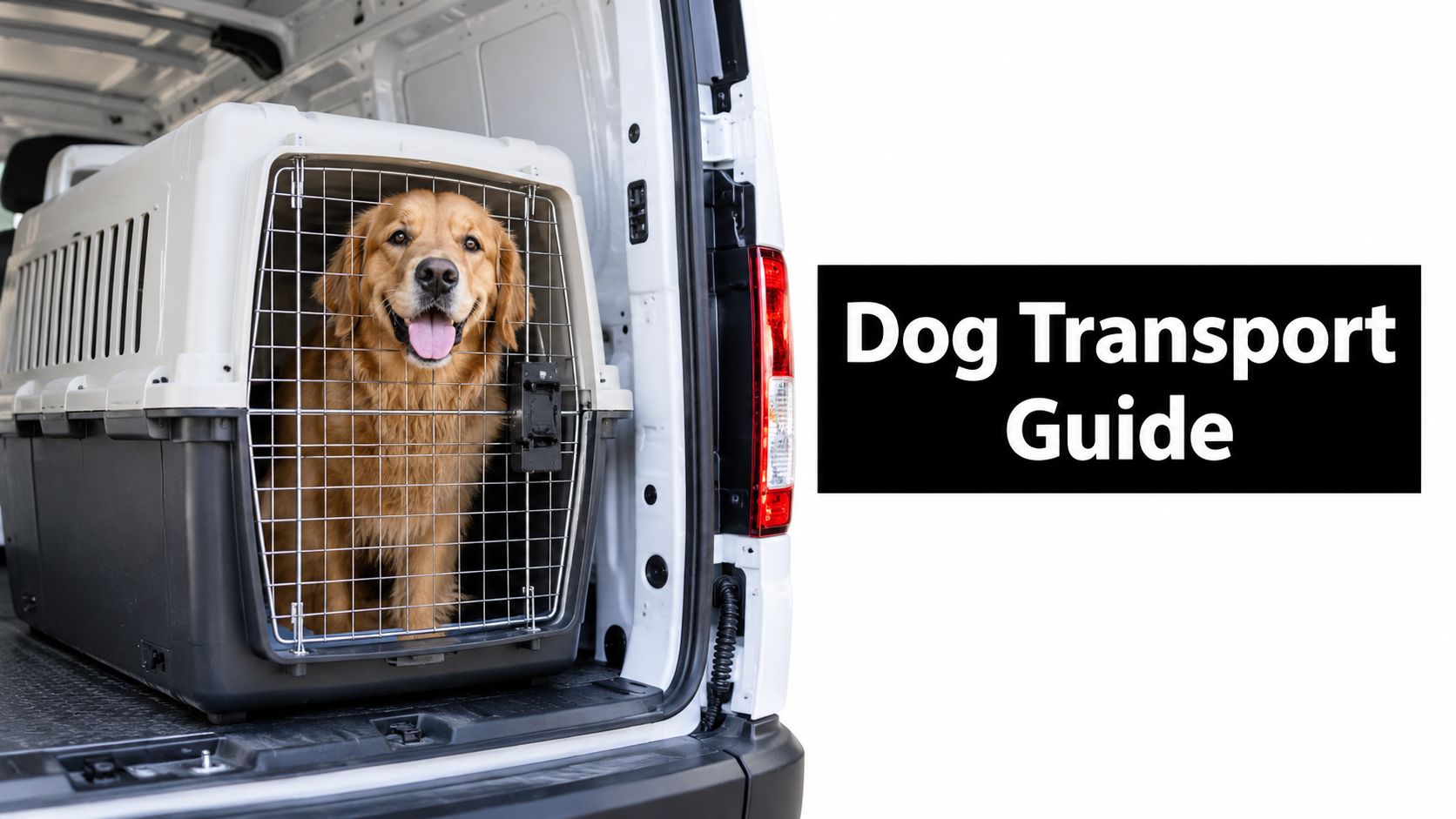
You're coordinating a move, staring at airline rules, veterinary paperwork, crate measurements, and a calendar that keeps shrinking. Your dog may be a senior Labrador who needs regular meals and careful walking, a puppy traveling from a breeder, or a family pet crossing an international border. In each case, the difficult part isn't just getting from one address to another. It's managing the handoffs, temperature, documentation, feeding, supervision, and unexpected delays without leaving your dog's welfare to chance.
Professional dog transport services are designed to manage those details. The right provider can coordinate veterinary documents, choose an appropriate travel mode, arrange crate handling, supervise overnight stays, and deliver your dog to the final address. This guide explains how the pieces fit together, what to ask before booking, and how to choose a service that treats transport as animal care rather than ordinary freight.
Table of Contents
- What Dog Transport Services Actually Cover
- Comparing Ground, Air, Door-to-Door, and International Transport
- Safety Standards and Regulatory Requirements
- What Drives the Cost of Dog Transport Services
- Real Routes and Case Examples
- Pre-Move Checklist to Prepare Your Dog
- How to Choose a Reputable Dog Transport Company
- Bringing It All Together
What Dog Transport Services Actually Cover
A family moving across the country with a senior Labrador usually starts with a simple question: “Can someone take our dog to the new home?” The answer involves several separate tasks. Someone must confirm whether the dog can travel safely, select ground or air transport, prepare the crate, coordinate the route, maintain feeding and exercise routines, and respond if a vehicle, flight, or border schedule changes.
Dog transport services may cover one part of that process or manage it from door to door. A courier-style ground provider might collect the dog at the origin and drive a planned route with other pets. A dedicated ground provider may assign a vehicle and driver to one family. Air transport can involve an owner accompanying the dog in the cabin, checked-baggage arrangements where permitted, or manifest cargo handled through airline and cargo facilities.

The service window
Before comparing quotes, ask exactly where the provider's responsibility begins and ends. A relocation specialist may coordinate:
- Veterinary paperwork: Scheduling the examination, checking vaccination records, and preparing documents for the route.
- Government endorsement: Arranging USDA or APHIS processing when the destination requires it.
- Crate preparation: Supplying, renting, or checking an airline-compliant crate.
- Daily care: Following written feeding, medication, walking, and hydration instructions.
- Overnight supervision: Transferring the dog to a supervised boarding location or keeping the dog with a trained handler.
- Final-mile delivery: Completing the trip from an airport, kennel, or transport hub to the destination home.
A general freight handler may move an animal through a cargo system but may not provide the same level of personal coordination. A pet relocation specialist plans around the dog's age, breed, medical needs, temperament, and the owner's schedule.
These services support military transfers, employee relocations, breeder shipments, rescue movements, shelter transfers, and international adoptions. If you're only arranging a short local ride, a private vehicle transfer may be enough. Guidance on direct private car transfers can help clarify how a dedicated point-to-point trip differs from a larger relocation package.
Comparing Ground, Air, Door-to-Door, and International Transport
The best mode depends on more than distance. Consider your dog's tolerance for cars, age, health, breed, crate comfort, the number of handoffs, and how much coordination you want to manage personally.
Ground transport is often the clearest choice for short and mid-range domestic moves. Climate-controlled vans can provide scheduled stops, familiar handling, and home pickup and delivery. It can suit dogs that settle well in vehicles, though a long route may require overnight care and driver changes.
Air transport can reduce travel time, but it adds airport handling, airline restrictions, crate compliance, and temperature planning. Accompanied cabin travel may work for eligible small dogs, while larger dogs may need checked or manifest cargo arrangements subject to airline policy. Air cargo also requires owners to think carefully about noise, holding areas, loading procedures, and connections.
Door-to-door service describes the coordination level rather than one specific vehicle. The trip may combine a ground pickup, an airport flight, and destination delivery. This option removes the need for the owner to manage airport handoffs, cargo counters, and final-mile transport.
International relocation adds another compliance layer. Depending on the destination, owners may need health documentation, government endorsement, import authorization, customs coordination, and destination-specific veterinary procedures. A provider should give you a written timeline instead of treating international travel like a domestic booking.
| Mode | Transit Time | Average Cost Range | Stress Level | Best For |
|---|---|---|---|---|
| Courier-style ground | Route dependent | Quote required | Low to moderate, depending on stops and temperament | Domestic moves where shared routing is acceptable |
| Dedicated ground | Route dependent | Quote required | Low to moderate | Senior dogs, anxious travelers, or owners wanting fewer handoffs |
| Air cargo | Often faster than long ground routes | Quote required | Moderate to high, depending on handling and connections | Long-distance moves where routing and airline rules permit |
| Door-to-door | Depends on combined legs | Quote required | Variable, with fewer owner-managed handoffs | Families seeking one coordinated service |
| International relocation | Depends on route, approvals, and customs | Quote required | Variable, with high compliance complexity | Cross-border moves and international adoptions |
For a deeper look at ground logistics, review this guide to ground pet transport. If air travel is under consideration, the Petmate Sky Kennel is one airline-travel option. When properly assembled with metal hardware and airline-compliant accessories, it's suitable for domestic and international flights, and its ventilation and construction are features professional transporters commonly look for.
Decision cue: Ground usually wins when oversight and routine matter more than speed. Air may win when the route is very long and a suitable, compliant itinerary is available. Door-to-door wins when you want one provider accountable for the complete journey.
Safety Standards and Regulatory Requirements
A legitimate provider should explain the rules that apply to your route before accepting payment. In the United States, animal transport is shaped by federal animal-welfare requirements, airline policies, state rules, and destination requirements. The provider should also tell you which responsibilities remain with you, such as attending the veterinary appointment or supplying accurate medication instructions.
Federal guidance limits air transport to one live dog or cat, six months of age or older, per primary enclosure when shipped through an air carrier. The same guidance says dogs and cats must not be exposed to temperatures above 85°F, or 29.5°C, or below 45°F, or 7.2°C, for more than four hours. These requirements explain why a professional operator needs climate planning, enclosure checks, and a response plan for delays. (USDA APHIS guidance)
Road transport has a comparable operational threshold. Auxiliary ventilation should be used when the cargo space reaches 85°F, and the ambient temperature may not remain above that level or below 45°F for more than four consecutive hours while dogs or cats are present. Enclosed vehicles can accumulate heat and moisture quickly, so providers should use airflow, climate control, and active temperature monitoring. (National Academies guidance)
Documents and handling controls
Ask the company to identify each document required for your specific route. A domestic trip may require a veterinary health certificate and destination records. An international move can involve government endorsement, import permits, customs documents, and destination-country requirements involving microchips, vaccinations, testing, or quarantine.
You can use this resource on a USDA health certificate for dogs to understand the document process, but your transporter and veterinarian should confirm current route rules. Airline policies can also restrict certain breeds, crate configurations, travel windows, and aircraft types.
Transport welfare deserves equal attention. A CDC analysis found that dogs imported into the United States faced three to five times greater risk of death or illness when transported through air cargo or checked baggage. The finding supports practical precautions such as reducing holding time, avoiding unnecessary connections, maintaining stable temperature and humidity, and using well-ventilated, correctly sized enclosures. (CDC analysis)

Insurance can support your broader travel planning. Spot Pet Insurance offers customizable accident and illness coverage for dogs and cats, with reimbursement options, multi-pet discounts, and access to any licensed veterinarian, based on the supplied product information. Confirm coverage, exclusions, and travel terms directly before relying on a policy.
What Drives the Cost of Dog Transport Services
A quote reflects the work required to move one dog safely, not just the miles on a map. Distance matters, but so do route availability, dog size, crate dimensions, transport mode, timing, paperwork, overnight care, and the number of people involved.
A short regional ground trip may be relatively straightforward. A transcontinental or international move can become much more involved because air cargo, government documents, customs, veterinary coordination, and destination procedures may all apply. Rather than focusing on a single advertised figure, request an itemized estimate that shows what the provider is doing.
| Factor | Impact on Price | Typical Range |
|---|---|---|
| Distance and route | Longer routes require more driving, fuel, staffing, and planning | Quote specific to route |
| Transport mode | Air, ground, and combined door-to-door services involve different handling and booking requirements | Quote specific to mode |
| Dog size and crate | Larger dogs may need larger enclosures and more cargo or vehicle space | Quote specific to dog and crate |
| Timing | Rush bookings, limited flight schedules, and seasonal constraints can increase coordination work | Quote specific to timing |
| Add-on services | Veterinary coordination, endorsements, customs, permits, boarding, and final-mile delivery add tasks | Itemized by provider |
Ask whether the quote includes pickup, delivery, crate rental, meals, walking, overnight supervision, airport handling, document review, customs clearance, and delay-related care. Also ask what happens if the airline changes a schedule or the driver encounters a road closure. A low initial quote can become difficult to compare if essential services appear later as separate charges.
Pricing rule: Compare two or three itemized quotes, not two headline totals. The more clearly a provider lists included care and possible extra charges, the easier it is to judge value.
Real Routes and Case Examples
The following routes are representative planning examples, not reports of completed customer journeys. Their purpose is to show how a coordinator thinks through the small decisions that shape a dog's experience.
A Virginia-to-Germany relocation begins with destination requirements, not an airline search. The owner and veterinarian review the dog's records, the transporter checks the health-certificate timeline, and the shipment is prepared for USDA endorsement when required. The coordinator then confirms the airline cargo booking, crate specifications, arrival handling, customs process, and any EU entry documentation. A senior dog may need a quieter routing plan, carefully timed meals, and a clear medication handoff rather than the fastest available itinerary.
A ground relay from Arizona to Maine requires a written care plan that survives driver changes. The coordinator records the dog's normal feeding schedule, water preferences, walking habits, medication instructions, and behavior around unfamiliar handlers. At each overnight handoff, the receiving driver should verify the dog's identity, crate condition, food supply, and next departure time. Owners should receive updates that confirm where the dog is, who has responsibility, and whether the schedule has changed.
A Kansas-to-Texas breeder delivery may use a short, dedicated courier route. A young puppy benefits from minimal handling, a clean and secure crate, careful water placement, and a same-day handoff when conditions allow. The driver should know whether the puppy is comfortable being picked up, whether it needs a quiet approach, and how to respond if it becomes carsick or distressed.

Across all three examples, quality appears in operational details. The provider doesn't promise “safe transport.” They document feeding, inspect crate fittings, plan rest periods, identify breed-specific risks, and explain what happens when the original route no longer works.
Pre-Move Checklist to Prepare Your Dog
Preparation should begin as soon as you know the travel date. The exact timeline depends on the destination and your dog's records, but international travel generally requires more coordination than a domestic ground move.
Health and documentation
Start with your veterinarian. Confirm that your dog is fit for the proposed mode, update required vaccinations, address parasite prevention, and verify that the microchip information matches the travel records. A health certificate may need to be issued within 10 days of travel, so schedule the examination close enough to departure without leaving room for paperwork problems.
For international moves, ask who handles government endorsement, import permits, customs documentation, and destination-country requirements. Keep scanned copies and printed copies in separate places. You can also review this guide to preparing a pet for travel before the final appointment.
Crate and routine preparation
Crate training works best as a gradual comfort exercise, not a last-minute confinement test. Leave the crate open at home, add familiar bedding, reward calm entry, and build up short closed-door sessions. Never introduce a new sedative or calming product without veterinary direction.
Prepare a written care sheet with:
- Meals: Food type, portion instructions, feeding times, and acceptable substitutes.
- Water: Normal drinking habits and the provider's preferred bowl or attachment.
- Exercise: Walking style, leash behavior, and bathroom routine.
- Health: Medications, allergies, veterinary contact, and warning signs.
- Temperament: Triggers, handling preferences, and reactions to other dogs.
Pack identification tags, leash and collar backups, documents, food, medication, cleaning supplies, familiar bedding, and a recent photograph. For owners who want location-awareness during handoffs, these no-nonsense GPS dog tracker tips can help you think through battery life, attachment security, and responsible use.
Transport-day handoff
Exercise your dog appropriately before pickup, offer water according to the written care plan, and avoid an unfamiliar heavy meal immediately before departure. Photograph the dog and crate at handoff, confirm the driver's name and contact method, and make sure both sides agree on the destination recipient and release procedure.
How to Choose a Reputable Dog Transport Company
Treat provider selection like a safety review, not a bargain hunt. A company should be able to explain its licensing, insurance, drivers, route planning, care procedures, and communication system in plain language. If the answers stay vague, keep looking.
Ask for documentation of the credentials relevant to the service. For regulated commercial animal transport, that may include current USDA licensing or a comparable applicable authorization. IPATA membership can indicate participation in an established pet-shipping network, but it shouldn't replace your own review of the provider's actual process. Request proof of commercial liability insurance and ask whether drivers receive background checks and animal-handling training.
Questions to ask before booking
Put your questions in writing and keep the responses with the contract:
- Who has responsibility at each handoff? Get names, locations, and expected times.
- Where does the dog stay overnight? Ask whether a trained employee remains with the animals or whether the dog moves to a separate boarding facility.
- How are meals and medications recorded? Look for a written log rather than a verbal promise.
- What happens during a delay? The answer should cover weather, mechanical trouble, missed connections, illness, and route disruption.
- How will updates arrive? Confirm the frequency and format of photo, location, and arrival updates.
- Who can authorize veterinary care? Clarify the emergency contact and release procedure before departure.
- What does the quote include? Check crate handling, boarding, airport fees, customs work, and final delivery.
A reliable company won't pressure you to accept an itinerary that conflicts with temperature limits, airline rules, or your veterinarian's concerns. It should also explain limitations clearly, especially for brachycephalic breeds, senior dogs, puppies, and animals with medical conditions.
Reading reviews with care
Look for detailed patterns rather than broad praise. Useful reviews mention communication, timing, driver conduct, handoffs, condition on arrival, and how the company handled a problem. Ask finalists for references involving a route or dog profile similar to yours, then compare their answers.
The lowest quote may exclude care that another provider includes. Compare two or three finalists using the same checklist, and don't sign until the route, responsibilities, cancellation terms, emergency authority, and communication plan are written clearly.
Bringing It All Together
Choose the transport mode by answering three questions in order.
First, how far is the move? A local or regional trip may suit a dedicated courier. A long domestic route may work better with a ground provider that has planned rest stops and overnight supervision. An international move requires a coordinator who understands airline cargo, government documents, customs, and destination rules.
Second, what does your dog need? A healthy, car-comfortable dog may manage ground travel well. A senior dog, anxious dog, brachycephalic breed, or dog with medication needs may require fewer handoffs, closer monitoring, and a veterinarian-informed itinerary. Your dog's behavior and health should influence the route as much as the map does.
Third, how much time do you have? A flexible schedule gives the provider more room to avoid unsuitable weather, limited flights, and rushed paperwork. A tight timeline makes early document review and a written contingency plan even more important.
Use three pillars to judge every provider:
- Safety: Appropriate licensing, insurance, climate control, crate standards, and trained handlers.
- Welfare: Familiar routines, suitable feeding, hydration, exercise, rest, and stress reduction.
- Communication: A written contract, named contacts, documented handoffs, journey updates, and clear emergency authority.
The pet travel market is growing from USD 1.2 billion in 2025 toward a projected USD 2.4 billion by 2034, with an estimated 8.5% CAGR, according to MarketIntelo's pet travel market estimate. That scale gives owners more service choices, but it also makes careful vetting essential. Start preparation at least several weeks before departure, and begin earlier when international documents, permits, or veterinary timing are involved. The best experience comes from matching the mode, provider, and care plan to the individual dog.
Precious Pets Transport Services, LLC provides domestic and international pet relocation, including door-to-door ground transportation, climate-controlled vehicles, supervised overnight care, routine-based feeding, and coordination for international travel from Virginia, Washington, D.C., Maryland, and nearby areas. Review the service details and request an estimate from Precious Pets Transport Services, LLC to discuss a transport plan built around your dog's route, health, and daily routine.
Leave a Reply