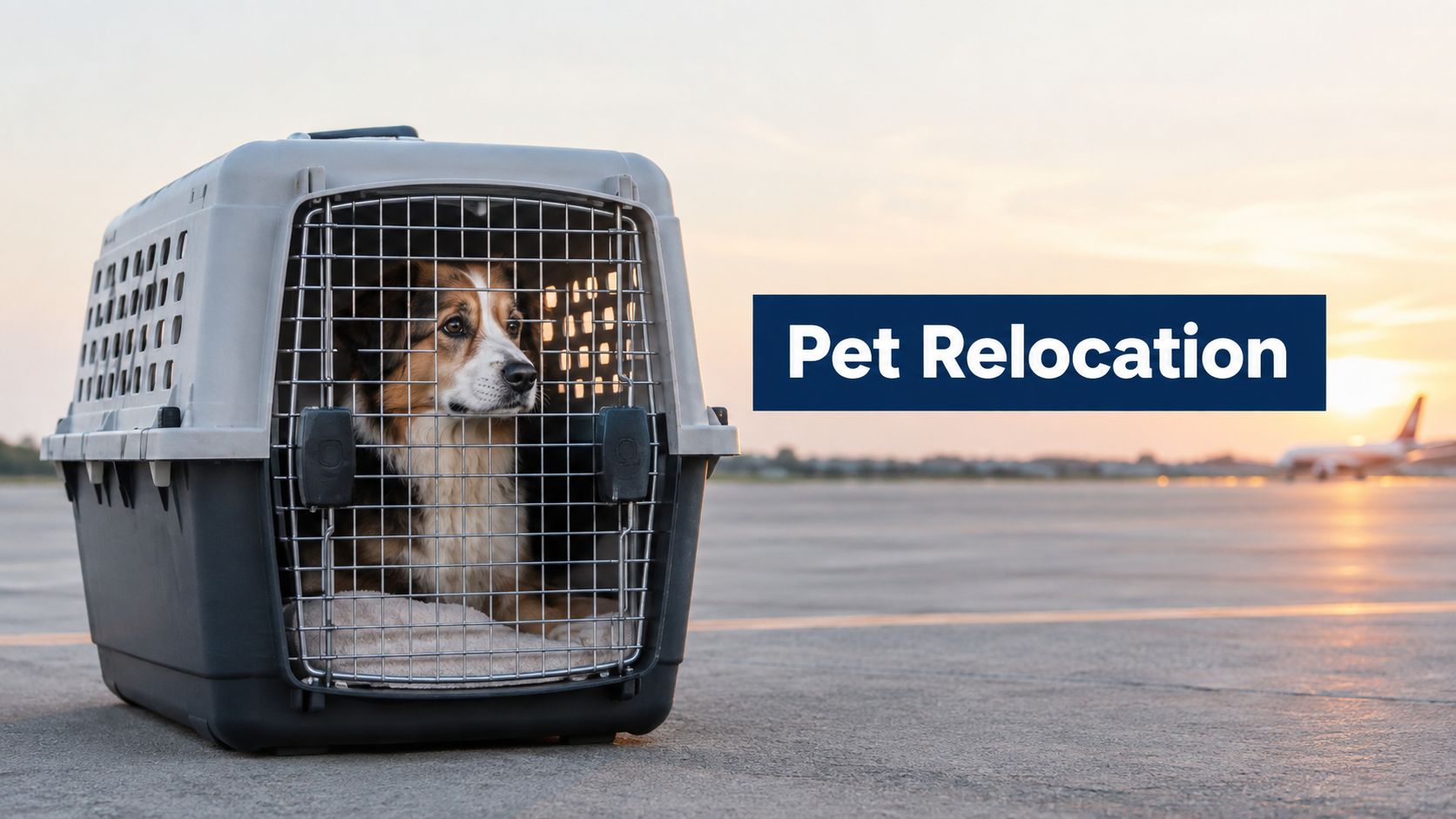
You've accepted a new job, the moving truck is booked, and your 80-pound Lab mix still needs to get across the country. He can't comfortably ride in the cab for three straight days, your work schedule won't allow a separate driving trip, and the thought of handing him to an unfamiliar carrier feels worse than the move itself. That's the moment many pet parents begin searching for a dog transport company.
Hiring help doesn't mean you love your dog any less. It means the journey has constraints, including distance, vehicle space, health needs, work obligations, weather, or an international border. A qualified provider turns those constraints into a planned itinerary, with clear responsibility at each handoff.
This guide explains how professional dog transport works, how air and ground protections differ, what paperwork and welfare practices matter, and how to compare providers without choosing on price alone.
Table of Contents
- The Moment You Realize You Can't Drive Your Dog Across the Country
- What a Dog Transport Company Actually Does
- Air, Ground, and Door-to-Door Service Types Compared
- A Step-by-Step Look at Your Dog's Journey
- Safety Rules and Welfare Standards That Apply
- Key Questions to Ask Before You Book
- Realistic Cost and Time Estimates
- How to Choose the Right Provider for Your Move
The Moment You Realize You Can't Drive Your Dog Across the Country
Moving day often makes the decision for you. The household items are packed, the children have travel plans, and the family vehicle is full. Your dog, meanwhile, needs regular care, room to move safely, and a calm handler who can focus on him rather than on a packed schedule.
A friend may offer to help, but long-distance travel can involve changing weather, overnight stops, unfamiliar feeding routines, and strict destination requirements. A professional transporter exists for precisely this gap. The company coordinates the journey while you continue managing the move, your job, or a family obligation.

The problem isn't only distance
A dog may also need transport because the owner has limited mobility, the family is transferring duty stations, the destination is overseas, or the dog's size makes ordinary travel impractical. A nervous dog may be safer with a carefully managed ground journey than with an airport handoff. Another dog may need air travel because the relocation crosses an ocean or must fit a narrow schedule.
Practical rule: Choose the transport method around your dog's welfare and the journey's requirements, not around the shortest online quote.
A reputable dog transport company should make the process feel less mysterious. It should explain who has custody, which documents are needed, how weather affects scheduling, and how you'll receive updates. It should also tell you when it can't safely or legally accept a trip.
The sections ahead cover the services these companies provide, the difference between air and ground oversight, the questions to ask before booking, and the warning signs that deserve a second look.
What a Dog Transport Company Actually Does
Think of a dog transport company as a travel coordinator for an animal who can't complete the journey independently. You provide the origin, destination, dog's size, breed, temperament, health information, and timing. The provider then builds the route and coordinates the people, vehicles, documents, and handoffs required to complete it.
That work can include:
- Route planning: Selecting air, ground, or combined travel based on distance, timing, weather, and destination rules.
- Health preparation: Verifying vaccination and microchip records, then helping schedule appointments with an appropriately qualified veterinarian.
- Document coordination: Organizing health certificates, destination-state requirements, and international paperwork when applicable.
- Crate selection: Matching the dog to an airline-accepted container that supports safe posture, ventilation, and secure handling.
- Handoff management: Confirming who receives the dog at pickup, transfer points, airports, customs, and delivery.
- Owner communication: Providing agreed updates instead of leaving you to guess where your dog is.

Company, carrier, or broker
The label matters because different businesses may perform different parts of the journey. A transport company may own vehicles, employ drivers, and carry insurance. A broker may instead arrange a carrier from its network. Neither description automatically tells you whether the service is suitable, so ask who physically handles your dog and who remains accountable if the itinerary changes.
For international travel, a provider may coordinate airline cargo bookings, customs clearance, and destination agents rather than personally flying with the dog. That arrangement can be appropriate when the company explains every handoff in writing.
Owners preparing for travel may also review Spot Pet Insurance, which provides customizable accident and illness coverage for dogs and cats, with flexible reimbursement options, multi-pet discounts, and access to any licensed veterinarian, according to the provided product information.
Relocating families, military households, breeders, rescues, shelters, snowbirds, and busy or senior pet parents commonly seek this kind of coordination. The service is less about putting a dog in a vehicle and more about making each transition controlled and visible.
Air, Ground, and Door-to-Door Service Types Compared
Your dog's route may begin with a familiar leash and end at a cargo terminal, or it may stay on the road from one home to the next. The suitable service depends on distance, destination rules, your dog's temperament, and how many handoffs you can reasonably manage.
| Service Type | Best For | Typical Use Case | Key Trade-Off |
|---|---|---|---|
| Air transport | Long distances, international moves, and dogs able to manage airline procedures | Manifest cargo or an in-cabin escort where available | Airline schedules, weather restrictions, and airport handoffs reduce flexibility |
| Ground transport | Domestic relocations and dogs who shouldn't fly | Private courier, shared shuttle, or ride-along driver | Longer transit can require careful rest, feeding, and overnight planning |
| Door-to-door | Owners who want one coordinated journey | Pickup at the current home and delivery to the new home | The added coordination and personal service may cost more than airport-only handling |
Air travel
Air transport can reduce travel time across a large geographic distance, but it creates a chain of custody involving several parties. Depending on the arrangement, the shipper, airline staff, cargo personnel, and destination representative may each handle the dog. International travel also brings customs procedures and destination-country requirements.
The International Air Transport Association has said that more than 4 million pets travel by air each year worldwide, according to industry reporting on air-cargo pet safety and trends. That level of traffic helps explain the detailed container, timing, and acceptance procedures airlines use.
An in-cabin escort may suit a small, calm dog when the airline and itinerary allow it. A larger dog or an international route may require manifest cargo. Ask the provider to explain the specific airline's acceptance process, since one flight cannot automatically be treated like another.
Airline rules govern the air handoff. They do not describe every welfare decision during pickup, waiting time, or delivery.
Ground and door-to-door travel
Ground transport often gives the handler more direct control over stops, loading, ventilation, and observation. It can suit a dog who becomes distressed in airports, or one whose health or temperament makes flying a poor choice. The longer road journey still requires planned rest, feeding, medication, and overnight arrangements.
Door-to-door service connects the current home with the new home, reducing the airport transfers an owner must arrange. It may help when the owner cannot safely reach an airport, when the destination airport is far from the new residence, or when several handoffs could increase stress. A guide to pet transport services and common relocation options can help compare these arrangements.
Ask whether the same company retains custody throughout or whether a subcontractor takes over at a transfer point. That answer reveals how ground welfare is managed after the airline's responsibility ends.
A Step-by-Step Look at Your Dog's Journey
A well-run relocation starts before pickup day. The provider should gather enough information to build a route that fits the dog, the destination, and the applicable rules.
Before the vehicle or flight
The first conversation usually covers the dog's size, breed, age, temperament, medical history, origin, destination, and preferred travel window. The company can then explain whether ground, air, or a combined plan is appropriate and identify documents that may take time to obtain.
After you approve the itinerary, read the contract carefully. It should identify the parties, custody arrangements, included services, payment terms, cancellation rules, emergency contacts, and what happens if weather or an airline delay interrupts the plan.
A veterinarian helps confirm travel readiness. Depending on the route, the provider may coordinate vaccination records, microchip information, a health certificate, destination-state forms, or international export and import documents. Don't assume that a certificate for one destination works for another.

Pickup and transit
At pickup, the handler should confirm your identity, review feeding and medication instructions, check the dog's leash and identification details, and observe temperament before loading. Give written instructions rather than relying on a hurried conversation beside the vehicle.
During transit, care may include exercise, feeding, hydration, welfare checks, and overnight boarding when the itinerary requires it. Ask how those actions are recorded and how quickly the company contacts you if your dog refuses food, becomes ill, or the route changes.
International journeys may include customs clearance and inspection before the destination handoff. Those steps are not merely administrative. Missing or inconsistent information can delay release, so the provider should tell you which documents travel with the dog and which are submitted electronically or held by an agent.
Delivery
At delivery, the handler should confirm the recipient's identity and allow time for a calm wellness check. Look at your dog from head to tail, check hydration and comfort, and compare the dog's condition with the pickup record.
Request copies of the completed paperwork, transport notes, receipts for agreed services, and any incident or delay report. A clear closeout gives both sides a record of what happened and helps your veterinarian address any concern promptly.
Safety Rules and Welfare Standards That Apply
A dog's protections can change at each handoff. Air transport is governed largely by airline acceptance procedures, federal reporting, and IATA container standards. Ground transport depends more directly on the carrier's vehicle, route planning, custody practices, and the rules covering businesses that transport animals for hire. Treat the air portion and the road portion as related but separate safety systems.
For air travel, USDA APHIS guidance requires temperature control so animals are not exposed above 85 °F (29.5 °C) or below 45 °F (7.2 °C) for more than 4 hours. Loading and unloading exposure is limited to 45 minutes. When ambient temperature reaches 85 °F or higher, auxiliary ventilation, such as fans or air conditioning, must be used in animal cargo spaces, as explained in the USDA APHIS air-travel care and handling guidance.
A route therefore needs more than a mileage calculation. The operator should account for ramp time, staging, overnight holding, traffic delays, and the temperature inside the vehicle or cargo area. A short trip can still create welfare concerns if the dog waits too long during a hot transfer.
The container is safety equipment
An airline crate works like a protective piece of travel equipment, not ordinary luggage. IATA standards require ventilation on all four sides, with total ventilation area of at least 16% of the combined surface of those four sides. For dogs, openings must be nose and paw proof, with maximum dimensions of 25 mm by 25 mm.
Sizing also depends on the dog's measurements. The formulas are length = A + 1/2B, width = C x 2, and height = D + bedding, as specified in the IATA pet container requirements. A crate that looks spacious may still fail airline acceptance if its dimensions or openings do not meet the standard.
| Agency or standard | Scope of oversight | Key standard | Enforcement trigger |
|---|---|---|---|
| USDA APHIS | Animal welfare and handling conditions | Temperature, ventilation, and handling controls | Unsafe exposure or noncompliant transport conditions |
| U.S. DOT | Airline reporting and passenger guidance | Reporting of transported animals and incidents | Loss, injury, or death during covered air transport |
| IATA | Airline container and operational standards | Ventilation, sizing, and acceptance requirements | Container or handling failure at airline acceptance |
| Destination authorities | Entry and customs requirements | Health, import, and clearance documentation | Missing, inaccurate, or unacceptable paperwork |
Federal air-transport reporting helps show why airline travel receives specialized oversight, but it cannot describe how a particular company handles your dog. Ask separate questions about the road legs, where vehicle ventilation, rest stops, overnight care, and written welfare checks become the provider's direct responsibility.
For ground transport, the company should explain how it applies welfare principles during each driving period and handoff. The USDA pet travel requirements overview can help you prepare, while the transporter should identify which requirements apply to its own operation.
Key Questions to Ask Before You Book
A quote tells you what the trip may cost. An interview tells you whether the provider has designed the trip responsibly. Ask the same questions to every company so you can compare service rather than marketing language.
Licensing and insurance
Ask, “Are you USDA-registered, or do you work with an APHIS-licensed intermediary?” Then ask for the legal business name, insurance details, and any applicable carrier identifiers. If a broker is involved, ask which company will physically transport your dog and whether that company is named in the agreement.
Handlers and custody
Use direct wording: “Who has physical custody of my dog between each leg, and how are welfare checks logged?” Also ask about experience with large dogs, anxious dogs, medication routines, and escape-prevention procedures.
A provider should be able to explain the handoff without vague phrases such as “our network” or “a trusted partner.” You deserve the names or roles of the people responsible for your dog.
Vehicles and equipment
Ask whether the vehicle is climate controlled, how crates are secured, how ventilation is monitored, and what equipment is used during loading. For air travel, ask who verifies crate dimensions and airline acceptance before departure.

Communication and contingencies
Clarify how often you'll receive updates, who contacts you during an emergency, and whether updates come from the driver, a coordinator, or an automated system. Then ask, “What happens if extreme temperatures, mechanical trouble, illness, or a flight cancellation interrupts the itinerary?”
Look for a written answer, not reassurance alone.
- Written contract: Avoid providers who won't document scope, custody, timing, and cancellation terms.
- Transparent payment: Be cautious about cash-only deposits or unexplained charges.
- Verifiable identifiers: A refusal to share relevant DOT or MC numbers is a warning sign when those identifiers apply to the carrier.
- Specific health language: Be wary of vague guarantees that promise an outcome no transporter can control.
Realistic Cost and Time Estimates
A precise price can't be responsible without knowing the dog, route, timing, transport mode, paperwork, and handoff requirements. A quote for a short regional ground trip shouldn't be compared directly with a full international relocation that includes veterinary preparation, airline handling, customs, and destination coordination.
Some planning discussions use broad market ranges, such as $300 to $800 for short regional ground moves, $1,000 to $2,500 for coast-to-coast ground transport, $200 to $600 in domestic air fees plus a compatible fare, and $2,500 to $10,000 or more for full-service international relocation. Those figures are planning ranges supplied in the brief, not universal prices, so treat them as comparison points rather than promises.
| Move Type | Typical Cost (USD) | Total Timeline |
|---|---|---|
| Short regional ground move | $300 to $800 | Depends on route, scheduling, and handoffs |
| Coast-to-coast ground move | $1,000 to $2,500 | Measured in travel days and overnight planning |
| Domestic air transport | $200 to $600 in fees, plus a compatible fare | Depends on airline availability and acceptance |
| Full-service international relocation | $2,500 to $10,000 or more | Can require extended veterinary and customs preparation |
What changes the quote
Dog size affects crate requirements and vehicle space. Extra-large crates, unusual handling needs, remote pickup, complex transfers, and unusual breeds can raise the price. A provider should itemize those factors instead of presenting one unexplained total.
Timing can change as well. Airline embargoes, temperature restrictions, veterinary appointments, destination entry rules, customs processing, and quarantine requirements may all affect the departure date. For a practical discussion of quote drivers and service components, review this resource on the cost of shipping pets across the country.
Don't choose an unusually low quote until you know what it excludes. The missing item may be a health certificate, a transfer, an overnight stay, a properly sized crate, or the contingency plan you thought was included.
How to Choose the Right Provider for Your Move
Start with the journey, then choose the provider. A cross-state ground move may need a qualified ground carrier with a suitable vehicle and clear welfare procedures. A move to London or Tokyo may require an experienced international shipper who can coordinate airline acceptance, veterinary documentation, customs, and destination agents.
Match service depth to risk
Prioritize these checks:
- Confirm legal and operational status. Ask for applicable USDA registration or licensing information, insurance details, and the legal identity of the carrier.
- Read the welfare policy. Look for temperature planning, ventilation, feeding, exercise, rest, medication, and emergency procedures.
- Identify one accountable contact. You should know who answers before departure and who coordinates changes during transit.
- Demand an itemized quote. Separate transport, veterinary work, crates, customs, handling, boarding, and possible additional charges.
- Check independent reviews. Look for detailed accounts that describe the route and the provider's response to complications.
Green flags include real-time or scheduled updates, a named contingency plan, a willingness to explain every handoff, and a temperature-controlled vehicle policy. Red flags include cash-only pricing, vague arrival estimates, refusal to provide relevant carrier identifiers, and no written answer about weather delays.
Moving a dog is also one part of moving a household. If you're coordinating the pet journey alongside a home move, a local resource such as find removals services Exeter may help you organize the broader relocation workload separately from animal transport.
Precious Pets Transport Services, LLC offers USDA-licensed and insured domestic and international pet relocation, including door-to-door ground transport with climate-controlled vans, sanitized kennels, regular care, and coordination for international moves from Virginia, Washington, D.C., Maryland, and nearby states. Visit Precious Pets Transport Services, LLC to request an estimate and discuss the handoffs, documents, and welfare plan for your dog's journey.
Leave a Reply