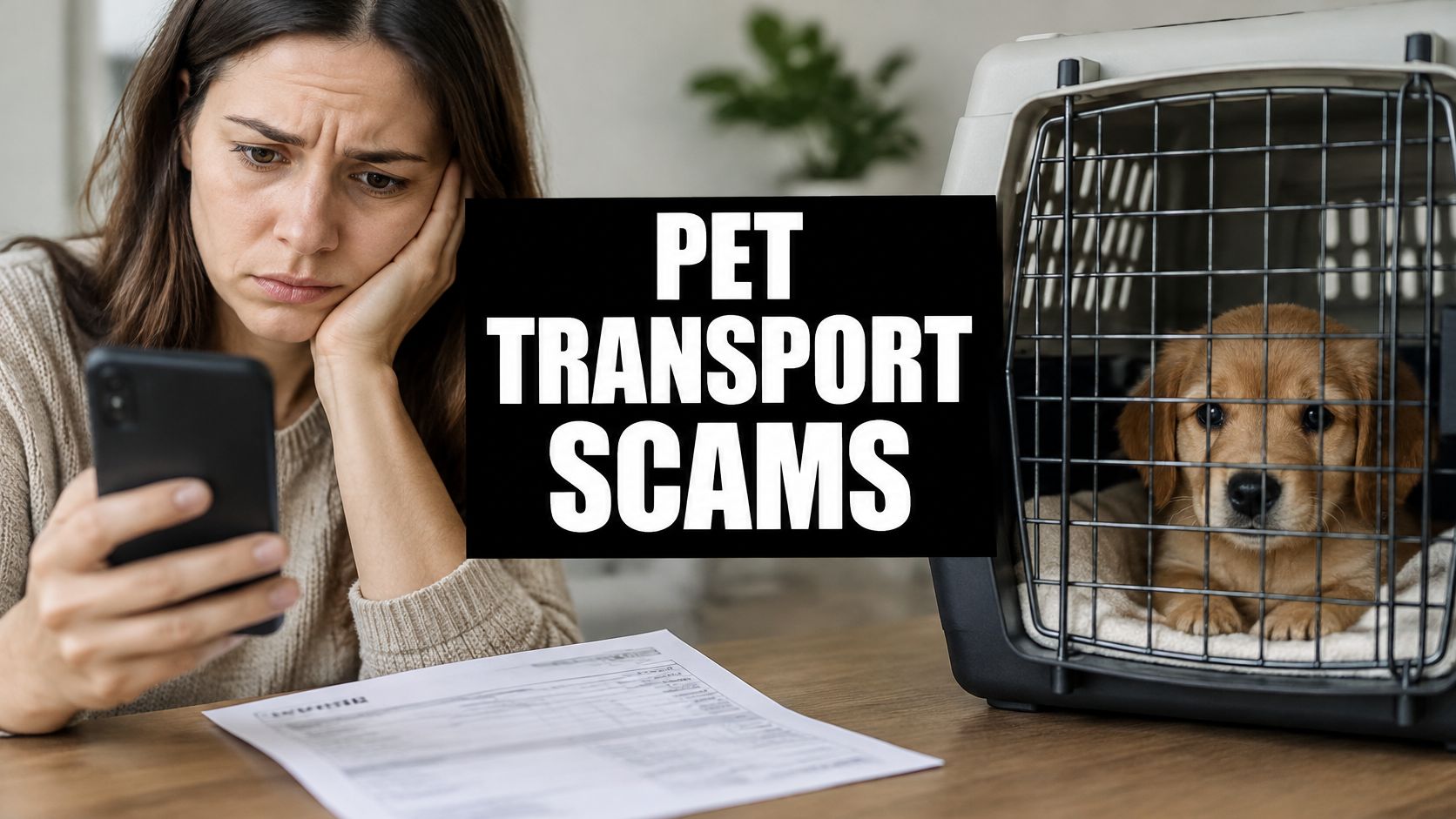
The message lands on a Thursday evening, four days after the deposit cleared. The puppy is at a "partner facility" near the airport, the seller writes, and can't board until shipping insurance, an airline-approved crate, a health certificate, temperature control for the hold, and an emergency handling fee are paid. The total is a few hundred dollars more, tonight, or the animal goes back and the money is gone.
That's the moment to stop typing.
The first payment bought a story. The transport bill is the tollbooth that keeps the story moving. Most pet transport scams aren't a moving van that never arrives. They're the second act of a fake animal sale, and the Better Business Bureau's 2021 puppy-scam study shows how the pattern works. The BBB recorded 907 reports in its ScamTracker database, which came to 12.5% of all complaints involving online-purchase fraud in that set. The same study cited an internal Federal Trade Commission report identifying approximately 37,000 pet-related complaints in 2015, with the vast majority believed to involve pet-sales scams. Typical reported losses ran from $100 to $1,000, and the FTC put the average at about $300.
Those totals are a floor, not a ceiling. The BBB warned that fewer than 10% of fraud victims report to the FTC or the BBB, so the published numbers describe a fraction of what happens.

The invented charges are remarkably consistent: shipping insurance, a special crate, a veterinary certificate, temperature control, emergency handling. Each one sounds like something a real logistics office would bill for, which is exactly why it works. If you're still at the earlier stage, working out whether the animal exists at all, the 2026 guide to pet adoption fraud covers the fake-listing side of the sequence in detail.
What follows gives you two tools: a signal chart for the message already on your screen, and a way to check a real company or a real extra charge without freezing a genuine move.
Table of Contents
- Signals That Separate a Scam From a Real Fee
- How a Fake Shipping Bill Keeps Growing
- How to Check a Transporter Before You Book
- How to Confirm a New Charge Before You Pay
- What Recent Scam Losses and Payments Show
- Choose a Documented Move or Walk Away
Signals That Separate a Scam From a Real Fee
Score the message in your hand row by row, rather than judging it by the size of the number. A deposit, a payment app, and an extra charge are not proof of fraud on their own. Real relocations involve route changes, airline restrictions, customs paperwork, veterinary certificates, and weather holds, and each of those can move a price.
| Signal | Scam pattern | Legitimate pattern |
|---|---|---|
| Animal identity | Photos or a story only, animal never produced | Live video or in-person handover matching breed, age, and paperwork |
| Reason for the fee | Vague insurance, crate, vaccine, or delay bill with no rule named | Itemized charge tied to route, airline, USDA, customs, or veterinary need |
| Invoice | A text or email total with no line items | Written estimate or invoice listing each cost |
| Authority cited | A phone number or link supplied only in the payment demand | A public airline, USDA, customs, or clinic contact you look up yourself |
| Timing | Pay within hours or the pet is stranded or resold | A dated schedule with room to confirm before the deadline |
| Payment | Gift card, crypto, wire, or app as the only method | A traceable method on a company invoice you can dispute |
| Sender history | New social-media seller who then becomes the shipper | A company you can match to a license, membership, or long operating record |
Start with the invoice row. A text reading "additional charges: $450" tells you nothing you can check. A written invoice that lists a crate at one price, a health certificate at another, and names the airline rule behind each line gives you something to verify with a phone call.
The rows that catch the most people
The authority cited row is the one readers skip. When a payment demand includes a phone number for "the shipping company," that number is part of the message, not independent proof of anything. Look up the airline's cargo desk, the USDA office, or your own veterinarian and ask them directly. The scam signal is the combination of urgency, an unexplained jump in price, and pressure toward a payment method you can't reverse, not the existence of a fee.
Recent reporting shows the pattern at scale. More than 35 complaints filed with BBB Scam Tracker in Texas from December 2025 through February 2026 reported over $31,000 in losses, often after follow-on demands for insurance, vaccinations, or delay fees, according to News 4 San Antonio's coverage of the Texas surge. The FTC's guidance points the same way, flagging gift cards, cryptocurrency, wire transfers, and payment apps as the only accepted method as a marker of fraud.
Decision rule: a fee can be real, but a fee you can't trace to a rule and an outside source isn't safe to pay.
One more comparison worth making early, because it calibrates your gut: what a normal move costs. A figure far below the market for a cross-country run is the hook that makes the later add-ons feel small, so it helps to know what a legitimate pet transport costs before you decide that a cheap quote is a lucky break.
How a Fake Shipping Bill Keeps Growing
Picture the sequence as a single case, because that's how it reaches most families. What follows is a composite of the pattern rather than one news story, and the order of events is what matters.
Stage one, the listing
A breed that's hard to find locally appears on social media at a price well under what nearby breeders quote. The seller is friendly, sends fresh-looking photos, and explains that an in-person visit isn't possible because the puppy is already with a partner transporter. That last detail does two jobs. It explains the absence of the animal, and it introduces the person who'll soon be asking for money.
Stage two, the purchase
The buyer pays for the animal. Once that money clears, the buyer is committed in a way that has nothing to do with logic. They've told their family. They've bought a bed. Walking away now means admitting the whole thing was a mistake, and scammers count on that.
Stage three, the escalating bill
The first transport message says the crate doesn't meet airline rules, so a compliant one must be purchased. Then comes a vaccine the buyer was told was already done. Then a weather hold, or a customs document, or an emergency handling charge. Each message reuses the same pressure: the pet is in a kennel, the next flight leaves tonight, and someone else is waiting for that space.
What makes this convincing is the partial truth underneath it. Airlines really do restrict certain breeds and cabin temperatures. International trips really do require health certificates and import permits. A heat embargo really can push a departure by days. The fraud isn't the existence of these rules. It's the stack of new totals with no itinerary, no airway bill number, and no clinic the buyer can call without going through the seller.
A real delay comes with a name and a number. A coordinator tells you which airport rule applied, revises the written estimate, and hands you a public phone number for the airline or the veterinarian.
Two groups get targeted hardest: military families with orders and a report date, and cross-country movers with a closing date. Both have genuine deadlines, so a scammer's countdown blends into the pressure the move already created. The next section checks the company before the first transport dollar goes out, which is earlier than most victims stop.
How to Check a Transporter Before You Book
Think of hiring a transporter the way you'd hire a project manager for one animal. Then prove the manager exists, in a place other than their own website.

1. Match the business identity across three places. The legal business name, phone number, and street address should agree on the website, on a written estimate, and in a directory you open yourself, such as the Better Business Bureau or, for pet shippers, IPATA. A P.O. box and a contact form aren't an address.
2. Make them name the route. Ask whether the trip is ground or air, private or shared, and which states or countries it covers. A quote that won't describe the route can't be checked against anything.
3. Get the estimate in writing with care spelled out. Pickup, delivery, dates, and what's included during the trip: climate control, feeding, walks or litter breaks, overnight supervision. We provide a written estimate for each pet's trip, and it's the document every later charge has to be measured against. For ground travel that means a plan covering pickup, routing, care stops, and delivery.
4. Offer the pet's details before anyone promises a seat. Age, breed, size, mobility, medical conditions, medications. We ask for all six before booking, because they change crate size, stops, and timing. A company that never asks is skipping the part of the job that costs it money.
5. See the animal yourself. A live video call, or an in-person handover, matching breed, age, and paperwork. Never let the seller's transporter be the only person who has laid eyes on the pet.
6. For flights, read the airline's own pet page. Ask which carrier and whether the animal travels in cabin or cargo, then open that airline's current rules yourself instead of trusting a screenshot.
7. For international moves, look up the government requirement. Health certificate, import permit, crate standard, and the destination authority that issues them. Read the official page, not a PDF attached to an email.
A company with a long operating record and a current IPATA listing passes an initial filter that fraudulent operators don't, since membership requires an application, review, and a signed code of ethics. Treat it as a clue, not a substitute for the estimate and the pet details. If you want to understand what licenses and registrations apply to interstate and international animal moves, this explanation of how pet transport licensing works lays out which record proves what.
Stop when the only evidence is a social profile and a rush deposit.
How to Confirm a New Charge Before You Pay
A company can be real and a new amount can still be wrong. Treat the request the way a moving company treats a change order: a change to a contract needs a reason, a number, and a date, in writing.
Step one. Ask for an itemized invoice. It should name the pet, the route, the travel date, and each added dollar on its own line. A single total is not an invoice.
Step two. Ask which sentence authorizes it. Point to the clause in the estimate or contract that allows the charge. If nobody can find the clause, you've found your answer.
Step three. Ask for the rule by name. Not "airline policy," but the specific embargo, crate dimension, USDA or state health requirement, customs document, or weather hold. Vague insurance language is the most common failure here.
Step four. Confirm the rule yourself. Call the airline for embargoes and crate limits. Call USDA APHIS or the destination authority for international health papers. Call the pet's own veterinarian for vaccines. Use a number you look up, never the one printed in the payment text.

Step five. Compare the new total to the original estimate. Then ask the question that flushes out a bluff: if I decline this charge, what happens to the travel date? A real coordinator answers with a revised schedule. A scammer answers with a deadline.
Step six. Pay only by a method you can dispute. A credit card on a company invoice gives you a paper trail. Converting a balance to a gift card or crypto because a flight is boarding tonight gives you nothing.
Step seven. Stop paying if the answers fail. If the animal is already in someone else's custody and steps one through four produce nothing, contact the platform the listing ran on, your bank, and local police or the BBB. Buying the next invented requirement rarely ends the sequence. It extends it.
The four-part test: an itemized invoice, the contract clause that authorizes the charge, the public rule that created it, and independent confirmation from a source you found yourself.
The edge case deserves respect. A heat delay or a breed restriction is often genuine, and refusing every new charge can strand a pet that's ready to fly. The goal isn't reflexive suspicion. It's a confirmed rule and a revised schedule before money moves.
What Recent Scam Losses and Payments Show
The scale of the problem reads more clearly as a table than as a warning. Reported figures cover puppy sales and the shipping demands that follow them, and the trend line is what matters.
| Period | Source | Complaints | Reported losses | Average loss |
|---|---|---|---|---|
| 2020-2021 peak | BBB | Not broken out | More than $3 million | Not broken out |
| Jan-Sep 2021 | BBB | Not reported | Not reported | About $755 |
| Jan 1-Sep 30, 2022 | BBB ScamTracker | 1,577 | More than $1.3 million | About $850 |
| Full year 2022 (expected) | BBB | Not broken out | Expected to surpass $2 million | Not broken out |
| Jan 1-Oct 15, 2023 | FBI | About 3,500 | About $6.6 million | About $1,900 (computed) |
| Jan 1-Sep 30, 2024 | FBI | About 2,600 | About $5.6 million | About $2,150 (computed) |
Read it from the pandemic peak forward, as the BBB's 2022 reporting on rising puppy-scam losses sets it out. Losses passed $3 million at the 2020 to 2021 peak and were expected to exceed $2 million in 2022. Through September 30, 2022, ScamTracker logged 1,577 reports and more than $1.3 million in losses, an average of about $850 per consumer, up from $755 in 2021. The FBI then recorded about 3,500 complaints and $6.6 million from January 1 through October 15, 2023, followed by roughly 2,600 complaints and $5.6 million through September 30, 2024.

Every one of those numbers counts complaints, not victims. The reporting agencies say so directly, and the gap between the two is where most of these crimes live.
Why the payment method decides the outcome
The payment column in a scam message is the part you can still control. A card charge on a company invoice can often be disputed inside the card network's window. A wire leaves your bank and lands in a stranger's account with little to claw back. Gift cards and cryptocurrency are treated as cash the moment a code or a wallet address is shared, and many peer-to-peer app transfers behave the same way once the money is claimed. Scammers choose those rails because the shipping story creates a clock, and a clock is what stops people from checking.
If money has already gone, save everything before you block anyone: the listing, the chat history, the invoice, the wallet address or gift card numbers, and the itinerary you were given. Report to the FTC, the FBI's IC3, and BBB Scam Tracker even when the amount feels too small to bother with. Small reports are how the undercount shrinks, and they're often what connects one case to a hundred others.
A lost purchase and a pet already booked with a verified ground or air coordinator are different situations, and only one of them needs a decision about whether to keep going.
Choose a Documented Move or Walk Away
Three endings are possible from here, and each one is decided by paper.
If the pet exists, the company matches a public record, and the estimate is written, book the trip. Then keep every later change on that same trail: a revised estimate, a named rule, a new date. A move that lives in writing is one you can question later.
If a seller you've never met is also the shipper and accepts only gift cards, crypto, wires, or a payment app, stop. Don't send a rescue fee to receive an animal. Report instead.
If a real company adds a charge, pay after the invoice, the contract line, and an outside confirmation all agree. That's the whole test, and it takes about twenty minutes.
For a genuine domestic or international move, look for a coordinator whose record you can check and whose quote process feels like a conversation. Precious Pets Transport Services has provided ground pet transportation since 2004 and has been an IPATA member since 2015, and after a quote request the team reviews it and contacts you to discuss transportation options and pricing rather than pushing a countdown. Founders Linda Allison and Jill White have spent more than two decades on the road with pets, which is context for that kind of constant-care trip, not a reason to skip your own verification. Before you commit to an international route, it also helps to read global pet relocation reviews so you know what other families asked before they booked.
The single action that matters: don't send the next dollar until either the company and the fee both check out, or your report to the FTC, IC3, and BBB is filed.
Precious Pets Transport Services, LLC handles door-to-door ground transport across the continental United States and coordinates international moves from Virginia, Washington, D.C., Maryland, and surrounding states, with a written estimate for every pet and a planning conversation that covers pickup, routing, care stops, and delivery. If you're moving and want the route, the paperwork, and the price confirmed before anything is paid, request an estimate and let the team walk you through the options for your pet. Visit Precious Pets Transport Services, LLC to start the conversation.
Leave a Reply