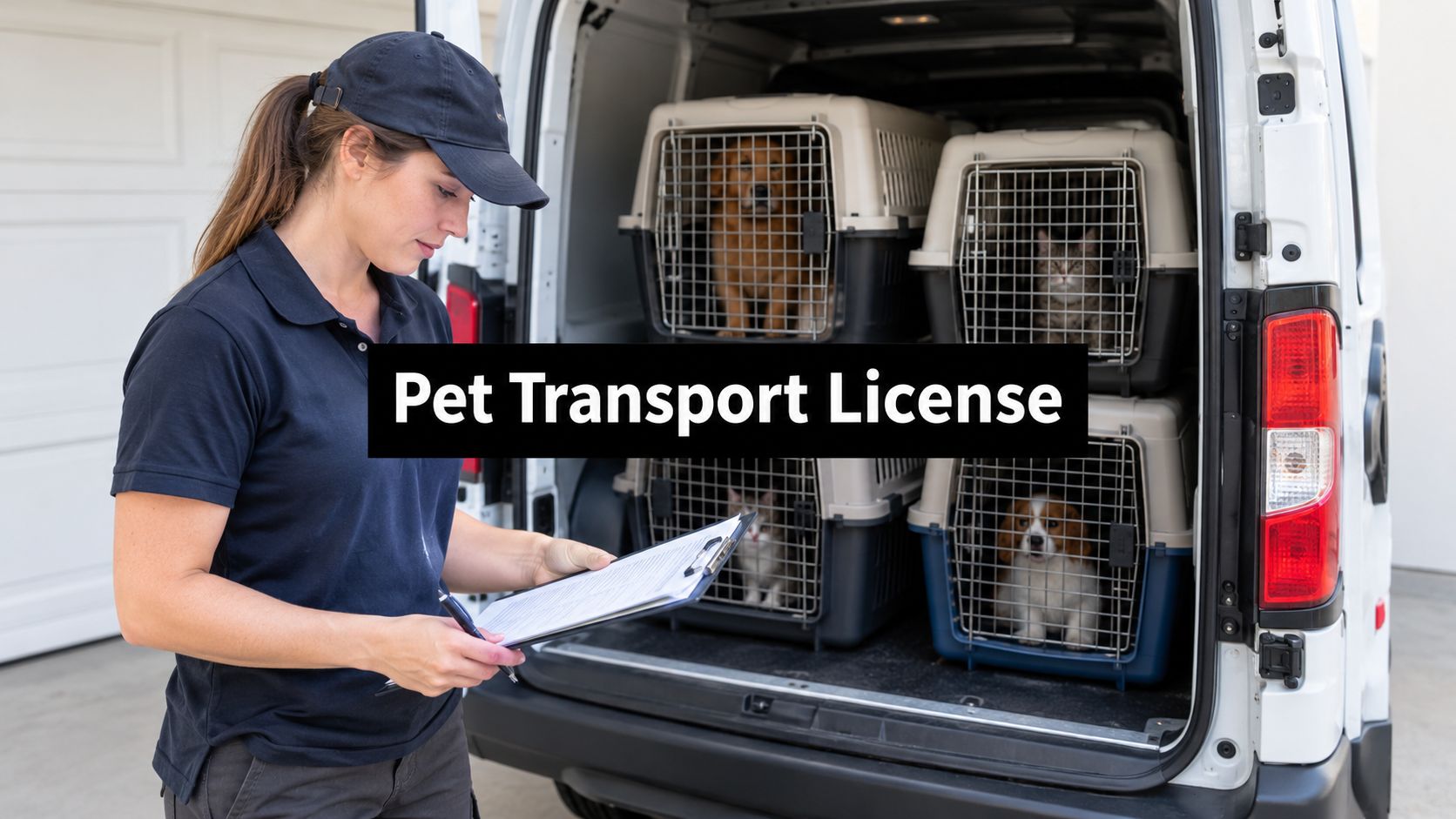
You're standing in a driveway surrounded by cardboard boxes, trying to keep two dogs from escaping while your cat watches the commotion from a carrier. Your family is moving from Northern Virginia, and the transport company says it can take the pets cross-country. Before you load the first crate, you ask the question that matters: Does this company have a legitimate pet transport license, and what does that prove?
The answer isn't one badge or slogan. A reliable review looks at federal registration, professional credentials, state and local authorization, insurance, and destination-country paperwork. Think of licensing as the seatbelt beneath the journey, not a registration sticker on the vehicle. If you're comparing private air travel with ground or commercial options, it can also help to compare pet-friendly charter options before choosing a route.
Table of Contents
- Why Pet Transport Licensing Matters Before You Book
- What a Pet Transport License Actually Covers
- Federal Standards Behind the License
- USDA Registration, IPATA Membership, and State Permits Compared
- How to Verify a Transporter's Credentials Step by Step
- International Moves and the Limits of a Domestic License
- State, Local, and Insurance Layers Most Buyers Skip
- Verification Checklist and Common Licensing Questions
Why Pet Transport Licensing Matters Before You Book
Your pets don't understand a relocation schedule. They understand whether the vehicle is secure, whether the temperature is comfortable, whether someone responds when they're anxious, and whether their routine is maintained. Licensing matters because it gives you a way to test whether the company has built systems around those needs, rather than relying on reassuring website language.
For a professional transporter that takes custody of animals for compensation, the first layer is usually USDA Animal and Plant Health Inspection Service registration when the activity falls under the federal Animal Welfare Act. The second layer is professional accountability, such as membership in the International Pet and Animal Transportation Association, commonly known as IPATA. The third layer includes state or local business requirements, motor-carrier obligations where applicable, and insurance suited to live-animal transport.
Those layers answer different questions:
- Federal registration: Is the business operating within the federal framework for regulated commercial animal transport?
- Professional membership: Does the company participate in an industry network with international coordination and professional standards?
- State and local authorization: Is the business properly established for the places and routes where it operates?
- Insurance: What protection exists if an accident, illness, delay, or other problem occurs while the pets are in the transporter's care?
Practical rule: Ask for documents before you pay a deposit, not after the vehicle leaves your driveway.
A transporter moving two dogs and a cat from Virginia to another state should be able to explain who takes custody, what vehicle will be used, how the pets will be monitored, and which credentials apply to that exact service. A company arranging an international flight must also separate its own authorization from the owner's import documents. The sections below unpack each layer so you can verify the stack instead of trusting one word, such as “licensed.”
What a Pet Transport License Actually Covers
A pet transport license isn't a universal permission slip for every service involving animals. The easiest analogy is a driver's license. A driver's license shows that a person is authorized to drive under defined conditions, but it doesn't prove that the person owns a suitable vehicle, carries the right insurance, or can enter another country.
Federal animal-transport registration works in much the same way. The modern U.S. framework grew from the Laboratory Animal Welfare Act, signed on August 24, 1966, which authorized the USDA to regulate the transportation, sale, and handling of certain animals. The law originally covered six species, including dogs, cats, nonhuman primates, guinea pigs, hamsters, and rabbits. The 1976 amendments broadened the definition of a carrier to include airlines, railroads, motor carriers, shipping lines, and other businesses transporting animals for hire. These historical details are documented in the USDA National Agricultural Library's Animal Welfare Act history.

The custody question
The important dividing line is custody for compensation. USDA guidance says an airline, motor carrier, rail carrier, shipping line, or other business that takes custody of regulated animals and transports them for hire is subject to the transportation provisions. Carriers transporting regulated animals for hire must register under the applicable federal rules, including 7 CFR Part 2, Subpart B, sections 2.25 through 2.27, while transportation standards appear in Part 3.
That doesn't mean an owner driving with a pet automatically needs the same federal registration. Transportation of pets that remain in their owner's custody is generally outside the Animal Welfare Act's commercial transport scope.
So when a website says “licensed,” ask a more precise question: licensed or registered for which activity, and under whose custody? The phrase might refer to federal registration, a state business license, a vehicle credential, or just informal marketing language. Those aren't interchangeable.
Federal Standards Behind the License
Federal registration matters because it connects the transporter to operating duties, not merely a database entry. A commercial provider taking custody of dogs or cats must plan for humane handling, suitable confinement, documentation, and species-specific requirements under the Animal Welfare Act framework.
One clear safeguard concerns age. Dogs and cats generally can't be delivered to a carrier or transported in commerce unless they're at least 8 weeks old and weaned, except when they're being transported to a registered research facility. A transporter should know this rule before accepting a young animal, not discover it at dispatch.

What the operating standards mean on the road
Part 3 contains separate subparts addressing species-specific transportation requirements. In practical terms, the company should be ready to discuss how it manages:
- Crates and confinement: Each pet needs an appropriate, secure setup that reduces injury and prevents escape.
- Climate and welfare: The vehicle or transport environment must protect animals from unsuitable conditions and reduce avoidable stress.
- Records: The business should maintain transport information and incident records required for its regulated activity.
- Handling: Staff need procedures that reduce fighting, disease exposure, injury, and unsuitable confinement.
- Dispatch decisions: The company should identify when an animal's age, condition, documentation, or route makes transport inappropriate.
These duties apply differently from an owner taking a pet on a personal trip. The business becomes responsible for a regulated transport operation once it takes custody for compensation. That's why “we're licensed” should lead to operational questions: Who checks the crates? Who records handoffs? What happens if the vehicle breaks down?
For a plain-language companion to federal travel paperwork, see this guide to USDA pet travel requirements. Owners should also separate transport compliance from veterinary risk planning. Spot Pet Insurance provides customizable accident and illness coverage for dogs and cats, with flexible reimbursement options, multi-pet discounts, and access to any licensed veterinarian.
USDA Registration, IPATA Membership, and State Permits Compared
A trustworthy credential profile looks like a stack, not a single line in a footer. Each layer proves something useful, but no layer proves everything.
| Credential | What It Covers | Key Verification Step |
|---|---|---|
| USDA APHIS registration | Federal registration for regulated commercial transport activities covered by the Animal Welfare Act | Search the company or legal entity in the USDA APHIS public database |
| IPATA membership | Voluntary professional association participation, industry networking, and international coordination | Check the company in the IPATA member directory |
| State or local business authorization | Business registration and local operating requirements | Search the relevant state corporation commission or local licensing office |
| Motor-carrier credentials | Transportation authority that may apply to qualifying interstate operations | Ask for the applicable USDOT information and compare it with the vehicle and route |
| Insurance documentation | Financial protection for defined risks, subject to policy terms and exclusions | Request a current certificate and confirm the insured business name and coverage type |
USDA APHIS registration is the federal layer. It matters when the transporter takes custody of regulated animals and moves them for hire. It doesn't automatically confirm that the company has suitable commercial auto coverage, a current local business license, or authorization for every international destination.
IPATA membership is different. It's voluntary and doesn't replace federal registration. It can show that a company participates in a professional network built around pet and animal logistics, which may help when several parties coordinate an international move. Still, membership should be treated as an additional signal, not a government approval.
State and local documents fill practical gaps. A business may need registration where it's based, while an interstate ground operation may also face motor-carrier requirements. The exact obligations depend on the vehicle, route, business model, and jurisdiction.
A polished website can display all three layers, but verification should happen in three different places.
Your relocation may also involve destination research beyond the carrier's credentials. If Texas is part of the move, you can browse Texas city grades while comparing neighborhoods, schools, and practical relocation conditions.
How to Verify a Transporter's Credentials Step by Step
You can complete a useful first review during one focused call and a few independent searches. Don't ask only, “Are you licensed?” Ask for the legal name, registration details, insurance evidence, and the documents that match your route.

A practical verification sequence
Ask for the exact legal business name and USDA information. Search the company in the USDA APHIS public database. Confirm that the registration status is active and that the listed activity matches the service being offered.
Check the IPATA directory separately. If the company claims membership, search the association directory yourself. The member name should correspond with the business name on the quote or contract.
Match the legal entity. Use the relevant state corporation commission or business registry. Compare the registered name and address with the contract, invoice, website, and insurance certificate.
Request insurance evidence. A transporter should be willing to provide a current certificate of insurance. Check the named insured, effective dates, and whether the policy addresses commercial vehicle use and animal custody. A certificate summarizes coverage, so ask questions about exclusions rather than assuming it guarantees every loss.
Get the plan in writing. The agreement should identify pickup and delivery responsibilities, custody transfer, emergency contacts, cancellation terms, route assumptions, and what happens if weather or a vehicle issue causes a delay.
For a broader look at evaluating a provider, review this guide to choosing a pet transportation company.
Red flags that deserve a pause
Be cautious if the company refuses to share a USDA registration reference, won't identify its legal entity, can't explain insurance, or pressures you to pay before producing basic paperwork. For interstate ground transport, ask about the applicable motor-carrier credentials rather than assuming a business license covers the vehicle operation.
A missing document doesn't automatically prove misconduct, but refusal to answer reasonable questions changes the risk calculation. You're hiring a custodian for a living animal, so transparency should be part of the service.
International Moves and the Limits of a Domestic License
A domestic pet transport license can establish that a transporter is authorized for a regulated commercial activity. It doesn't clear your dog or cat to enter another country. Border agencies make their own decision based on the animal's history, health documentation, purpose of travel, arrival date, and destination rules.
For dogs that have been only in rabies-free or low-risk countries during the previous six months, the CDC says that, beginning August 1, 2024, the generally required CDC documentation is a CDC Dog Import Form. The CDC guidance for dogs from rabies-free or low-risk countries also explains that dogs returning from or arriving after time in high-risk countries can face materially different requirements. The form receipt is tied to a single entry and the stated arrival date, so it isn't a reusable blanket permit.
Separate the transport file from the entry file
For an international air move, IATA identifies core shipment records that can include:
- Import permits
- Veterinary health certification
- Shipper certification
- An air waybill
- CITES documentation where applicable
The transporter can coordinate these records, but the owner remains responsible for providing accurate information about the pet's travel history and eligibility. Customs guidance can also impose additional USDA requirements for commercial imports for resale, which is a different situation from a family relocating with its own pets.
European routes add another authorization layer. EU guidance says anyone transporting live animals more than 65 km for commercial purposes must be authorized by the competent authority. Journeys exceeding 8 hours require an approved, inspected, and certified means of transport. Commercial operators must carry documentation and retain journey records, while transporter authorizations for short journeys may be valid for no more than five years. Adult dogs and cats must be fed at intervals of no more than 24 hours, with water freely available or provided at intervals no greater than four hours. Puppies and kittens up to six months require feeding at intervals no longer than eight hours. These requirements appear in the European Commission land-transport guidance for dogs and cats.
A registered transporter can coordinate a route from Virginia, Maryland, or Washington, D.C., to an airport and onward destination. It can't cure incomplete CDC paperwork, an invalid rabies history, or an owner's failure to meet entry rules.
State, Local, and Insurance Layers Most Buyers Skip
Federal registration sets an important floor, but the everyday journey also depends on local authorization and financial protection. A Virginia-based ground transporter may need a state or local business license, and an interstate operation may need applicable motor-carrier registration. Ask how the company determines which rules apply to its vehicle, route, and custody model.
Insurance deserves the same scrutiny. A generic liability policy may not answer what happens when an animal is injured, becomes ill, escapes, or is lost while in the company's care. Request the certificate, identify the named business, and ask whether the policy addresses commercial auto use and live-animal custody.
Bonded coverage can provide another consumer-protection layer, depending on the policy and jurisdiction. Workers' compensation coverage matters when employees handle pets, drive vehicles, or stay overnight with animals. These documents won't replace careful handling, but they show whether the business has planned for the risks created by its actual work.
For families comparing local providers, a search for pet movers near me should be the start of verification, not the end. Proximity is convenient, but it doesn't prove federal registration, insurance, or route readiness.
Verification Checklist and Common Licensing Questions
Before booking, keep one written checklist beside your notes:
- USDA APHIS: Search the transporter's legal name and confirm active registration where the activity is regulated.
- IPATA: Check claimed membership independently in the association directory.
- Business entity: Match the company name and address with the state business registry.
- Interstate operation: Ask which USDOT or other motor-carrier requirements apply to the proposed route.
- Insurance: Request a current certificate and ask specifically about commercial auto and animal custody.
- International entry: Confirm the destination pathway, CDC documentation where applicable, veterinary records, import permits, and airline acceptance requirements.
Common questions from first-time clients
Does a license transfer if I switch transporters? No. A transporter's registration belongs to that business and doesn't transfer to another provider. Your pet's veterinary and entry paperwork may still be usable if it remains valid and accurate, but the new company must be assessed separately.
How long should verification take? A basic review should be possible before booking. The timing of international document preparation depends on the destination, the pet's history, veterinary appointments, and airline requirements, so ask for a route-specific document timeline.
What if the company won't provide a certificate number? Pause the booking. Ask for the legal name and supporting records in writing. If the company refuses, choose a provider that allows independent verification.
Does a small local pet taxi need USDA registration? It depends on the activity, the animal's custody, and the applicable rules. Ordinary owner travel is generally treated differently from a business taking custody of regulated animals for compensation. Ask the operator how it has classified its service and which authority confirms that classification.
Today, request the transporter's legal name, federal registration details, insurance certificate, and route-specific document list, then verify each item independently before paying.
Precious Pets Transport Services, LLC provides door-to-door domestic and international pet relocation, including climate-controlled ground transport and coordination for families moving from Virginia, Maryland, Washington, D.C., and nearby areas. Visit Precious Pets Transport Services, LLC to request an estimate and discuss the credentials and paperwork for your pets' route.
Leave a Reply