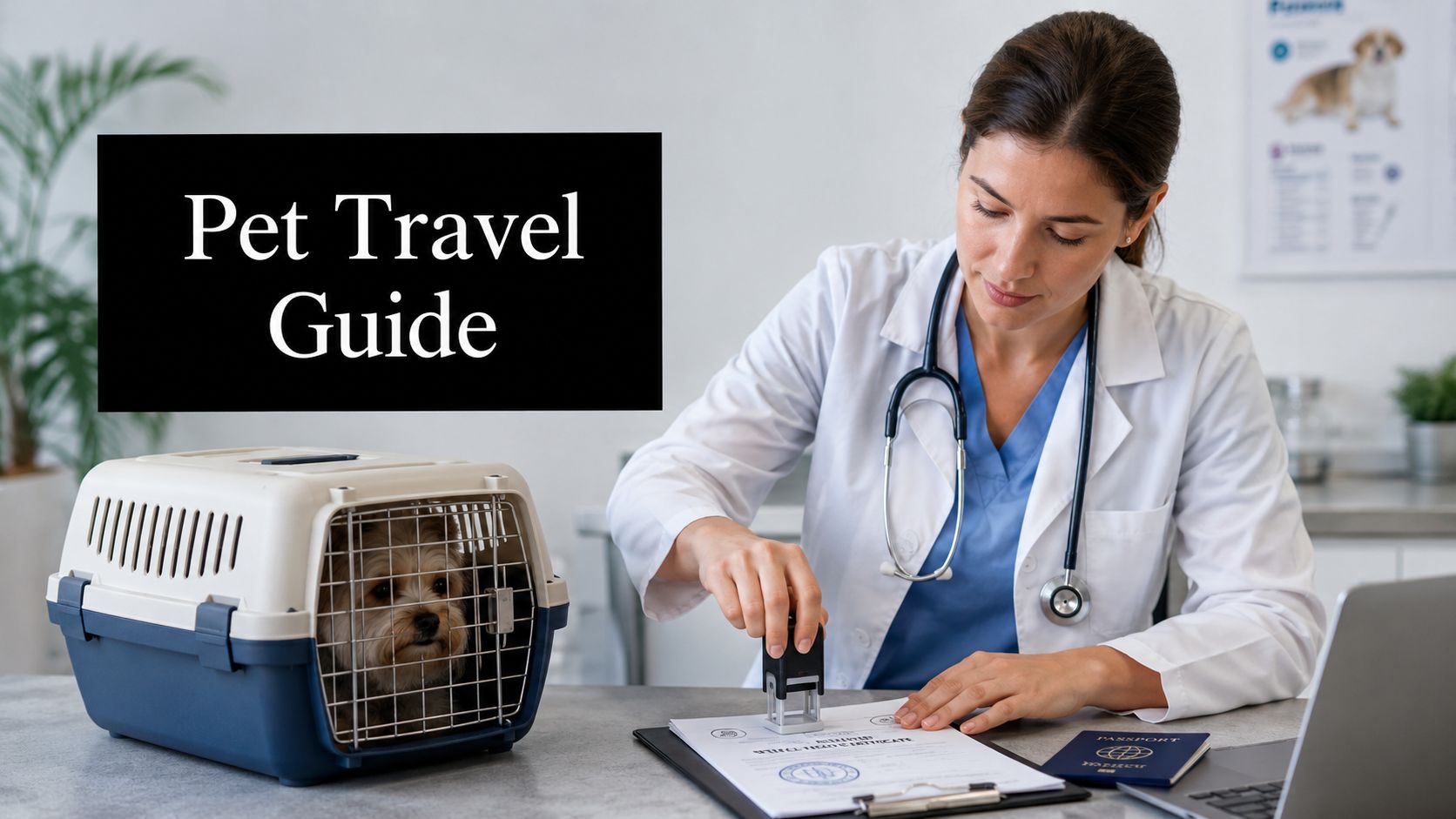
You're trying to move a dog, cat, or other pet, and the paperwork looks contradictory because it is. One office says one thing, the airline says another, and a state vet office may want a certificate that has nothing to do with federal export rules. The fastest way to waste money is to treat all of that as one process.
USDA pet travel requirements split into two separate tracks. If you're moving within the United States, federal USDA oversight is usually not the issue, state entry rules are. If you're leaving the United States, USDA APHIS endorsement becomes the gatekeeper, and for dogs coming back in, CDC rules now sit on top of everything else. Start with destination rules, then work backward to the vet appointment, the certificate, and the final endorsement.
Table of Contents
- How USDA Pet Travel Requirements Work in 2026
- The Federal Agencies and Accredited Vets You Must Know
- Interstate Travel and the State Rules That Override Federal Silence
- International Export From the United States Step by Step
- CDC Dog Import Rules That Now Apply at Every U.S. Border
- Rabies Forms and the High-Risk Country Re-Entry Path
- USDA Air Transport Welfare Standards for Dogs and Cats
- Travel Requirements by Pet Species Beyond Dogs and Cats
- Master Compliance Checklist and Realistic Timelines
- Most Common USDA Pet Travel Failures and How to Recover
- Official USDA APHIS and CDC Resources You Can Trust
- USDA Pet Travel FAQ for 2026 Relocations
How USDA Pet Travel Requirements Work in 2026

A relocation coordinator sees the same costly error repeatedly: the owner books the flight before identifying the governing track. Track A covers interstate travel. USDA APHIS generally does not regulate pets moving between U.S. states with their owners, so the destination state's agriculture or veterinary office sets the entry requirements. Track B covers international export. The destination country's rules determine the health certificate, testing, vaccinations, and timing, while an accredited veterinarian and APHIS endorsement complete the U.S. export process. Begin with the destination requirements, then work backward through the appointment and endorsement steps using USDA pet travel guidance.
For international moves, plan within a 30 to 45 day planning window. That gives the veterinarian time to confirm destination rules, complete required lab work, prepare the certificate, and submit it for endorsement. APHIS endorsement can take several business days and is often completed only 1 to 2 days before departure. Do not book a nonrefundable itinerary until the certificate path and submission timing are confirmed.
The CDC track applies to dogs returning to or entering the United States. Since August 1, 2024, every entering dog must be at least 6 months old, appear healthy on arrival, have a microchip, and travel with a CDC Dog Import Form receipt CDC dog import rule update. Dogs arriving from high-risk countries may face additional documentation and re-entry steps, so confirm the dog's travel history before scheduling the veterinary visit.
Practical rule: Ask, “Am I following interstate entry rules or export rules?” That answer determines which office, veterinarian, certificate, and deadline control the move.
Keep state entry documents separate from export documents. A state permit does not replace APHIS endorsement, and an endorsed export certificate does not automatically satisfy every state requirement.
The Federal Agencies and Accredited Vets You Must Know
A pet move can stall when the owner asks the right question to the wrong agency. Four authorities handle separate parts of the process: USDA APHIS endorses international export health certificates and sets animal transport rules, CDC controls dog entry and re-entry, U.S. Customs and Border Protection inspects the animal and documents at the port of entry, and state agriculture departments set interstate entry conditions. Confirm which track applies before you schedule appointments or submit paperwork.
An USDA-accredited veterinarian can issue and submit international health certificates through VEHCS, the Veterinary Export Health Certification System VEHCS and accredited vet guidance. A regular veterinarian may provide excellent medical care yet lack authorization to complete the export certificate process. Ask the clinic about its accreditation before booking the examination. Waiting until departure week can leave too little time to correct a missing form, test, or endorsement step.
| Agency | Primary Role in Pet Travel | Key Document or System |
|---|---|---|
| USDA APHIS | Endorses export health certificates and sets animal transport rules | VEHCS, APHIS endorsement |
| CDC | Sets dog re-entry rules into the United States | CDC Dog Import Form, CDC permit path |
| CBP | Inspects documents at the port of entry | Endorsed packet, import receipt |
| State Department of Agriculture | Handles interstate entry conditions | State CVI, entry permit |
For a pre-travel buffer for veterinary costs, an option such as Embrace Pet Insurance offers customizable accident and illness coverage for dogs and cats, with optional wellness rewards. Insurance does not satisfy an agency requirement or replace an endorsed certificate. It can, however, help manage eligible veterinary expenses during a relocation.
The accredited vet is not a form-filler. That vet determines whether your timeline is feasible, which certificate path applies, and whether the required examination and submission steps fit before departure.
Interstate Travel and the State Rules That Override Federal Silence
A family can spend hours hunting for a federal pet permit and still miss the rule. For interstate moves, the state you are entering sets the paperwork. USDA APHIS does not run a general owner-to-owner interstate approval process, so start with the destination state instead of waiting for a federal form that may never apply.
Call the destination state's department of agriculture before you book transport. Ask for the current entry permit, the Certificate of Veterinary Inspection window, and any species or breed restrictions that apply on arrival. The details change by state, and the only version that matters is the one tied to where the pet is going.
Hawaii is its own case, with quarantine requirements and rabies testing rules that are different from mainland moves. Other states, including California, Texas, and Florida, usually rely on a veterinarian-issued certificate rather than a separate entry permit. The state sets the interstate paperwork, not APHIS, as noted in USDA state-to-state guidance.
| Destination State | Entry Permit Required | CVI Age Window | Notable Extras |
|---|---|---|---|
| Hawaii | Yes, for its quarantine and entry pathway | State-specific | Rabies quarantine route and titer testing apply |
| California | No entry permit for dogs | Destination-issued CVI | Check local county or breed-related rules |
| Texas | No entry permit for dogs | Destination-issued CVI | Verify timing before ground or air transport |
| Florida | No entry permit for dogs | Destination-issued CVI | Confirm the certificate age window with the state |
Check the state first: If you call the airline before the destination state vet office, you are doing it backwards.
Interstate travel inside the continental U.S. still carries animal transport rules from carriers and federal welfare standards. The move is not paperwork-free. It is state-led, and that is the part people skip until they are already at the airport.
International Export From the United States Step by Step
A dog can pass the veterinary exam and still miss the flight if the destination rules were checked too late. Run international export on two parallel tracks: confirm the destination country's import requirements, then prepare the federal USDA export documents. Book an USDA-accredited veterinarian 30 to 45 days before departure, and verify the import permit, species requirements, tests, and document format before the examination. The current destination rules, not a generic checklist, control the filing.
For eligible moves, the veterinarian completes the health certificate in VEHCS, uploads the rabies certificate and laboratory results, and submits the file for APHIS endorsement. APHIS review can take several business days, so plan for the endorsed certificate to return near departure, often 1 to 2 days before the flight. A paper submission through an APHIS Endorsement Office remains possible, but electronic filing reduces courier handling and gives the veterinarian a clearer submission record.
Set the certificate's validity window against the airline schedule and the destination's entry deadline. The veterinarian must correct missing signatures, tests, or attachments before submission, not after the file reaches review. For a practical explanation of the certificate process, use this guide to the USDA health certificate for dogs.

Do not board until the endorsed packet is complete and accessible. Airlines and foreign border officials can refuse the animal when the certificate lacks endorsement or supporting records. Carry the final documents through departure because CBP may inspect them, even though the destination country controls admission.
| Step | Owner Action | Why It Matters |
|---|---|---|
| Book vet visit | Schedule with an accredited vet 30 to 45 days before departure | Leaves time for tests, corrections, and endorsement |
| Confirm destination rules | Verify import permit and species requirements | Prevents rework after the exam |
| Complete certificate | Use VEHCS where allowed | Speeds APHIS review |
| Endorsement | Submit for APHIS review and payment | Required for most international moves |
| Airline check-in | Present the endorsed packet | Airline won't accept an incomplete file |
| CBP exit | Carry the documents through departure | The packet should be ready if inspected |
CDC Dog Import Rules That Now Apply at Every U.S. Border
A dog returning from overseas can clear the outbound USDA process and still be stopped at the U.S. border. Since August 1, 2024, every dog entering the United States must be at least 6 months old, appear healthy on arrival, carry a readable microchip, and have a CDC Dog Import Form receipt CDC dog import rule update. The rule applies at airports, land crossings, and seaports.
Treat re-entry as a separate federal track. A USDA-endorsed export health certificate proves the dog met the destination country's requirements. It does not replace the CDC entry documents. If the dog stayed only in a dog rabies-free or low-risk country during the prior 6 months, the owner can obtain the CDC form receipt online on the travel day. The receipt supports multiple entries for 6 months from issuance, provided the dog fits the CDC country-risk requirements.
Review the dog's travel history before booking the return flight. A stay in a high-risk country during the prior 6 months sends the dog into a stricter process. The required route may use a valid foreign-rabies form or a U.S.-issued rabies vaccination form endorsed by USDA APHIS. A foreign-vaccinated dog must also enter through an approved port and may require revaccination, a titer, or a 28-day quarantine CDC family travel with pets. An endorsed USDA packet alone will not satisfy that pathway.
| Requirement | Documentation | Verification Point | Low-Risk vs. High-Risk Country |
|---|---|---|---|
| Age | Proof of age | Border inspection | 6 months minimum |
| Microchip | Microchip scan and number | Arrival check | Required for all dogs |
| Import form | CDC Dog Import Form receipt | Port of entry | Used for re-entry |
| Health status | Appears healthy | CBP or CDC review | Same for both paths |
| Rabies path | CDC or endorsed rabies form | Travel history and paperwork | High-risk rules are stricter |
Confirm the dog's country history, rabies documentation, approved entry port, and CDC form before departure. These are CDC re-entry checks, separate from state rules and the USDA export endorsement process.
Rabies Forms and the High-Risk Country Re-Entry Path
A U.S.-origin dog can leave the country with a valid rabies record and still face a border problem on return. If the dog has visited a high-risk country, the return paperwork must be settled before departure. Treating the rabies certificate as a routine vaccination record is how travelers end up facing delays, denied boarding, or quarantine.
Handle the CDC permit path before booking the outbound flight. The application requires lead time, and older substitute paperwork is valid only if issued no later than July 31, 2025. Outdated checklists are unsafe. Confirm the dog's microchip and rabies record first, then have the accredited veterinarian prepare the correct documents. For the testing requirements that may apply to a high-risk-country return, review this rabies titer test guide.
Cats and ferrets do not use the same CDC dog import permit process. They still need export documents and a review of the destination country's rules, so do not transfer a dog checklist to another species.
| Country Risk Category | Lead Time | Required Form/Permit | CDC Permit Required | Endorsed Rabies Certificate |
|---|---|---|---|---|
| Low-risk or rabies-free | Start early, before travel booking | CDC Dog Import Form receipt | Not usually, if the dog qualifies | May still be needed depending on travel history |
| High-risk country return | Apply well before departure | CDC permit path and supporting records | Yes, for the CDC route | U.S.-issued or foreign-rabies form as applicable |
If the dog is traveling to a high-risk country and returning to the United States, solve the return requirements before leaving. That is the practical way to avoid a border problem.
Use VEHCS to check every rabies certificate field before submission. The dog's identity, microchip number, vaccination details, and travel history must match across the records. The accredited veterinarian submits the packet, while USDA APHIS endorsement remains a separate export track. Keep the CDC re-entry documents and USDA export documents organized separately, because satisfying one process does not replace the other.
USDA Air Transport Welfare Standards for Dogs and Cats
An airline can reject a pet at check-in even after the booking is confirmed. USDA air transport rules set the baseline, while each carrier controls cargo acceptance. Dogs and cats must be at least 8 weeks old and fully weaned before travel. Two puppies or kittens may share a kennel only if they're 8 weeks to 6 months old, similar in size, and each weighs 20 pounds or less. A younger animal cannot fly under these conditions, regardless of what a booking agent promises.
The kennel must let the pet stand, turn around, and lie down naturally. Attach feeding and watering instructions that airline staff can follow, and carry a copy with your travel records. Temperature restrictions may require an acclimation certificate. Airlines can also impose stricter embargoes than the USDA baseline, so confirm their rules before paying for transport.

For route planning, kennel selection, and cargo-handling details, review AUSFF animal transport services. Use that logistics information alongside the USDA minimums and the airline's written acceptance policy.
| Standard | Traveler Action |
|---|---|
| Minimum age and weaning | Verify age on the birth record and confirm the animal is fully weaned |
| Kennel sharing limits | Share a kennel only when every USDA condition is met |
| Feeding and watering | Attach clear instructions to the kennel and keep a copy |
| Acclimation need | Ask the airline early whether temperature-related certification is required |
Treat airline approval as a separate track from USDA compliance. Confirm the kennel, temperatures, route, and handling rules before the health-certificate appointment, then recheck them before departure.
Travel Requirements by Pet Species Beyond Dogs and Cats
A rabbit, ferret, bird, or reptile cannot be processed by copying a dog's checklist. USDA APHIS guidance covers ferrets, rabbits, rodents, hedgehogs, tenrecs, reptiles, amphibians, and some birds, but each species can follow a different authority, form, and inspection route. Start by identifying the species and destination, then confirm which agency controls the move.
Ferrets follow canine re-entry rules only in a high-risk country return scenario. Rabbits commonly need an export health certificate from an accredited veterinarian, but rabies endorsement is generally not part of that route. Reptiles and amphibians may require state fish-and-wildlife permits and destination-country CITES documents, while airlines often refuse them as cargo. Birds require separate APHIS live-bird procedures, which can include quarantine, testing, and inspection.
| Species | Governing Authority | Required Certificate | Lead Time |
|---|---|---|---|
| Dog | USDA APHIS and CDC for re-entry | Export certificate, CDC form for return | Start early |
| Cat | USDA APHIS and destination country rules | Export health certificate | Start early |
| Ferret | USDA APHIS, plus CDC logic only on re-entry | Species-specific export paperwork | Start early |
| Rabbit | USDA APHIS and destination country rules | Export health certificate | Start early |
| Reptile or amphibian | State wildlife, destination-country rules | Permits may replace USDA endorsement | Start early |
| Bird | APHIS live-bird program | Quarantine and inspection paperwork | Start well ahead |
The authority determines the paperwork. A destination country may require documents that USDA does not issue, and a state wildlife office may control a reptile move even when a federal endorsement is not required. Confirm those layers before booking transport or scheduling the veterinary examination.
Precious Pets Transport Services, LLC handles domestic and international pet relocation, including door-to-door ground transport across the United States and coordination support for international moves from Virginia, Washington, D.C., Maryland, and nearby states. Use that as a logistics option, not as a substitute for permits, certificates, or inspections.
Master Compliance Checklist and Realistic Timelines

A missed endorsement window can cancel an otherwise valid itinerary. Work backward from departure and keep interstate travel and international export on separate tracks. Interstate moves start with the destination state's entry rules, then the accredited veterinarian's certificate window, followed by carrier and transport scheduling. International export adds the destination permit, veterinary examination, VEHCS submission, and APHIS endorsement. For high-risk-country re-entry, confirm the CDC dog pathway before the dog leaves the United States.
Do not book transport while any document requirement remains unclear. A booking made too early can create duplicate charges when the certificate, CDC paperwork, or endorsement does not match the itinerary.
Use this guide on preparing a pet for travel to keep owner preparation in the same order as the regulatory work.
| Trip Type | Working-Backward Window | Core Task |
|---|---|---|
| Domestic interstate | Before booking transport | Confirm state entry rules and CVI timing |
| International export | 30 to 45 days out | Vet exam, certificate, VEHCS, endorsement |
| High-risk country re-entry | Before departure from the U.S. | Microchip, CDC path, rabies documents |
Give the same one-page checklist to the accredited vet, airline cargo desk, and receiving party. Include the animal's route, certificate dates, required signatures, and submission status. Clear handoffs prevent the common mistake of assuming one federal approval satisfies every state or destination requirement.
Most Common USDA Pet Travel Failures and How to Recover
The same mistakes show up over and over. The worst one is booking transport before the accredited vet exam, because that locks you into dates before you know whether the animal qualifies. The second is missing the 15-digit microchip requirement for CDC dog re-entry, which can't be fixed with wishful thinking at the airport.
Late vet visit. Call the accredited vet immediately and move the appointment earlier. Expect a delay because APHIS endorsement still has to happen after the paperwork is complete.
Expired rabies certificate. Ask the accredited vet whether the dog needs a new vaccination record or a corrected submission. If the history is wrong, don't board.
Wrong port selected on the CDC form. Recheck the arrival airport or port before resubmitting. A wrong entry point can force a new submission or a rerouted itinerary.
Missing or unscannable microchip. Return to the vet for chip verification and, if needed, a re-vaccination sequence tied to the correct chip. A chip insertion alone doesn't solve the documentation problem.
Late APHIS submission. Send the file to the APHIS Endorsement Office or through VEHCS as soon as the vet signs it. Endorsement won't be magically rushed past the normal business window.
| Failure | Symptom | Recovery Action | Typical Delay |
|---|---|---|---|
| Booking before vet exam | Missing certificate timing | Reschedule transport after vet clearance | Variable |
| Expired rabies record | Document rejection | Correct or renew with accredited vet | Variable |
| Missing microchip | Border refusal risk | Verify chip and redo vaccination sequence | Variable |
| Late endorsement submission | No endorsed packet | Refile through VEHCS or the office | Several business days |
| Wrong CDC port | Form mismatch | Resubmit with the correct port | Variable |
| Too-young puppy | Airline refusal | Wait until age and weaning requirements are met | Until compliant |
The recovery rule is simple. Fix documentation errors before booking transport again.
Official USDA APHIS and CDC Resources You Can Trust
Use official agency pages when a relocation is booked. USDA APHIS and CDC rules can change, and border officials check current requirements against the documents presented. For endorsement status, contact APHIS directly, especially when departure is near. Start with the USDA APHIS pet travel page for country-specific export instructions and certificate guidance.
Keep the federal process on two parallel tracks:
- USDA APHIS export track, covering destination-country requirements, accredited-veterinarian certificates, VEHCS submissions, and APHIS endorsement.
- CDC dog re-entry track, covering the CDC Dog Import Form and any additional requirements tied to the dog's travel history and country risk.
- Interstate track, where the destination state sets its own rules and federal silence does not mean no paperwork is required.
Use the APHIS pet travel overview to confirm which animals and certificate types fall under federal oversight. Accredited veterinarians use the VEHCS portal for electronic international certificate submissions. For dogs returning to the United States, use the CDC Dog Import Form portal and review the CDC high-risk country guidance when that route applies. The APHIS National Import Export Services directory provides contacts for endorsement and process questions.
The CDC form is one part of the border file. If the dog's situation requires an APHIS-endorsed certificate, coordinate both tracks before booking transport, then confirm each agency's submission and review window.
USDA Pet Travel FAQ for 2026 Relocations
Does APHIS endorse documents for a dog returning from a high-risk rabies country without a CDC reservation? No. The CDC re-entry pathway controls the border decision, while APHIS endorsement supports only the documents that pathway requires. Check the current high-risk-country instructions first, then ask an accredited veterinarian or APHIS which certificate and endorsement steps apply.
Is airline cargo treated differently from accompanied baggage for USDA paperwork? The animal's travel category does not loosen the paperwork standard. Airlines may classify the shipment differently, but required certificates, endorsements, and animal-welfare rules still apply.
Do interstate moves ever need a USDA-endorsed health certificate? APHIS does not regulate ordinary interstate pet movement by owners. The destination state can require a health certificate issued by a licensed veterinarian, so verify state rules before booking transport.
What about puppies too young for rabies vaccination? Do not book a return or export trip until the puppy meets the applicable age, vaccination, and documentation requirements. A rushed booking will not bypass an import pathway's eligibility rules.
Does USDA regulate cat exports too? Cats can follow the export certificate and APHIS endorsement process through VEHCS when the destination country requires it. That country still sets its own import conditions.
Use the federal guidance pages cited earlier, including the CDC dog import guidance, and confirm requirements close to departure. For hands-on help, Precious Pets Transport Services, LLC coordinates pet relocation, door-to-door ground transport, and international move logistics.
Leave a Reply