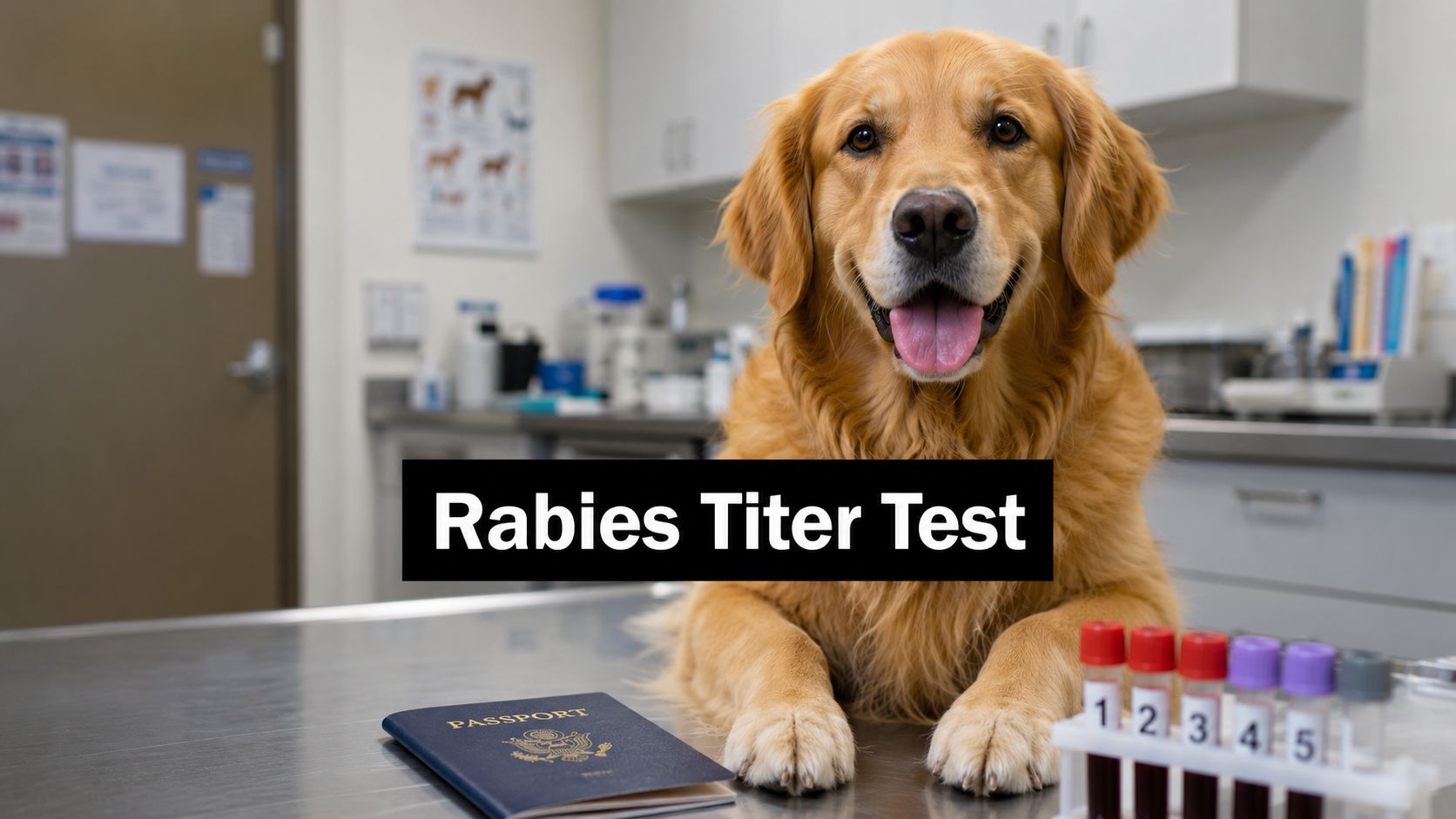
You're at the kitchen table with a leash, a laptop, and a half-finished country checklist, trying to figure out why one line item about a dog rabies titer test seems to control everything else. The flight is booked, the moving truck is on the calendar, and now someone is asking for vaccine dates, lab names, and blood-draw windows that don't leave much room for error. That's where families get stuck, because the test sounds like a medical detail, but in real life it often decides whether your dog boards next week, waits for paperwork, or spends time in quarantine.
Table of Contents
- Why the Dog Rabies Titer Test Matters for Travel
- What a Rabies Titer Measures
- Who Needs a Rabies Titer and When
- Step-by-Step Process From Blood Draw to Lab Result
- Reading the Result and What 0.5 IU/mL Really Means
- CDC Timing Rules and International Relocation Strategy
- Common Misconceptions and Practical Tips for a Smooth Move
Why the Dog Rabies Titer Test Matters for Travel
A family can do almost everything right, then lose the schedule because the rabies titer wasn't handled in the right order. That's what makes this test more than paperwork. It's the document that often tells border officials whether your dog can fly, whether the move pauses, or whether the plan has to absorb quarantine and rebooking.
The test sits in the middle of the move
I've seen owners focus on the airline first, then discover the destination cares more about serology than seat selection. That happens because many destinations, especially rabies-free islands and countries with strict entry rules, want proof that vaccination produced a measurable immune response before they'll clear the dog. The test isn't a substitute for the vaccine, it's proof that the vaccine did its job in the dog's bloodstream.
Practical rule: treat the titer as a calendar anchor, not a checkbox. If the timing slips, every later step slips too.
The public-health logic is simple. Border authorities want to reduce the chance that a dog arrives without adequate rabies protection, especially when the country's own animal and human populations depend on tight import controls. That's why a dog rabies titer test can become the lynchpin for relocation even when the dog looks healthy and the rabies shot is up to date.
Why delays get expensive fast
When the titer is delayed, the rest of the move often gets pushed with it. Airlines won't hold flexible space forever, transport companies have to reschedule, and some destinations only accept the dog within a narrow compliance window. If the entry paperwork is rejected, the family may be forced to rework the entire sequence, not just resend one form.
The same thing happens with rushed planning. People often assume the “hard part” is the flight, but the harder part is making sure the blood draw, the approved lab, and the import rules all line up. That's why relocation teams usually tell families to start with the veterinarian, not with the airline counter.
A good way to think about it is this. The move is a chain, and the titer is one of the first links that border officials examine. If that link is weak, the rest of the chain doesn't matter much.
What a Rabies Titer Measures

The lab does not look for rabies virus in the blood. It measures the concentration of virus-neutralizing antibodies instead, which shows whether the rabies vaccine prompted the dog's immune system to make a protective response. For a family planning a move, that distinction matters because the test is about proof of response, not proof of illness.
The lab uses a functional test, not a guess
The main reference method is the RFFIT, the rapid fluorescent focus inhibition test, because it measures how well antibodies neutralize rabies virus. That matters for travel paperwork. A number on paper only helps if it reflects actual neutralizing ability, and the RFFIT is the standard method used for that purpose (RFFIT reference method and thresholds).
The result is usually reported in IU/mL, which stands for international units per milliliter. For many import systems, the key benchmark is 0.5 IU/mL, and the CDC guidance cited in the reference material ties that level to complete neutralization at a 1:25 serum dilution. That is why a result just below the line can lead to a very different travel outcome from a result just above it.
Why the threshold matters so much
A positive number does not mean the dog is protected forever. It means the dog showed a measurable immune response at the time the sample was taken. In travel terms, that can satisfy many entry rules, but only if the sample was collected and processed under the right conditions.
The titer is a snapshot, not a lifetime guarantee.
Border officials and import programs also care about consistency. If two labs use different methods, they can produce very different interpretations of the same sample. For that reason, the method behind the result can decide whether a family spends the next month packing boxes or waiting for a redraw.
Read the number as a travel tool
If you are staring at a lab report, the first question is not whether the dog looks healthy. It is whether the report uses the standard your destination accepts, and whether it matches the rest of the paperwork you will file with the move. The dog rabies titer test only becomes useful when the test method, threshold, and documents line up with the travel rule you are trying to satisfy, and the broader paper trail is organized the same way as a USDA health certificate for dogs.
Who Needs a Rabies Titer and When
A lot of families assume the titer is for one type of move, then find out the rule changes with destination and purpose. A dog heading to a rabies-controlled country, a pet bound for a rabies-free jurisdiction, or a family crossing an international border from the U.S. can all face different documentation requirements. The key question is never just “Does my dog need one?” It's “Who is asking for it, and why?”
International movers and destination-specific rules
A Virginia family moving to Germany may need to prove antibody response because the destination's entry process treats the titer as part of the import package. A military family transferring overseas can run into the same issue, especially when a pet's arrival date has to match a duty station move. The requirement follows the destination's rulebook, not the dog's size, breed, or temperament.
If you're sorting through the rest of the import paperwork, this guide on a USDA health certificate for dogs can help you see where the titer fits inside the larger document set.
Hawaii, island destinations, and high-risk origins
Island destinations often pay special attention to rabies proof because they're protecting a status that's hard to maintain. The same is true for dogs coming from places with more complicated rabies control histories. In those cases, the titer is less about convenience and more about confirming that a vaccinated dog really did mount the expected response before travel begins.
The people who ask for it
- International relocation families: They usually need the test because the destination country requires antibody proof before entry.
- Military and government personnel: Their timelines are often fixed, so the titer has to fit a move date that's already set by assignment orders.
- Breeders, rescues, and transporters: They may need the test when moving dogs out of a higher-risk origin country or into a destination with strict serology rules.
- Owners of dogs heading to rabies-free jurisdictions: They often face the toughest paperwork, because those destinations have the least tolerance for missing or borderline documentation.
A useful mental shortcut is this. If the move crosses a border and the destination cares about rabies status, the rabies titer may stop being optional very quickly. And in most cases, the deciding factor is the entry authority's rules, not the family's convenience.
Step-by-Step Process From Blood Draw to Lab Result

The process starts with the calendar, not the needle. Before anyone draws blood, the clinic needs to confirm that the sample will meet the lab's sample handling requirements. Major veterinary laboratories ask for clotted blood without anticoagulant, and they typically want about 1 to 2 mL of serum from roughly 3 to 4 mL of whole blood. They also caution against excessively hemolyzed samples, because broken-down blood can interfere with the test.
Start with the rabies vaccine date
The first checkpoint is simple. At least 30 days need to pass between the last rabies vaccination and the blood draw, or the sample may be taken too early to reflect the dog's immune response properly. Drawing too early can give an artificially low result even in a properly vaccinated dog.
That timing issue is one of the easiest ways to derail a move. A dog can be vaccinated, healthy, and otherwise ready, but still produce a poor titer if the blood is collected before the immune system has finished responding.
Then move through collection and shipping
The vet draws the blood into the right tube, lets it clot, separates the serum, and sends it to an approved laboratory. That part sounds routine, but the details matter. If the sample is hemolyzed, handled in the wrong tube, or sent to the wrong lab, the result can be delayed or rejected.
Good travel habit: ask the clinic to confirm the destination's approved lab list before the blood draw, not after.
A vet visit often includes more than the sample itself. A relocation family may also be coordinating insurance, boarding, or a backup transport plan at the same time. Some owners like to have broader pet coverage in place before they start, and Embrace Pet Insurance is one option that offers customizable accident and illness coverage for dogs and cats, with optional wellness rewards.
Expect a wait for the result
Once the sample reaches the lab, the family has to wait for processing and reporting. In practice, this can stretch into a few weeks, which is why early planning matters so much. A result that arrives after the flight is already booked doesn't help much if the destination required proof before departure.
If you're building the rest of the moving timeline, this preparation guide on getting a pet ready for travel can help you connect the titer appointment with the rest of the logistics.
Reading the Result and What 0.5 IU/mL Really Means
A lab report can look more final than it feels. The number is tidy, but the decision it triggers carries real consequences for a move. For many import systems, 0.5 IU/mL is the line between acceptable and not acceptable, and the same threshold appears in the verified research as the minimum post-vaccination standard referenced by WHO and OIE (protective threshold data).
What the number says, and what it doesn't
A titer at or above 0.5 IU/mL tells the destination authority that the dog produced a measurable rabies antibody response. It does not replace the vaccination record, and it does not clear every paperwork hurdle on its own. It is one piece of evidence, useful because many jurisdictions use that benchmark as a travel standard (protective threshold data).
A result between 0.1 and 0.3 IU/mL can still show some immune response, but it remains below the common import threshold described in the reference material on CDC and ACIP benchmarks (RFFIT reference method and thresholds). That is where families often get tripped up. A number can look close to passing and still fail the specific rule that matters for entry.
What happens when the result is low
If the result comes back below the cutoff, the usual next step is a booster, followed by a redraw after the waiting period required by the destination or lab protocol. In some relocation cases, the family has to reset the timing and wait out a quarantine period at a CDC-registered animal care facility after revaccination, especially when the paperwork required for import isn't complete (CDC import timing and quarantine guidance).
The imported-dog study makes the travel risk easier to picture. It found that 48% (32/67) of dogs arriving mainly from Egypt had titres below 0.5 IU/mL, including 19 dogs with no measurable titre, while 14% (9/65) of nonimported dogs in the same study were below that cutoff (imported-dog study). That does not mean every imported dog will fail, but it does show why origin and vaccination history matter.
Common outcomes and what they mean
| Titer Result | What It Means | Travel Consequence |
|---|---|---|
| At or above 0.5 IU/mL | Meets the common import benchmark | Often acceptable for entry when other paperwork is correct |
| Below 0.5 IU/mL | Below the standard used in many travel rules | May require booster, redraw, or quarantine |
| Detectable but below threshold | Immune response is present, but not enough for the rule in question | Border officials may still reject it |
| No measurable titre | No usable antibody level detected on the report | Usually means the move needs to be rescheduled |
If the family is still building the rest of the travel file, a practical place to start is this guide to a dog passport for the USA, since the titer result is only one part of the paperwork stack.
The main thing to remember is that the number functions like a passport stamp, and it only matters for the authority reviewing the paperwork.
CDC Timing Rules and International Relocation Strategy
A dog rabies titer test only helps if its timing fits the trip. Families usually do better when they work backward from the arrival date, because the blood draw, lab processing, and paperwork review all have to line up before the dog boards a plane. The CDC timing rule is specific, the sample must be drawn at least 30 days after the initial rabies vaccination and at least 28 days before importation (CDC approved labs and timing rules).
Build the calendar from the arrival date
Start with the landing day and count backward from there. That gives you the last safe window for the blood draw, then you can check whether the vaccination date leaves enough room for the test to count. Families who set the relocation date first often end up paying for changed flights, temporary boarding, or a short-term hotel stay when the paperwork slips.
A useful way to think about it is that the lab appointment drives the rest of the file. The result has to arrive in time for the health certificate and the other import documents to match the travel plan. If you are still organizing the human side of the move, Expat Global Medical's Canada checklist is a practical reminder that pet paperwork is only one part of a larger relocation schedule.
The blood draw is only one step in the sequence.
Miss the window, and quarantine can follow
If the sample is collected too late, or if the serology paperwork does not match what the destination asks for, the CDC guidance says dogs without the required documentation may face 28 days of quarantine after revaccination at a CDC-registered animal care facility (CDC approved labs and timing rules). For a family that is already juggling children, work start dates, and a long drive or flight, that can turn a planned arrival into an expensive detour.
Relocation rule: the lab appointment controls the move, not the airline reservation.
That is why experienced relocation planners put the titer test near the top of the checklist. A rushed test can trigger a chain of delays, while an early test leaves room to fix a missed vaccination date, a lab issue, or a document mismatch before departure. A good place to keep the wider paperwork picture in view is a guide like the dog passport for the USA checklist, since the titer result has to fit inside the full file, not stand alone.
A simple working sequence
- Confirm the destination rules first: Different countries may use different lab lists and timing sequences.
- Schedule the rabies vaccination: The dog has to be eligible for the later blood-draw window.
- Book the blood draw early: Leave time for lab processing and any redraw that might be needed.
- Keep the paperwork together: The lab result, vaccine record, and travel certificate should line up.
- Plan for backup time: If a document is rejected, you need margin to correct it.
The benefit of starting early is practical and emotional. Families stop reacting to paperwork and start managing it.
Common Misconceptions and Practical Tips for a Smooth Move
The biggest mistakes I see are rarely about the science. They come from timing, paperwork, and the way families interpret a lab report when they are already under pressure. A dog can have a valid-looking result on paper and still run into trouble if the vaccination record, lab approval, or travel sequence does not match what the destination expects.
Three myths that cause real problems
A positive rabies titer does not legally substitute for rabies vaccination in the U.S. The verified guidance says titers are useful for measuring immune response, but they are not legally accepted as a substitute for rabies vaccination here, and an overdue dog that bites someone can still be treated as potentially rabid even with a good titer (Maddies Fund guidance).
A second misconception is that any laboratory result will work at the border. That is not how import compliance functions. Countries care about authorized labs, approved methods, and whether the report matches the paperwork sequence they require. A family may have the right test in hand and still face rejection if the lab is not on the accepted list or the dates do not line up with the rest of the file.
A third mistake is assuming a passing titer removes quarantine forever. It does not. It can help meet entry conditions, but it does not erase every later legal or public-health consequence. The result is one part of the entry picture, not a blanket promise that every authority will treat the dog the same way.
Practical moves that keep the process smooth
- Book the vet first: The blood draw date drives everything else.
- Confirm the destination's accepted lab list: Do not assume your regular clinic's preferred lab is automatically acceptable.
- Budget for redraws: Border paperwork can be unforgiving, and a second test may be the fastest fix.
- Keep vaccination on schedule: An overdue booster can break the chain of compliance.
- Pair the timeline with transport support: Some families use a vetted transport partner, such as Precious Pets Transport Services, LLC, to manage ground logistics while they handle the documents.
That last point matters because the titer is only one piece of a larger move. Someone still has to line up the dog's movement, the airport timing, the vet dates, and the travel documents without missing a window. When those pieces are organized together, families spend less time reacting to surprises and more time checking off what is already complete.
A calm move comes from narrow planning
The test answers a single question at a single point in the process. Respecting that specificity makes the rest of the move easier to manage, because you stop expecting the titer to do jobs it was never meant to do.
If you want help turning your dog's titer timeline into an actual relocation plan, visit Precious Pets Transport Services, LLC. They coordinate safe domestic and international pet relocation, and they can help line up the travel logistics around the veterinary paperwork so you are not trying to solve both at once.
Leave a Reply