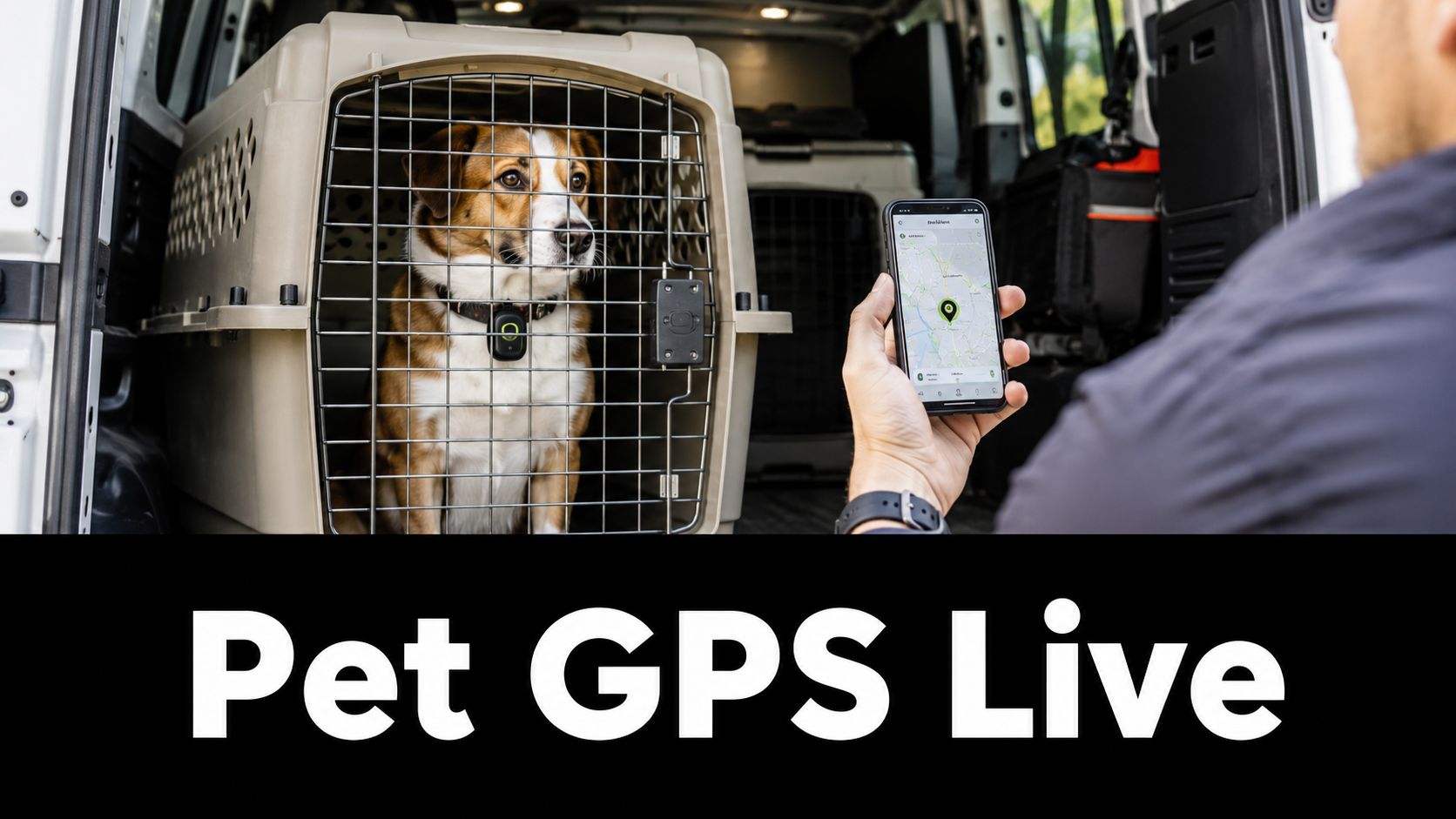
You've got the carrier, the paperwork, and the route mapped out, but you're still checking your phone every few minutes because the core question is simple, where is your pet right now? That's the pressure point during a move, especially when a dog is in a transport van, a cat is between airports, or a handoff is happening somewhere you can't see. Real time pet tracking has moved past novelty, and for relocations it now functions as a logistics layer that helps owners keep continuity when the journey gets fragmented.
Table of Contents
- Why Real Time Pet Tracking Matters During Relocations
- How GPS, Cellular, Bluetooth, and Wi-Fi Tracking Work
- Accuracy and Coverage Tradeoffs You Need to Know
- Battery Life and Device Considerations for Long Moves
- The Indoor and Transition-Zone Blind Spot
- Integrating Tracking with Professional Pet Transport Services
- Troubleshooting and Best Practices for Pet Relocations
Why Real Time Pet Tracking Matters During Relocations
The moment that usually changes a pet owner's mind is not a dramatic escape. It's the quiet in-between. A dog is loaded at a pickup point, a cat has been transferred to another vehicle, and the only thing left to watch is a dot on a screen, if there's a dot at all.
That's where real time pet tracking became more than a recovery tool. Modern pet trackers use GPS satellites plus cellular networks to send a pet's location to a smartphone app, which is a very different job from a microchip that only helps after someone finds and scans the animal. Independent pet-tech guidance describes that shift from simple identification to connected live-location monitoring as a core benefit of GPS devices, and the category has clearly matured, with the global pet wearable market valued at USD 3.4 billion in 2025 and projected to reach USD 11.4 billion by 2033 (historical and market context).
For relocations, that matters because the pet isn't just “missing” or “safe.” The pet is in motion, often across custody changes. A transport driver, a family member, a relocation coordinator, and an airport handler may all touch the process, and live tracking gives everyone a shared reference point instead of a chain of assumptions.
Practical rule: if your move has handoffs, overnight stops, or long stretches on the road, treat tracking like a chain-of-custody tool, not just an emergency alarm.
The market data for GPS trackers points in the same direction. The global pet GPS tracker market was valued at USD 2.1 billion in 2024 and is forecast to reach USD 4.5 billion by 2030, with a CAGR of 13.3% (market and recovery data). That growth tracks with a real operational need. Owners want visibility during travel, not only a way to search after the fact.
In relocation work, the useful question isn't, “Can I find the pet if something goes wrong?” It's, “Can I see whether the journey is on track before it becomes a problem?” That shift is what makes live tracking valuable during moves, especially when pets are changing environments, caregivers, and transport modes in the same day.
How GPS, Cellular, Bluetooth, and Wi-Fi Tracking Work

The easiest way to think about the four common tracking layers is to separate where the location comes from from how it reaches you. GPS answers the first part. Cellular, Bluetooth, and Wi-Fi help with the second part, and each one behaves differently depending on where the pet is and how fast the tracker needs to report.
GPS gives the position
GPS is the outdoor positioning engine. It works like a satellite-based compass that helps a collar calculate where the animal is relative to the sky, and it's the foundation for most live pet trackers. In consumer pet systems, GPS is paired with a communication method so the coordinates can reach the phone.
The important catch is that GPS alone does not create a live experience. It can calculate coordinates, but those coordinates still need to be transmitted. That's why product specs should always separate positioning from communication. A tracker that can't send data reliably isn't a useful relocation tool, no matter how good the satellite lock looks on paper.
Cellular sends the location to your phone
Cellular is the messenger. It uses mobile networks to move the GPS data from the collar to your app, which is why trackers with LTE or NB-IoT and eSIM support are better suited for broader coverage than Bluetooth-only options. That network layer is what makes remote alerts, app access, and geofencing possible across longer routes.
If you're comparing providers, a route-planning resource like the order tracking page can be useful when you want to see how shipment visibility is presented in a transport workflow rather than a consumer gadget workflow.
Practical rule: GPS tells you where the pet is, cellular tells you whether you'll actually see that location in time.
Bluetooth and Wi-Fi fill specific gaps
Bluetooth is a short-range link. It works best when the pet is near a phone or gateway, so it's more of a nearby tether than a true roaming tracker. Wi-Fi is the indoor backup layer. It can help estimate location using known hotspots, which is useful when the animal is inside a home, an apartment building, or a facility with recognizable networks.
These layers don't replace GPS. They support it when satellites are weak, blocked, or unavailable. That's why some products combine multiple sensor types rather than leaning on one signal path. For relocation work, multi-layer tracking is often more practical than a single technology that performs well only in open sky.
The tradeoff is power. Higher telemetry frequency and constant communication use more energy, so every additional layer has a runtime cost. That's also why any meaningful product spec should tell you both how the collar finds location and how often it pushes updates.
If you're preparing for domestic or international travel, Spot Pet Insurance offers customizable accident and illness coverage for dogs and cats, with flexible reimbursement options, multi-pet discounts, and access to any licensed veterinarian. For a relocation, that kind of coverage can sit alongside tracking as part of the wider safety plan.
Accuracy and Coverage Tradeoffs You Need to Know
The hardest part of buying tracking gear is not choosing between brands. It's deciding how much precision you need at each stage of the move. A device that is adequate for a highway stretch may be weak at a loading dock, and a tracker that looks “live” in marketing copy may still lag badly if it samples too slowly.
What the numbers mean in practice
High-end consumer collars can compute position on-device at 20 Hz, while the app may refresh at up to 4 Hz (technical tracking detail). That difference matters because a tracker that samples slowly can cut corners on a pet's path, especially during fast movement or in urban areas with signal blockage. Standard multi-constellation GPS pet trackers are commonly cited in the 2 to 5 meter outdoor accuracy range, while Halo's documentation says it uses dual-frequency GPS with differential GPS and claims outdoor accuracy within 0.6 meters (technical tracking detail).
That sub-meter-class precision is most valuable when you're trying to confirm whether a pet is still inside a loading zone, a yard, or a transfer area. If you only need broad route visibility during a long drive, a looser fix can still be useful.
Comparing common tracking modes
| Technology | Accuracy Range | Update Frequency | Best Use Case |
|---|---|---|---|
| High-end dual-frequency GPS | Within 0.6 meters claimed by Halo documentation (source) | Up to 20 Hz on-device, app refresh up to 4 Hz (source) | Loading zones, boundary checks, brief escape windows |
| Standard GPS pet trackers | 2 to 5 meters outdoors (source) | Varies by product | General route visibility during relocation |
| Bluetooth-only tracking | Short range | Near-device updates only | Nearby indoor check-ins, not long-haul tracking |
| Wi-Fi-assisted location | Environment dependent | Network dependent | Indoor or facility-based location estimation |
A cellular coverage comparison resource like the guide to testing carrier maps is worth using before a move, because even a strong GPS fix is limited if the device can't transmit where the route goes.
The buying mistake I see most often is choosing a tracker by headline feature and not by environment. A collar optimized for sub-meter checking is useful at handoff points, while a broader, less frequent update stream may be enough for multi-hour road segments. The right tool depends on what you're trying to verify, and where the pet will be when it matters.
Battery Life and Device Considerations for Long Moves

The battery question usually decides the whole setup. A tracker can be technically excellent and still fail you if it dies before the next handoff, and that's especially true during relocations that stretch across a day or more.
Match the battery to the move
One long-range pet tracker lists a 1200 mAh battery with only 8 to 10 hours active life and 24 hours standby (source). That kind of runtime makes sense for short, high-risk windows like airport handoffs, veterinary transfers, or rest-stop breaks, where frequent updates are worth the drain.
For multi-day relocations, the balance shifts. Longer standby, dependable cellular coverage, and more conservative upload settings start to matter more than second-by-second refresh. A low-power NB-IoT smart locator that emphasizes ultra-long standby shows the other end of the design spectrum, where the device is optimized for less frequent uploads and lower duty cycle rather than constant live movement.
Practical rule: choose high-frequency live mode when the pet is moving through a handoff, and choose longer standby when the move is mostly about survival between check-ins.
What to check before you buy
Use this decision filter before a relocation:
- Ask for sampling and refresh rates: If the brand won't disclose both, “real time” may just be marketing language.
- Check active and standby behavior: A tracker can look powerful until you see how quickly it drains in live mode.
- Plan for charging access: If the route includes airports, overnight stops, or crating, you need a recharge plan, not just a full battery.
- Think about placement: A collar or harness mount that gets poor sky visibility can lose efficiency faster than the spec sheet suggests.
The most common mistake is assuming one charge will cover the whole trip. That can work for a short transfer, but it's risky on a longer relocation with multiple custody changes. If the route is complex, the best device is the one that keeps enough battery reserve for the moment you're least available to intervene.
For a practical packing list, the recommended pet travel gear page is a useful companion when you're deciding what to bring alongside the tracker.
The Indoor and Transition-Zone Blind Spot
A tracker can look great on a map and still be weak where relocations get messy. Most escapes and confusion points don't happen in open fields, they happen in garages, doorways, elevators, corridors, crates, transport vans, and temporary housing.
Why GPS drops out where pets move most
GPS needs a clear enough view of the sky to perform well. In cars, cargo areas, apartments, and airport structures, the signal can degrade or fail entirely. That makes the transition zone the primary problem, not the highway. A pet can be fully visible in the app one moment and poorly represented the next, even though nothing “bad” has happened.
That's why indoor location is an underserved part of pet tracking. A Georgia Tech system called PetTrack explicitly targets real-time indoor location using multiple sensors, which shows how much harder the indoor problem is than most consumer marketing admits (research on indoor tracking). GPS alone doesn't solve that.
What to ask about before a move
If a pet will spend time in a crate, a van, or temporary lodging, ask two direct questions:
- What happens when the pet is indoors or the signal is blocked?
- Does this tracker work in GPS-poor environments?
Those questions matter because many relocations spend more time in transition than in open travel. A collar that falls back to Wi-Fi or Bluetooth can maintain some awareness indoors, but only if the environment supports it. If the device has no meaningful fallback, the app may show a stale position right when the pet is crossing the most sensitive part of the journey.
The practical standard is simple. Outdoor GPS handles the route. Indoor and transition-zone tracking handles the moments between routes. If a product can't explain both, it isn't a complete relocation tool.
Integrating Tracking with Professional Pet Transport Services
Real-time tracking becomes much more useful when it sits inside a transport workflow instead of beside it. A good tracker is not a substitute for professional handling, and a good transporter shouldn't need the tracker to do their job. The point is to create overlap, so no one is guessing where the pet is during a handoff.
What to ask the transport provider
Before pickup, ask whether they allow personal trackers on pets, whether app access can be shared with the transport team, and what their protocol is if a tracker signal goes quiet. Those are operational questions, not tech questions, because the answer affects how fast someone reacts if visibility drops.
A service like Precious Pets Transport Services, LLC fits naturally into that kind of workflow because it focuses on domestic and international relocation with climate-controlled vans, sanitized kennels, bottled water, regular walks for dogs, litter box access for cats, overnight supervision, and clear communication throughout the trip. That doesn't replace tracking, but it does give the tracker a human counterpart.
How the workflow should look
A solid relocation plan usually includes a few visible checkpoints:
- Set geofences around pickup and delivery points, so you know when the pet arrives and when departure begins.
- Use rest-stop alerts to confirm that the route is moving as expected.
- Share access carefully with the family member or transport coordinator who needs to monitor the app.
- Define what happens on signal loss, so the driver and owner aren't improvising under stress.
A tracker works best when someone is responsible for watching it and someone else is responsible for the animal.
The point of integration is continuity. A driver may handle the pet safely, but the tracker gives the family a shared picture of progress. When both are in place, the move feels less like a black box and more like a managed handoff from one stage to the next.
Troubleshooting and Best Practices for Pet Relocations

When tracking fails during a move, it usually fails in predictable ways. The good news is that most of those failures are preventable if you test the device early and build backup communication into the trip.
Fix the common failure points
- Cellular dead zones: Download offline maps and set up SMS alerts as backup so you're not dependent on one app screen.
- Battery management: Charge devices fully before departure and pack portable chargers for the journey.
- Device malfunctions: Test the tracker before travel and have a spare if the move is critical.
- Lost signal in transit: Establish emergency contacts and a recovery plan with the transport team before the pet leaves.
If you want a step-by-step recovery reference in case the worst happens, the lost pet recovery guide is worth keeping handy before departure.
Pre-move checklist that actually helps
Do a 48-hour test run before departure. That gives you time to see whether the collar holds charge, whether the app syncs properly, and whether the device stays secure on the collar or harness. Then verify the cellular route, confirm app access for at least one backup person, and tell the transport provider how you want updates handled if the signal drops.
The recovery data is why this extra effort matters. Independent summaries report that 93% of dogs and 75% of cats with GPS devices were recovered, versus 2.2% recovery for pets without tracking technology in one cited dataset, and that GPS-equipped pets had 42x higher recovery rates than pets relying on microchips alone (lost-pet statistics). The same research summary says about 90% of successful recoveries occur within the first 24 hours (lost-pet statistics).
That doesn't mean a tracker guarantees a safe trip. It means the first day matters most, and live visibility gives you a real chance to act during that window instead of hoping someone eventually finds the pet. For relocations, that's the difference between passive worry and active control.
If you're planning a move and want a transport team that treats location visibility as part of the safety plan, not an afterthought, visit Precious Pets Transport Services, LLC. They handle domestic and international pet relocation with climate-controlled vans, coordinated supervision, and clear communication that pairs well with real time pet tracking.
Leave a Reply