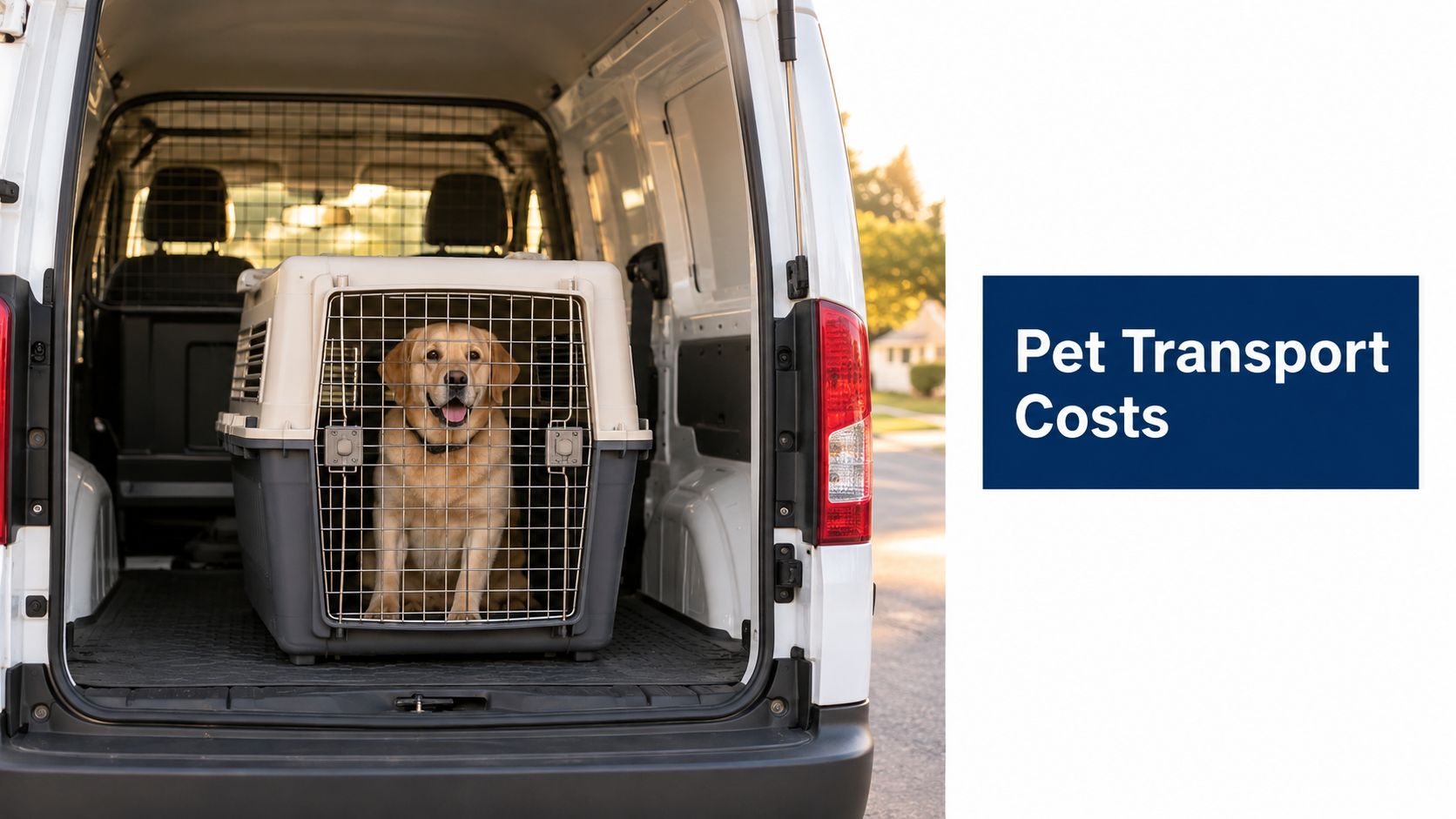
Most domestic pet transport falls between $100 and $6,400, depending on distance and service type, while international moves typically run $1,500 to $12,000+ once paperwork and logistics are included. The price depends less on the pet alone than on the route, transport method, service level, timing, and regulatory work required, as shown by this 2026 pet transport pricing guide.
You may be looking at a move right now with a departure date on the calendar, a nervous dog or cat beside you, and several quotes that appear impossible to compare. One provider lists a transport fee, another gives an all-in estimate, and a third leaves crates, veterinary paperwork, or airport handling out of the headline number.
The most useful way to understand how much do pet transport services cost is to separate the bill into two buckets: required compliance costs tied to your pet and destination, and provider service fees covering labor, routing, handling, and coordination. Once you see those buckets, a quote becomes a list of decisions rather than a mysterious total.
Table of Contents
- What You're Really Paying For When You Move a Pet
- The Five Cost Drivers Behind Every Pet Transport Quote
- Service Models and How Their Prices Differ
- Typical Price Ranges for Domestic Moves
- International Moves and the Compliance Cost Stack
- A Sample Quote Walked Through Line by Line
- Ways to Lower Your Bill Without Cutting Care
What You're Really Paying For When You Move a Pet
A family moving from Denver to Charlotte might request transportation for a 45-pound Lab mix and receive two quotes that look nearly identical at first glance. One provider may include pickup, overnight care, and delivery, while the other may price the route itself and leave the family to arrange the crate, veterinary certificate, and final handoff. The difference can reach hundreds of dollars without either quote being misleading.
That's why the first question shouldn't be, “Which company has the lowest number?” Ask instead, “Which line items are included, and which costs will I pay separately?” Domestic ground guidance places short-distance moves around $100 to $300, with longer domestic journeys often rising to roughly $350 to $600, while complex cross-country routes can reach $2,000 to $6,400 depending on method and requirements. These ranges are documented in independent domestic pet transport cost guidance.
The two buckets on a pet transport quote
Compliance costs are expenses you may owe regardless of which transport provider you choose. They can include veterinary examinations, health certificates, microchipping, government documents, import permits, approved crates, customs processing, and quarantine charges. Some are required by the destination or carrier, not created by the transport company.
Provider service fees pay for the company's work. That can include route planning, driver time, airline coordination, pickup and delivery, overnight monitoring, transfer management, customer updates, and administrative support. A full-service provider charges more because it takes responsibility for more steps.
Practical rule: If a quote doesn't identify who pays for a crate, veterinary paperwork, airport handling, overnight care, and destination delivery, you don't yet know the real cost.
A useful quote should help you answer four questions:
- What transport model is being used? Shared ground, private ground, in-cabin air, cargo, flight nanny, or managed relocation.
- What does the provider handle? Pickup, crate preparation, documents, transfers, customs, and delivery should be stated clearly.
- Which costs are third-party charges? Airlines, veterinarians, government agencies, and quarantine facilities may bill separately.
- What could change the estimate? Large crates, remote locations, timing changes, weather restrictions, and additional pets can alter the total.
For owners who want visibility during the trip, real-time pet tracking information can also be part of the service discussion. Tracking won't replace safe handling, but communication and status updates can make a complicated move easier to manage.

This two-bucket framework gives you a practical way to predict your own budget. Instead of relying on a generic average, identify the route, select the service model, list the required compliance work, and ask the provider to show every assumption in writing.
The Five Cost Drivers Behind Every Pet Transport Quote
Every quote responds to the same basic variables, although providers may label them differently. Distance matters, but it isn't the only lever. Routing, pet size, service level, and timing can change the cost structure at the same time.
Distance and route efficiency
A short trip may require only a local handoff and a limited driving window. A long route adds fuel, driver hours, overnight lodging, rest stops, monitoring, and scheduling work. Remote pickup or delivery can cost more because the driver may need to leave the main route and travel back without another booking.
A shared ground ride usually spreads route costs across multiple pets. A private ride reserves the vehicle and schedule for one household, so the same mileage produces a different price. Current market guidance places shared ground rides around $0.50 to $1.00 per mile and private ground rides around $1.00 to $3.00 per mile, depending on the service arrangement, as summarized by Petworks' pet transport marketplace guidance.
Pet size and weight
Size affects both physical space and equipment. A larger dog may need a larger crate, more vehicle capacity, and different airline or cargo handling. A weight change can therefore move a pet into a different crate or cargo class rather than just adding a small amount to the existing fee.
For the Denver-to-Charlotte Lab mix, the provider should state whether the quote assumes a standard crate, an owner-supplied crate, or a larger rental. Ask whether the crate charge is included in service fees or listed separately.
Service tier
Airport-to-airport service may look inexpensive because the owner handles transportation to the departure airport and from the arrival airport. Door-to-door service costs more because the provider manages those legs, coordinates timing, and assumes more responsibility.
The same distinction applies to ground transport. Shared service may reduce the price but usually requires greater flexibility. Private service can offer a more direct schedule and more individualized handling.
Routing
A direct route is simpler than one involving transfers, airline connections, remote locations, or overnight stays between legs. Each additional handoff creates work, and each handoff can introduce airport handling, kennel, lodging, or schedule-change charges.
Ask for the planned route, not only the origin and destination. A quote based on a major-city corridor may change when the pickup address sits far outside that corridor.
Timing
Last-minute bookings reduce the provider's scheduling options and can require expedited planning, limited flights, or additional labor. Holidays, peak moving periods, and severe weather can also affect availability and routing.
A flexible pickup window can save money, but only if the arrangement still gives your pet appropriate rest, supervision, and climate protection.
| Cost Driver | Baseline | Adjusted | Approx. Change |
|---|---|---|---|
| Distance | Direct route between major cities | Remote pickup and delivery | Higher fuel, labor, and deadhead costs |
| Pet size | Standard crate and vehicle space | Larger crate or cargo class | Added equipment and handling |
| Service tier | Airport-to-airport | Door-to-door | Added ground legs and coordination |
| Routing | Direct movement | Multi-leg route | Transfer, handling, and overnight costs |
| Timing | Flexible booking window | Urgent or peak-period booking | Fewer options and possible expedite charges |
These drivers multiply in practice. Changing the route, service tier, and timing together can produce a very different quote from changing any one item alone. The service models below show how those choices appear in real pricing bands.
Service Models and How Their Prices Differ
A 12-pound cat flying with its owner from Virginia to Texas may fit in-cabin rules on many domestic carriers. A large dog on the same broad route may need a ground vehicle or air cargo instead. The headline fare is only one part of the decision. Airport transfers, carrier requirements, crate preparation, and compliance work may remain with the owner unless the quote assigns them to the provider.
Ground transport
Ground transport can suit regional moves, large dogs, pets that should not fly, and owners who prefer a vehicle-based journey. Local service commonly runs $100 to $350, while long-distance ground transport can reach $350 to $1,200+, according to this 2026 pet transport pricing overview.
A shared ride may lower the service fee by placing several pets on one route, though pickup windows and travel times are less flexible. A private ride uses the vehicle and schedule for one pet, so the price rises. Check whether the quote includes overnight monitoring, walks, food, and final delivery. For a closer look at vehicle-based options, review ground pet transport services.
In-cabin commercial air
The airline ticket may be only the starting point. The owner usually travels with the pet and handles airport timing, carrier compliance, and any required documents. Airline charges, ticket coordination, and ground transfers may sit outside the basic travel price. This option can be practical when the pet meets the airline's size, carrier, health, and route requirements, but the owner must be present for the journey.
Air cargo
$300 to $1,200 is a reported 2026 range for air cargo, depending on pet size and carrier fees, according to Petworks' 2026 transport pricing discussion. Larger pets and routes that make ground travel impractical are common reasons to consider it. The quoted air charge may not cover every required step. Crate dimensions, airport handling, weather limits, and documents can create separate charges, much like adding several handling counters to a single shipment.
Flight nanny service
A flight nanny accompanies the pet, usually in the cabin when airline rules permit. For a small dog or cat, this can provide continuous human supervision when the owner cannot make the trip personally. The quoted amount may include the courier's time and flight, while airport transfers, layovers, and delivery may be separate. Ask who remains responsible for compliance tasks and what happens if the itinerary changes.
Door-to-door managed relocation
Door-to-door relocation combines planning, pickup, transport, arrival coordination, and delivery. It can help an owner who is moving internationally, has a tight schedule, or does not want to coordinate several providers. Full-service relocation can range from $2,500 to $12,000+, depending on route complexity and requirements. Under the two-bucket view, the service fee pays for coordination and movement, while required compliance costs may sit on top.
| Service Model | Typical 2026 Price | Best For | Watch Outs |
|---|---|---|---|
| Ground transport | $100 to $1,200+ | Large pets, regional or long-distance moves | Shared schedules, remote pickups, overnight care |
| In-cabin air | $95 to $200 for typical in-cabin travel | Eligible small pets traveling with an owner | Airline restrictions, tickets, carrier fees, ground legs |
| Air cargo | $300 to $1,200 | Larger pets and long routes | Crate, handling, airport transfers, weather limits |
| Flight nanny | $500 to $1,500 domestically | Small pets needing a human escort | Layovers, courier scheduling, delivery |
| Door-to-door relocation | $2,500 to $12,000+ | Owners needing coordinated service | Third-party compliance and destination charges |
Choose by separating required compliance costs from provider service fees, then match each line to the route, pet, and amount of work you will retain.
Typical Price Ranges for Domestic Moves
Domestic pricing becomes easier to estimate when you place the route into a distance category and then adjust for service type. Short local handoffs sit near the low end. Long routes rise because drivers spend more time on the road, providers manage more stops, and overnight care becomes more likely.
The table uses the route examples supplied in current 2026 pricing guidance. These are planning ranges, not guaranteed quotes, because the same distance can require shared ground service, private transport, cargo coordination, or a flight nanny.
| Route Type | Example Distance | Ground Transport | Air Cargo | Flight Nanny |
|---|---|---|---|---|
| Short local move | 50 miles | $100 to $300 | Not usually practical | Not usually practical |
| Medium interstate move | 500 miles | $400 to $900 | Route-dependent | Route-dependent |
| Cross-country move | 2,500 miles | $1,500 to $3,200 door-to-door | $2,800 to $6,400 | $2,200 to $4,500 |
A 50-mile courier handoff for one small pet may stay near $100 to $300, particularly when the pickup and delivery points are easy to reach. A 500-mile interstate journey commonly falls around $400 to $900 for ground transport. The long coast-to-coast example shows why the service model matters, because a door-to-door ground move, cargo option, and flight nanny are solving the same geographic problem in very different ways.
Pet weight can push a quote upward when the animal needs a larger crate or more vehicle space. Peak-season fuel charges, remote addresses, and expedited pickup windows can also move a route toward the top of its band. A provider should identify those adjustments rather than hide them inside an unexplained total.
Ask for the base route price, every surcharge, and every third-party expense in separate lines. A written breakdown lets you compare value, not just the largest or smallest headline number.
International Moves and the Compliance Cost Stack
A move from New York to London can involve an airline booking, airport transfers, customs processing, veterinary appointments, and destination paperwork. The flight is only one layer. Provider fees pay for coordination, while compliance costs go to veterinarians, airlines, governments, and arrival services.
Service-based coordination often places international moves in the $1,500 to $5,000 range. Complex relocations can reach $1,500 to $12,000+ when cargo handling, USDA documentation, testing, and quarantine are included. Treat those figures as planning ranges, not a complete quote.
Start with the provider fee
The service fee may cover route planning, airline booking, document coordination, airport transfers, ground transportation, and communication. It may exclude veterinarian, government, airline, customs, or quarantine charges. Ask the coordinator to separate these lines before you compare providers.
PetRelocation's published pet relocation cost breakdown separates required owner-paid costs from transport-company service fees. It lists domestic service fees around $900 for the first pet and $250 for additional pets, and international service fees around $2,500 plus $500 for each additional pet. It also notes that international support fees alone can range from $1,995 to $3,500, depending on the destination.
That distinction works like a restaurant bill. The provider fee covers the coordination work, while each required outside service appears as its own charge.
Add the compliance requirements
The compliance stack can include:
- Veterinary work: Examination, vaccinations, health certificates, and route-specific treatments.
- Identification: Microchip records and destination-specific verification.
- Government documents: USDA endorsements, import permits, and official forms.
- Travel equipment: An airline-compliant crate sized for the pet.
- Arrival handling: Customs, broker assistance, inspection, and quarantine where required.
Destination rules determine the final list. A country may require documents in a specific order, and an expired or incorrect certificate can require another appointment or cause a delay. Confirm each requirement with the provider, veterinarian, airline, and relevant government authorities. The USDA pet travel requirements guide helps explain why government paperwork belongs in a separate budget line.

International pricing is a stack, not one transportation fee. List the provider's service charge first, then each veterinary, government, airline, crate, customs, and quarantine expense before approving the move.
A Sample Quote Walked Through Line by Line
Consider a 2,800-mile domestic move from Denver to Miami for a 55-pound Labrador using door-to-door ground transport. The following example shows how a provider might present the estimate. It is a budgeting illustration based on the supplied quote components, not a universal rate.
The base movement
The base transport fee is $1,650, covering fuel, driver time, and overnight handler fees. Because the dog weighs more than 50 pounds, the quote adds a $250 size surcharge for the larger space and handling requirements.
The equipment line lists $95 for a climate-controlled crate rental. If the owner already has an accepted crate, this line might change, but the provider should confirm whether the existing crate meets the route's requirements.
Compliance and travel preparation
The quote then separates several preparation items:
- Veterinary health certificate: $185 for the required travel examination and certificate.
- USDA endorsement: $60 where the route requires it.
- Microchip: $55 if the existing chip isn't ISO-compliant.
- Travel kit: $40 for bowls, absorbent pads, and identification tags.
- Insurance upgrade: $120 for an added coverage option.
These lines illustrate why a transport quote shouldn't treat paperwork and equipment as invisible extras. Some owners will already have a compliant microchip or travel supplies, while others will need the provider to arrange them.
A product such as the Petmate Sky Kennel may be suitable for domestic and international flights when properly assembled with metal hardware and airline-compliant accessories.
Timing and total
The quote applies a peak-season booking premium of 8 percent, shown here as $140, and lists a $175 same-week pickup surcharge. The components total $2,595 before taxes, then reach $2,770 after the same-week surcharge.

The useful lesson isn't the final number alone. It's the visibility of each assumption. When comparing estimates, ask every provider, including Precious Pets Transport, to use a similar format and identify which charges are optional, which are required, and which can change if your dates or pickup location change.
Ways to Lower Your Bill Without Cutting Care
Lowering logistics costs is reasonable. Lowering welfare standards isn't. The safest savings usually come from planning, flexibility, and removing duplicated work rather than choosing a less supervised route.
- Book early: Start planning several weeks ahead so you have more shared-route, airline, and appointment options. Early planning can help you avoid the higher labor and scheduling pressure associated with urgent bookings.
- Use hub-to-hub service when practical: If you can safely deliver your pet to a major transport hub and collect the pet at the destination, you may avoid some door-to-door driving. Confirm who handles the pet during every handoff.
- Ask about shared rides: Shared ground service can reduce the cost when your pet is comfortable around other animals and your pickup window is flexible. Request details about stops, rest periods, supervision, and vehicle conditions.
- Choose a less pressured travel period: Moving outside the busiest periods may give the provider more routing flexibility. Don't choose dates that create unsafe heat, cold, or long delays for your pet.
- Consolidate preparation: Ask your veterinarian whether required examinations, documentation, and identification work can be handled efficiently in one planned visit. The veterinarian must still complete every required step properly.
- Move compatible pets together: Multiple pets from one household may share parts of the route or coordination process. Each animal still needs suitable space, records, and care.
- Request an itemized estimate: Ask providers to separate transport, crate, veterinary, government, airport, customs, and optional protection charges. You can then remove services you can handle without losing essential care.
Check the provider before booking
A low quote isn't useful if the provider can't explain who handles your pet or what happens during a delay. Verify the provider's registration and insurance status, ask how current government endorsements are managed, and request the health certificate timing in writing.
Also confirm the overnight plan, emergency contact process, climate controls, food and medication instructions, and delivery handoff. A trustworthy provider should be able to explain the complete route in plain language before you pay a deposit.

If you're arranging a domestic or international move, Precious Pets Transport Services, LLC provides door-to-door ground transportation and coordinates international relocation logistics, with itemized planning that helps you distinguish service fees from compliance costs. Request a written estimate with your route, pet details, timing, crate needs, and every required document listed before you book.
Leave a Reply