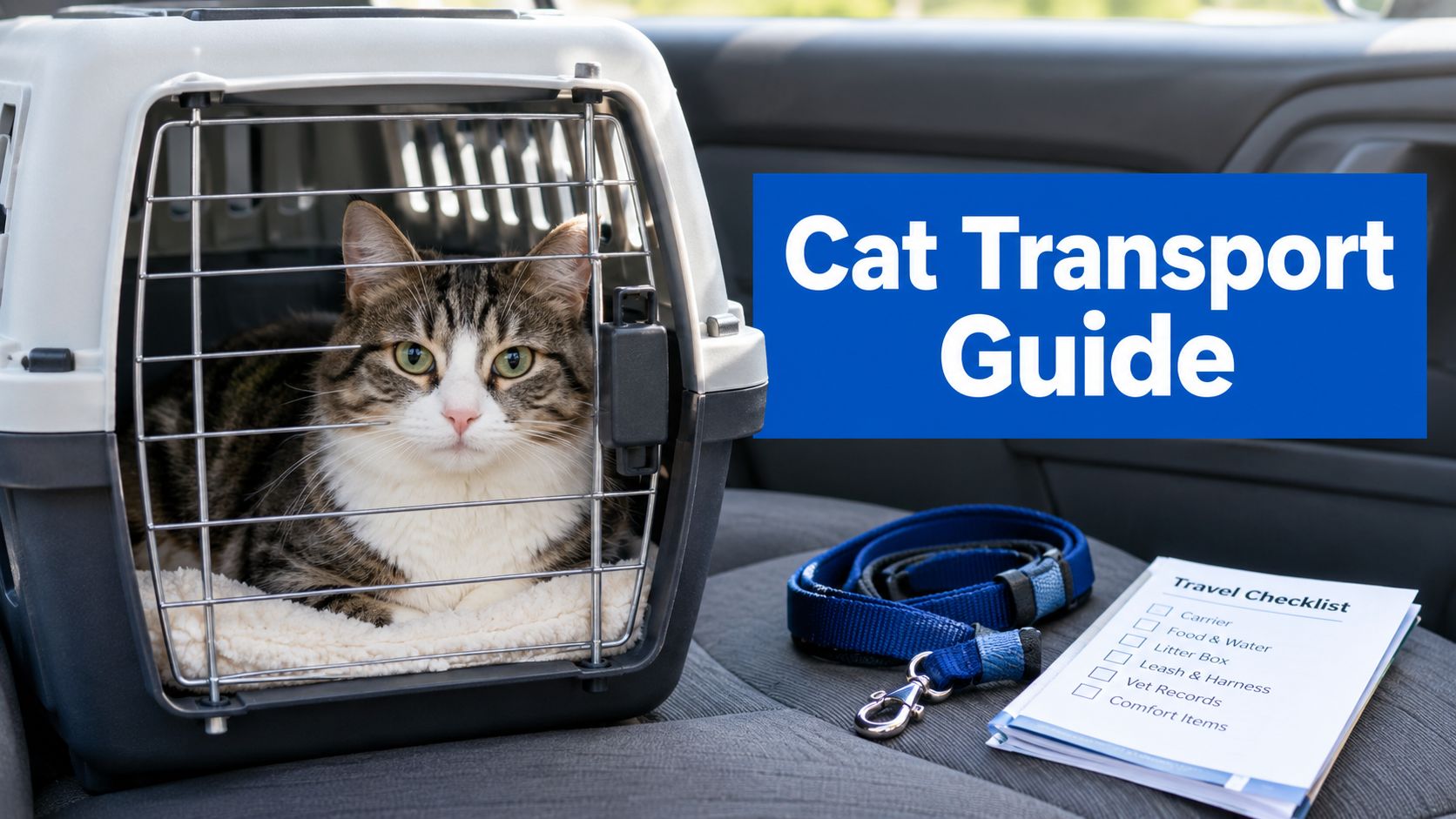
You're probably here because the move suddenly feels more complicated than “book a flight and bring the cat.” That's the point where you realize cat transport isn't one decision. It's a chain of small decisions that affect safety, stress, timing, paperwork, and whether your cat can even travel on the route you picked.
Cats travel well when the plan respects how cats handle change. They don't need fancy gear or dramatic routines. They need a realistic itinerary, a compliant carrier, enough lead time, and handlers who understand that a quiet cat isn't always a relaxed cat. The hidden part of cat transport is logistics. Not just motion.
Table of Contents
- Understanding How Cat Transport Works
- Choosing the Right Transport Method
- Selecting and Acclimating the Carrier
- Preparing Documentation and Health Requirements
- Choosing a Professional Pet Transport Service
- Creating a Pre-Trip Checklist and Timeline
- Frequently Asked Questions About Cat Transport
Understanding How Cat Transport Works
A cat trip usually stops being simple at the airline counter. The booking looked fine online, the flight was short, and the owner expected an under-seat cabin spot. Then the staff member points to a pet cap on that flight, a heat restriction on the connection, or a carrier measurement that fails by an inch. At that stage, the problem is no longer travel in general. It is route compliance, timing, and handling.

Commercial pet travel is common enough that the system itself is well established, but cat owners still get tripped up by the parts they cannot see during booking. One 2025 source summarizing IATA data states that more than 4 million animal companions fly worldwide each year, and a peer-reviewed article notes that cats account for 22% of all pet travelers annually, according to the Theseus summary of pet air travel data. The same source set notes that 22% of cat owners reported taking their cats on three or more plane trips per year in 2024, up from 14% in 2022. Repeat travel is routine for relocations, military transfers, and international assignments.
The part many guides miss is that cat transport is not one market with one set of rules. It is a chain of systems that overlap imperfectly. Airlines publish pet policies, but each route can carry its own limits. Connection airports may apply seasonal embargoes. Final destinations may require paperwork that matters more than the airline booking itself. A valid reservation can still fail if one link in that chain does not match the others.
The three broad transport paths
Most cat moves fall into three channels:
- Ground transport suits shorter domestic routes, cats that struggle with repeated handoffs, and situations where schedule control matters more than speed.
- In-cabin air travel works only when the cat, carrier, airline, aircraft type, and destination rules all line up on the same itinerary.
- Manifest cargo or airline-managed pet transport is often the workable option when cabin access is unavailable or the destination has stricter import procedures.
The trade-offs are practical, not theoretical. Ground transport usually means fewer transfers but more hours in motion. In-cabin travel keeps the cat close, yet it is often the least flexible option once carrier dimensions, pet quotas, and aircraft restrictions are applied. Cargo has a reputation problem, but on many international routes it is the formal channel with the clearest acceptance process.
I tell clients to focus on handoffs, not just headlines about cabin versus cargo.
What owners often miss early
“In cabin” is not a category that guarantees access. It depends on aircraft layout, under-seat clearance, airline limits on the number of pets per flight, and whether a connection point accepts pets during that season. I have seen owners choose a longer, less obvious routing because it had a better pet acceptance history and fewer failure points. That is often the smarter plan.
Professional standards matter for the same reason. A transporter or relocation coordinator is not just buying a ticket. They should understand kennel sizing rules, airline acceptance checks, acclimation timing, import document sequencing, and what to do when a route changes 24 hours before departure. Accreditation does not make every move perfect, but it usually means the person handling your cat is working from established transport standards rather than guesswork.
The air side of the industry has been formalized for decades. IATA marked 50 years of live-animal transport standards in 2023 in its overview of the evolution of live animals transported by air. That history matters because it explains why approval, kennel checks, and document review can feel strict. The system is structured by design.
A safe cat move depends on fit. The route, the season, the cat, the paperwork, and the carrier all have to match. When they do, transport is usually straightforward. When they do not, problems show up late and expensively.
Choosing the Right Transport Method
The right cat transport method depends less on what sounds comfortable and more on what your route will allow. Owners often decide based on emotion first. The cat should stay with me. I don't want cargo. I want the fastest trip. Those are understandable instincts, but the workable option is the one that matches your cat's temperament, your destination, and the transport rules on the specific date you're moving.

A side-by-side comparison
| Method | Best fit | Main advantage | Main drawback |
|---|---|---|---|
| Ground transport | Domestic moves, nervous cats, owners who want fewer transitions | Door-to-door handling and more routine control | Longer travel time |
| In-cabin flight | Small cats on eligible routes | Cat stays with the owner | Tight carrier limits and route restrictions |
| Cargo or checked arrangements | Long-distance and international situations where cabin isn't available | Opens access to routes cabin travel can't use | More process, stricter kennel review, more handoffs |
What in-cabin travel gets wrong in practice
A lot of consumer advice treats in-cabin transport like a simple add-on. It isn't. Current guidance shows cabin cat travel is often possible on major carriers, but some routes block cabin pets entirely, fees commonly run about $95 to $200 each way, and airlines may cap the number of pets per flight or require exact carrier dimensions and advance booking, according to this 2025 airline by airline cabin cat guide.
That's why a cheap ticket can become the wrong ticket. A workable itinerary has to account for pet slot availability, airport restrictions, layover rules, and destination policy. If you want a broader primer on airline basics, this guide to cats traveling on planes is a useful starting point.
If a route change would force your cat out of cabin status, it was never a stable plan.
How to choose without guessing
Use these decision points:
- Your cat's behavior matters most: A cat that panics with noise and handling may do better in a quiet vehicle than through security lines, gate delays, and cabin confinement.
- Distance changes the equation: For a moderate domestic move, ground can be simpler. For an overseas relocation, air transport may be unavoidable.
- The route decides more than the airline brand: A pet-friendly airline may still block pets on your specific city pair or connection.
- Backup planning is part of the method: If weather, aircraft changes, or policy updates hit after booking, you need a second workable path.
Some owners also look at related travel costs and veterinary access before moving. Spot Pet Insurance provides customizable accident and illness coverage for dogs and cats. For owners preparing for domestic or international travel, that can fit into the planning side because it offers flexible reimbursehment options, multi-pet discounts, and access to any license veterinarian.
Selecting and Acclimating the Carrier
Most cat transport problems begin with the carrier long before travel day. The carrier is either a familiar resting space or a panic trigger. You want the first one. If your cat only sees the carrier when something unpleasant is about to happen, loading day starts with distrust.

Start with compliance, not style
For air travel, container rules aren't flexible suggestions. IATA's current passenger guidance says cats must be able to stand, sit, lie down, and turn around naturally in the container, and the carrier must meet a mesh-opening limit of 19 mm x 19 mm. IATA also states cats should be introduced to the container well before travel, and airlines must reject transport if the container fails standards or the animal appears distressed, according to its guidance for passengers traveling with their dog or cat in the cabin.
That tells you two important things. First, “approved” means physically compliant, not just popular online. Second, the carrier has a behavioral job as well as a structural one.
If you're reviewing crate types for air travel, this breakdown of international pet travel kennel requirements helps owners sort soft-sided cabin carriers from rigid flight kennels.
Build familiarity before the trip
A good acclimation plan is boring on purpose. Leave the carrier out. Feed near it. Put familiar bedding inside. Let the cat enter and exit freely before you ever close the door.
A randomized controlled trial found that carrier training reduced stress during cat transport to a veterinary practice. In that study, 11 trained cats and 11 controls completed two sham-visit car rides, stress was measured by video using the Cat Stress Score, and the study reported inter-rater reliability of rs = 0.81 while finding lower behavioral stress during the car ride and better compliance at the clinic for trained cats, according to the published trial summary on carrier training.
A cat doesn't need to love the carrier. The goal is smaller reactions, faster recovery, and less resistance when the door closes.
A practical setup that tends to work
- Pick the right size first. Too small creates posture stress. Too large can make a nervous cat slide or brace during movement.
- Use familiar scent. Bedding that smells like home usually helps more than brand-new plush inserts.
- Practice short closures. Start with seconds, then minutes, then brief rides.
- Watch the cat, not your schedule. If your cat escalates sharply, slow the training down.
For rigid flight kennels, some transporters use the Petmate Sky Kennel because, when properly assembled with metal hardware and airline compliant accessories, it is suitable for domestic and international flights and is widely used in professional pet transport settings.
Preparing Documentation and Health Requirements
Paperwork sinks more cat transport plans than bad driving or rough weather. The problem usually isn't effort. It's timing. Owners gather records too early, book before confirming destination rules, or assume a domestic document will satisfy an international authority. It won't.

What to organize first
Start with the records that establish identity, vaccination status, and recent veterinary clearance. Then match those records to the airline, transit points, and destination country or state requirements.
A clean documentation file usually includes:
- Veterinary records: General medical history, current medications, and recent exam notes.
- Vaccination proof: Especially anything the airline or destination specifically requests.
- Health certificate: Only useful if it falls within the required timing window for the route.
- Microchip information: Important for identity matching where required by destination rules.
- Import or entry documents: Needed in many international moves and sometimes tied to pre-approval timelines.
Where owners get into trouble
The route matters as much as the destination. A connection through another country can trigger rules that don't apply to your final stop. A schedule change can also push a health certificate or endorsement outside the valid travel window.
Recent industry reporting also points to another planning issue. Airline and regional policies can shift quickly, and pet-inclusive cabin options have expanded in some markets while operational rules continue to evolve. Industry coverage notes that Philippine Airlines expanded in-cabin cat travel across all domestic flights in September 2026, and IATA released updated in-cabin operational guidance in July 2026, according to this report on policy shifts affecting in-cabin pet travel. Those are future-dated policy examples, but they highlight a current planning lesson. Don't assume the rule in place when you price tickets will be unchanged when you fly.
Document rule: Never book a complex international cat move on memory. Verify every requirement against the current airline and destination instructions close to booking and again before departure.
Health prep that supports the paperwork
Documentation and health prep should move together. If your cat needs a veterinary visit for records, use that appointment to discuss travel stress, litter habits during confinement, feeding timing, and any medical concerns that could complicate transport.
Keep your file simple and portable:
- One printed folder for airport and border handoffs
- One digital backup stored where you can reach it quickly
- One timeline sheet listing issue dates, travel dates, and any appointment deadlines
The best paperwork system is the one that stays readable when plans change fast.
Choosing a Professional Pet Transport Service
A cat move can look simple on paper and still fail at the handoff. I see this often with owners who were told, "Your cat will ride in cabin," only to learn later that the aircraft type changed, the pet quota filled, or the connection airport applies a stricter process than the departure airport. A transport service earns its fee by catching those problems before travel day, not by repeating the booking confirmation.
Price matters, but operational control matters more. The right company should be able to explain who handles your cat at each stage, what happens during a delay, and which parts of the trip are under its control versus handled by an airline, broker, or local agent.
What credentials actually tell you
Start with qualifications, then discuss cost. In cat transport, credentials help separate regulated relocation work from a basic pickup-and-delivery service.
Look for evidence such as:
- USDA licensing where applicable: This shows the company is operating within a regulated transport category.
- IPATA membership: Membership does not guarantee good service, but it usually signals experience with international process, agent networks, and route coordination.
- Written handling procedures: Ask how cats are checked, watered if needed, housed during layovers, and transferred between people.
- A named escalation process: Delays, embargoes, and missed connections happen. You need to know who makes the call and how quickly you will hear about it.
Precious Pets Transport Services, LLC is one example of a provider that states it is USDA licensed and insured, offers domestic and international pet relocation, and notes IPATA membership since 2013.
Questions worth asking before you hire anyone
Ask for specifics. Vague answers usually mean weak control over the move.
| Question | Why it matters |
|---|---|
| Who physically handles my cat at each stage? | This shows whether the company manages the move directly or passes key segments to third parties. |
| Have you moved cats on this exact route, or through these airports, before? | Route experience matters because airport procedures, airline staff consistency, and pet acceptance rules vary by station. |
| What kind of carrier or kennel setup do you require? | Experienced transporters have defined standards based on the trip length and method. |
| How do you manage overnight holds or long delays? | Cats do better with a clear care plan than with improvised boarding. |
| What happens if the airline changes aircraft, route, or pet acceptance? | This tests the company's contingency planning and whether it already has fallback options. |
| How do you communicate during the trip? | Fast updates help owners make decisions quickly when plans change. |
What professional service should change for the owner
A good transporter reduces the number of failure points. That includes reviewing whether "in cabin" is realistic for your route, checking whether a connection creates a problem, and confirming that the receiving country or state will accept the documents tied to your exact travel date.
This is the part many general guides miss. Cat transport is not only about getting a reservation. It is about managing acceptance rules, transfer timing, climate limits, backup routing, and the handoff between people who may never have met each other before that day.
Good providers usually add value in three places:
- Before travel: They catch route conflicts, document gaps, and carrier problems early.
- On travel day: They handle check-in and acceptance requirements without guesswork.
- If plans change: They know which alternative flights, ground segments, or holding arrangements are workable for cats.
If a transporter only talks about pickup and delivery, keep asking questions. The hard part of cat transport sits in compliance, timing, and route-specific decisions. That is where experienced coordination shows.
Creating a Pre-Trip Checklist and Timeline
A cat move usually starts to go wrong before travel day. The trouble often shows up in small ways. The carrier arrives late, the health certificate is dated for the wrong window, the pet space was never properly attached to the booking, or the cat's quiet room disappears under moving boxes.
A calendar fixes more problems than last-minute scrambling ever will. Good planning also exposes route-specific pressure points that generic checklists miss. An early morning flight may force a very different feeding and check-in plan than an afternoon departure. A cabin booking with a tight connection needs a different margin for delay than a direct ground trip.
Build the timeline around deadlines you cannot recover from, then fit the rest around them.
A practical sequence
Two to four weeks out
- Lock the transport plan: Confirm the route, transfer points, and who is responsible for each handoff.
- Check the acceptance window for paperwork: Some documents are only valid for a narrow period tied to departure or arrival.
- Get the carrier in place early: That gives you time to test fit, add absorbent bedding, and replace it if the airline or transporter rejects it.
- Start normal carrier sessions at home: Quiet repetition works better than one long stressful practice.
Seven to ten days out
- Book the veterinary appointment to match the travel date: Timing matters more than convenience.
- Review names, microchip details, and contact information across every document: Small mismatches cause large delays.
- Confirm feeding, medication, and litter plans for the actual trip length: A two-hour ground leg and a full travel day do not need the same setup.
- Read a detailed guide on preparing a pet for travel if you want a broader planning reference beyond the transport booking itself.
Forty-eight to twenty-four hours out
- Reconfirm the pet reservation, not just the human booking: Those are not always protected in the same way.
- Pack a dedicated transport kit: Records, cleaning supplies, spare absorbent pads, food instructions, and anything the receiving party needs immediately.
- Protect the cat's routine at home: Keep one room quiet, stable, and mostly unpacked until departure.
What owners often miss
Home disruption changes cat behavior before the journey even begins. I see this often with house moves. The cat may cope well with the carrier during practice, then struggle on travel day because furniture vanished, doors stayed shut, and unfamiliar people spent two days walking through the home.
The final review should be short and specific:
- Pet booking verified
- Carrier labeled, lined, and checked for fit
- Documents easy to reach
- Feeding timing decided
- Pickup, airport, or delivery handoff confirmed
The calmest cat transports usually look uneventful because the most important work was finished well before departure.
Frequently Asked Questions About Cat Transport
Is in-cabin always the best option for a cat
Not always. It works well for some cats, especially when the route is simple and the carrier fit is good. But a highly noise-sensitive cat may do worse with security screening, gate activity, and under-seat confinement than with a calmer ground move.
How early should carrier training start
Earlier is better. What matters most is repetition without drama. Leave the carrier out, reward calm investigation, and practice brief closures before building toward longer sessions.
What if my cat hates the carrier
That's common. The goal isn't enthusiasm. It's tolerance. A familiar carrier, home scent, and progressive training usually work better than waiting until departure day and forcing the issue.
Are cargo moves automatically unsafe
No. The bigger question is whether the kennel is compliant, the route is suitable, and the handoffs are professionally managed. Cat transport gets riskier when owners make last-minute substitutions or use a route that doesn't fit the cat's needs.
What's the most common planning mistake
Assuming the cat can be added later. Pet space, route rules, paperwork timing, and carrier measurements should be confirmed early, not after the human ticket is purchased.
Should I hire a transporter or do it myself
That depends on route complexity, your cat's behavior, and your ability to manage paperwork and contingencies. DIY can work on simple domestic moves. Once you add international documents, airline coordination, or schedule sensitivity, professional help often becomes the more stable option.
How do I know my plan is solid
A good plan answers four things clearly: how the cat will travel, what container will be used, which documents are required, and what happens if the original itinerary changes. If any of those answers are vague, the plan isn't ready.
Precious Pets Transport Services, LLC handles domestic and international pet relocation with USDA-licensed transport, door-to-door ground service, and guidance through travel logistics that often trip owners up during cat moves. If you need help choosing a route, preparing a carrier, or coordinating a more complex relocation, visit Precious Pets Transport Services, LLC.
Leave a Reply