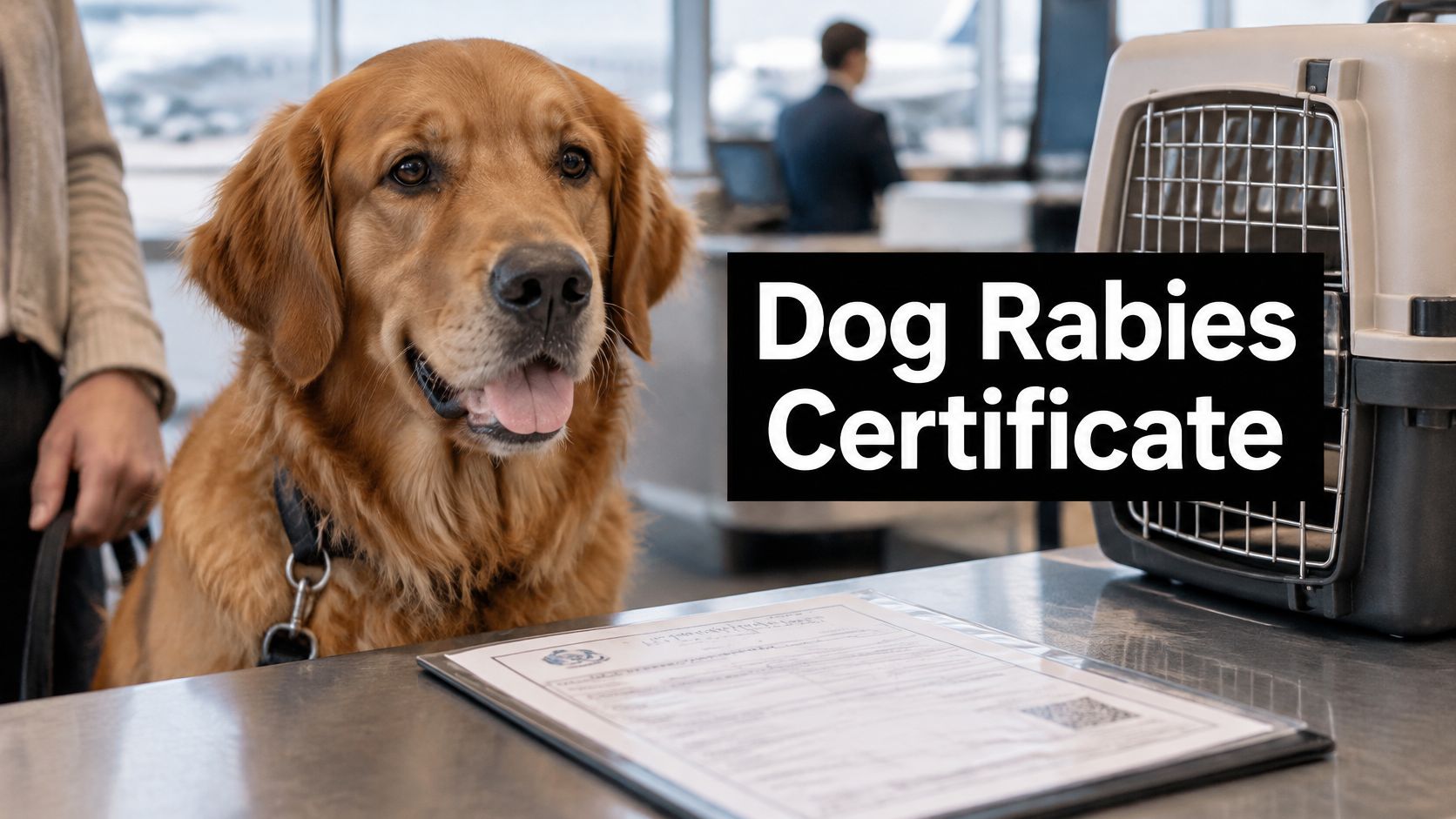
The folder comes out at the check-in desk. Inside are a vaccine receipt from the clinic, a handwritten note from the veterinarian, a printout of the airline's pet policy, and a small blue booklet with the dog's photo taped inside. The agent reads the receipt and turns it over, then asks for the certificate. The receipt shows that a rabies shot was paid for. It doesn't show a vaccine lot number, a microchip, or a veterinarian's license number, and those are the details the airline and the border officers check.
That gap is where moves fall apart, and it's rarely the dog's fault. A dog rabies certificate is a specific veterinary record with specific fields, and the version a clinic hands out for a city license isn't always the version that clears a border. Owners who treat the two as interchangeable end up at a counter being told their paperwork is close, but not right.
The rules below build in the order that matters: what the document must contain, when the vaccine has to be given, which authority signs which form for your route, and how to verify the whole set before you pay for a flight.
Table of Contents
- What a Dog Rabies Certificate Must Show
- Required Details on Every Certificate
- Vaccine Timing, Age and Microchip Sequence
- Which Rules Apply by Destination and Travel History
- Build the Paperwork Chain and Verify It Before Booking
- Mistakes That Cause Border Delays
What a Dog Rabies Certificate Must Show
A dog rabies certificate is an official veterinary record that ties three things together: the dog, the rabies vaccine, and the veterinarian who administered it. An inspector reads it to confirm that the animal in front of them is the animal described on the page, that the vaccine came from a traceable batch, and that a licensed professional signed for it. Break any one of those links and the document stops working, even when the dog is protected.
The vaccination is the event. The certificate is the evidence. A border officer can only act on the evidence.
Think about how a passport is used. Nobody opens one to admire the stamp. They open it because the page carries a photo, a number, a date of birth and an issuing authority that can be matched against a database and against the person standing at the counter. A rabies record behaves the same way. The breed, sex, color, age and microchip number are what let an officer connect the paper to your dog, and the veterinarian's license number and signature are what turn a clinic note into an official record.
Three situations cover most readers. You might be moving within the United States, where a current vaccination record that satisfies state and county rules is usually the whole requirement. You might be bringing a dog into the United States from abroad, where the record that counts is the CDC's own form rather than a foreign pet passport. Or you might be taking a U.S.-vaccinated dog overseas and back, which is the route where a certification has to be signed and endorsed before the dog leaves the country. Each route uses a different document, and none of them is universal.
Start with the field list. In most stalled moves, the delay traces back to a single blank box.
Required Details on Every Certificate
Most U.S. entry routes ask for the same core information, so one checklist covers the majority of moves. The USDA APHIS guidance on commercial dog imports describes the rabies certificate as a legally significant veterinary record rather than simple proof that a vaccine was given, and it names what the record must carry: animal identification such as breed, sex, age, color, name, microchip or tattoo, plus the vaccine manufacturer, lot number, expiration date, vaccination date and validity period, along with the issuing veterinarian's license number and signature.
| Field | What to Record | Common Gap |
|---|---|---|
| Dog identification | Breed, sex, age, color and name | Details do not match the passport or health certificate |
| Microchip number | ISO-compatible chip number | Chip missing or absent from the vet record |
| Vaccine product and manufacturer | Exact product as administered | Generic receipt without product name |
| Lot number | Lot number printed on the vaccine | Left blank |
| Vaccination date | Date the vaccine was given | Date too close to travel for the required interval |
| Expiration date and validity period | 1, 2 or 3 years, with the expiry documented | Expiry not stated, so a one-year period applies |
| Next-due date | Date of the next booster | Booster date missing, so a lapse goes unnoticed |
| Veterinarian license and signature | License number and signature of the issuing vet | Unsigned form or missing license number |
The three fields that cause the most border trouble
The microchip number. It has to appear identically on the rabies record, the health certificate and the airline booking. A chip that exists in the dog but not on the page is, for inspection purposes, a chip that doesn't exist.
The product and lot. A receipt that says "rabies vaccine" with no product name satisfies a billing system and nothing else. Ask the clinic to print the manufacturer and the lot number the vial carried, not a generic description.
The signature and license. An unsigned form or a missing license number gives an officer no one to hold responsible for the record, which is exactly what the license field exists to prevent.
Practical rule: Take this list to the appointment and read it aloud to the technician before the form prints. Corrections made in the exam room take five minutes. Corrections made after the clinic closes take days.
APHIS Form 7041, titled "Live Dog Import Health and Rabies Certificate," is a commonly recommended format for capturing these details in one place. Whether or not your route requires that exact form, its layout is a useful model: identity at the top, vaccine data in the middle, signature and license at the bottom.
Vaccine Timing, Age and Microchip Sequence
A puppy vaccinated on the day it turns 12 weeks has just met the minimum age for an initial U.S. import rabies vaccination, because 12 weeks is 84 days. Vaccinate one week earlier and the record shows a date below the threshold, which turns a valid shot into one the officer cannot accept.
Commercial-import rules also require the vaccination to have occurred at least 30 days before entry into the United States. A first vaccination or a lapse in coverage under CDC entry rules calls for at least 28 days before arrival, as set out in the CDC guidance on the rabies vaccination record. Plan to the longer window. A 28-day margin leaves nothing for a rescheduled flight.

| Rule | Requirement | Source |
|---|---|---|
| Minimum age at first rabies vaccine | 84 days | APHIS commercial import |
| Vaccine given before entry | At least 30 days | APHIS commercial import |
| Vaccine given before arrival, first vaccine or lapse | At least 28 days | CDC entry |
| Minimum dog age at entry | 180 days (6 months) | APHIS import pathways |
| Accepted validity with documented expiry | 1, 2 or 3 years | APHIS |
| Validity when expiry cannot be established | 1 year | APHIS |
| Microchip before vaccination | Required, and number on vet record | CDC |
The microchip has to come first
The sequence most owners have never been warned about is this one: chip, then vaccine. The CDC treats a rabies vaccination as invalid for U.S. entry if the dog was not microchipped before the vaccination or if the number is absent from the veterinary record. The chip works like the barcode on a lab sample: it ties the result to one specific animal, and a chip implanted later leaves the earlier shot attached to no one.
For a dog vaccinated abroad, the CDC Rabies Vaccination and Microchip Record is the standard form for U.S. entry. A foreign-issued record can still be accepted when it carries the same required details: the owner, the dog, the microchip number, the vaccine product and lot, the vaccination and next-due dates, and the administering licensed veterinarian's credentials and contact information.
Count backward, not forward. Mark the travel date, subtract the 30-day interval, confirm the dog met the minimum age on vaccination day, and check that the chip was scanned before the needle went in. If any step fails, the flight date moves, not the rule.
If the destination requires a blood test, the dog rabies titer test runs on its own clock and comes after the vaccine, never before it. Confirm the applicable interval with the destination's official authority, because the pathways don't align perfectly.
Which Rules Apply by Destination and Travel History
A dog can arrive at the border holding a perfectly valid rabies certificate and still be stopped, because the certificate answers only one question on a longer list. The route decides which questions get asked. Four of them, answered in order, determine which document set applies, and answering them out of order is how owners end up paying for the wrong form.
- Which direction is the dog moving? Entry into the United States, exit to another country, or a domestic move inside the U.S.
- Where was the vaccine given? A U.S.-administered vaccine and a foreign-administered one lead to different paperwork.
- How is the destination classified for dog rabies? Classification decides whether extra steps apply at all.
- Where has the dog been in the past six months? Not just where the flight starts. A single high-risk country visited mid-trip can change the entire route.
| Situation | Document Needed | Completed By |
|---|---|---|
| U.S.-vaccinated dog visiting or returning from a high-risk country within six months | Certification of U.S.-Issued Rabies Vaccination | USDA-accredited veterinarian, submitted before departure |
| Dog vaccinated abroad, entering the U.S. | CDC Rabies Vaccination and Microchip Record | Administering licensed veterinarian |
| Commercial dog import to the U.S. | APHIS health and rabies certificate | Accredited veterinarian, endorsed through VEHCS |
| Destination requiring a rabies antibody titer | Titer report of at least 0.5 IU/mL | Approved laboratory, carrying the same microchip number |
| Domestic move within the U.S. | Current rabies vaccination record | Issuing veterinarian |
The first row is the one travelers miss. Owners assume the certificate that got the dog out of the country will get it back in, but a dog returning from a country classified as high risk for dog rabies needs a Certification of U.S.-Issued Rabies Vaccination completed by a USDA-accredited veterinarian and submitted before the dog departs the United States. The USDA APHIS guidance on dog disease status makes clear that CDC rules apply to U.S.-origin dogs coming home exactly as they apply to foreign arrivals.
Classification isn't paperwork for its own sake. The CDC summary of rabies in the United States puts reported animal rabies cases at approximately 4,000 a year, with more than 90% of them in wildlife. That background is why an officer cares where your dog has been, and why a routine vaccination receipt can't answer the question.
One more detail decides whether a form counts at all. Forms are generally required in English and must be issued by a veterinarian licensed in the exporting country, so a form completed in the wrong jurisdiction can be refused even when the vaccine itself was fine.
Owners relocating a dog across a border usually end up managing two paperwork files at once, one for the animal and one for the family, and the two run on separate clocks. The UAE tourist visa paperwork guide from My Global Trips walks through a typical human document set, which is a useful reminder to build both files early rather than assume one deadline covers everyone. On the animal side, this explanation of the pet travel passport shows how the identity pages and vaccination history fit together into a single record.
A current certificate guarantees nothing on its own. The officer's decision weighs it together with the dog's age, its vaccination continuity, the countries it has visited and the timing of each submission, which is why the whole set has to hold up as one chain before anything gets booked.
Build the Paperwork Chain and Verify It Before Booking
On many routes the rabies certificate sits inside a chain of documents rather than standing alone. USDA-APHIS lets a USDA-accredited veterinarian complete and electronically submit international health certificates through VEHCS for official endorsement, and the APHIS accredited veterinarian portal documents that endorsement pathway. One weak link, whether a missing titer report or an unendorsed form, stops the trip no matter how solid the rest of the folder is.

Work through these in order.
- Confirm the destination's rules first. Find the rabies classification, then check whether the route demands a titer test, a quarantine reservation or a specific arrival airport. These decisions set the timeline, and every other step fits inside it.
- Verify the microchip came before the vaccine. Pull the implantation date and set it next to the vaccination date. If the chip went in later, ask the veterinarian to document the sequence in writing and plan a repeat vaccination where the rules require one.
- Schedule the vaccination or booster inside the required windows. The waiting period your destination sets between vaccine and entry is fixed on vaccination day, not travel day, so confirm the dog's age and the timing together rather than assuming they line up.
- Order the titer if the route calls for one. Some destination protocols require a rabies antibody titer report that meets the destination's minimum level, carried alongside the original rabies certificate and the endorsed health certificate. The lab report must show the same microchip number as every other page.
- Have the health certificate raised through VEHCS. Your veterinarian completes the international health certificate and submits it electronically for official endorsement. The USDA health certificate for dogs explains what that document covers beyond the rabies record.
- Submit the endorsed paperwork before departure. A U.S.-vaccinated dog returning after time in a high-risk country needs its certification completed and USDA-endorsed before it leaves, so this step cannot be finished from abroad.
Read the set, not the certificate. The officer will.
The pre-booking verification routine
Lay every page side by side and compare identifiers line by line: microchip number, the dog's name, breed, date of birth and the owner's name exactly as printed on your passport. One careful pass with a highlighter catches nearly everything, and it catches it while there is still time to fix it.
Keep originals and copies in one folder, with a date written beside each step. Endorsements and lab testing add weeks, so open those items early instead of treating them as last-week errands.
Linda Allison, co-owner of Precious Pets Transport Services, LLC, holds an IATA Live Animals Regulations certificate, so the airline's own rulebook gets read against your paperwork rather than assumed. Owners who want the airline side and the veterinary side checked against each other before booking can request a pet transport estimate with their pickup and delivery locations and travel dates.
Mistakes That Cause Border Delays
The assumption that does the most damage is also the simplest: that a rabies certificate is a universal document. The CDC Yellow Book chapter on traveling with pets makes the opposite point. The correct paperwork depends on the dog's recent travel history, where the vaccine was given, the destination, and the microchip timeline. "Bring a current rabies certificate" is advice that has sent plenty of families to an airport with a folder full of the wrong pages.
Most of these gaps surface at the check-in counter, where an officer reads the folder as one linked set.

- Trusting a generic certificate. Check the destination's classification and required form before anything else. The form follows the classification, not the other way around.
- Microchipping after the vaccination. Ask the veterinarian to confirm the sequence in writing. A wrong order can mean repeating the vaccine and restarting the waiting interval.
- A chip number that differs between pages. Compare the rabies form, the lab report and the health certificate side by side. One digit out of place is enough to break the chain.
- Relying on a foreign pet passport for U.S. entry. Ask for the official CDC record instead, since foreign-issued certificates don't satisfy that requirement.
- Leaving the expiration date blank. An undocumented expiry shortens the accepted validity, so have the veterinarian write the documented date on the form.
- Skipping the titer or the endorsement. Both involve outside parties, a laboratory and an endorsing office, so they move on their own schedule. Request them the day the route is confirmed.
- Ignoring high-risk entry conditions. A specified arrival airport, a reservation at a CDC-registered animal-care facility, and a quarantine or holding requirement when no valid titer exists can all apply. The official authority for your route sets the exact conditions and any holding period, so confirm them there rather than with a forum thread.
Every mistake on that list has the same root: one document trusted on its own. The fix is reading the folder the way the officer will, as a single chain where the microchip number, the dates and the signatures on every page have to agree. Before you pay for anything, find the destination's rule in writing and hold your paperwork against it. A move that stalls at a counter usually started with a folder nobody opened until the morning of the flight.
Precious Pets Transport Services, LLC has provided ground pet transportation since 2004, and the paperwork conversation starts well before a flight is booked. For an international move, the company coordinates the services you select, which may include flight arrangements, travel kennels, veterinary paperwork and destination assistance, so the certificate, the chip record and the airline's requirements are checked as one set rather than three separate errands. Visit Precious Pets Transport Services, LLC to request an estimate and put your travel date in front of someone who can count backward from it.
Leave a Reply