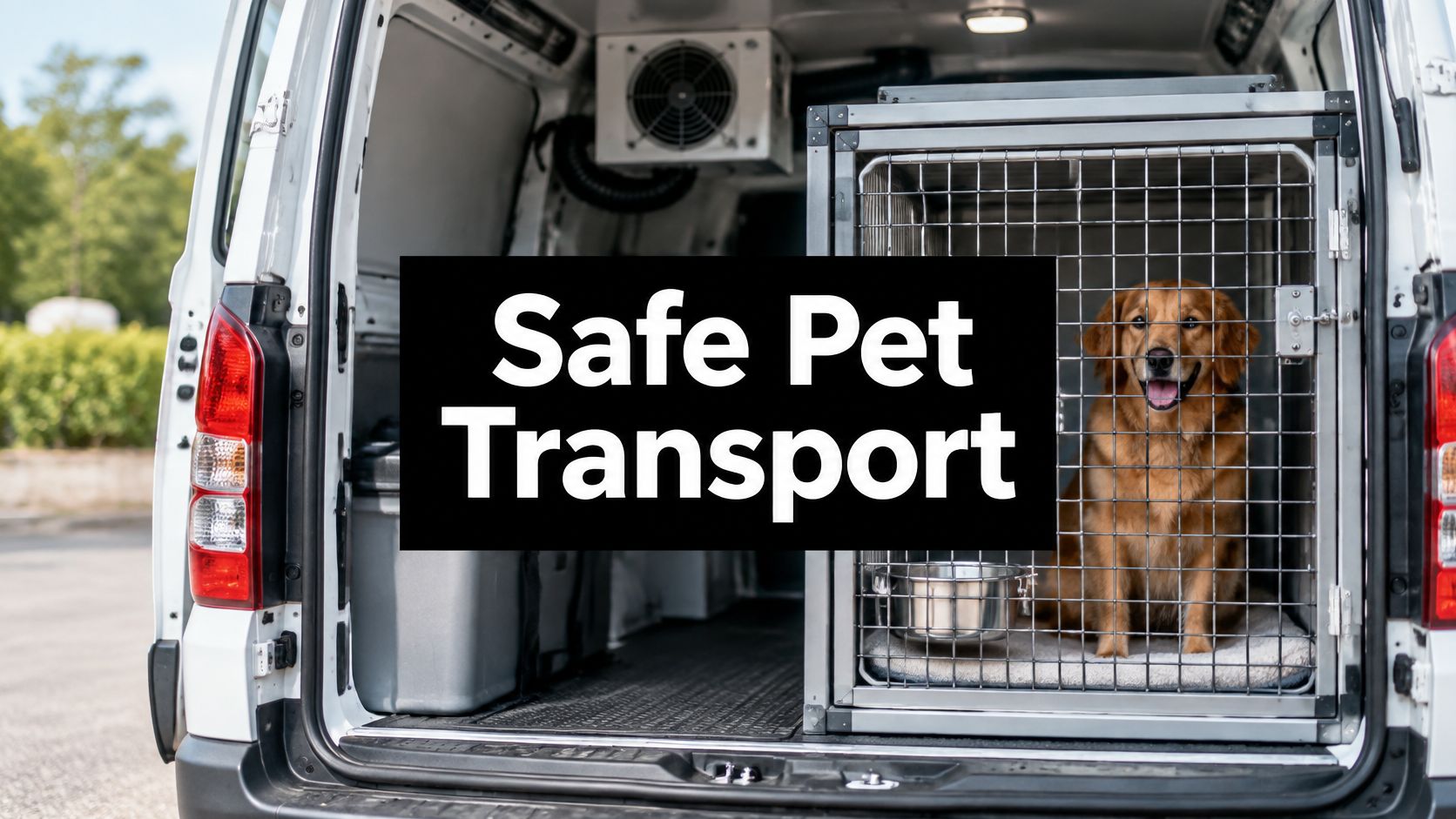
You're packing boxes, changing your address, and trying to answer a harder question. How does your dog or cat get to the new home safely when you can't sit beside them the whole way? A pet transport van sounds simple until you start comparing quotes and every company promises climate control, comfort, and loving care. Those words don't tell you where the temperature sensor sits, who stays with your pet overnight, or what happens if the air conditioning fails on a July highway.
Table of Contents
- What a Pet Transport Van Really Is
- Van, Owner-Driven Trip or Airline Choosing the Method
- Safety and Comfort Specs to Check in a Pet Transport Van
- Which Rules Apply to Your Move Under USDA and Custody Rules
- How a Door-to-Door Pet Move Works, Step by Step
- Verify Climate Claims and Ask These Questions Before Booking
What a Pet Transport Van Really Is
Picture a dog left in a parked car on a warm afternoon. The windows are cracked, the owner planned to be quick, and the inside still heats up faster than owners typically expect. That single image explains why this category exists. A professional van is built to prevent the parked car problem for hours or days at a time, not just to carry a crate from one address to another.
A pet transport van is a purpose built vehicle that carries dogs and cats in a controlled cargo area for ground relocation, often door to door. It's closer to a mobile nursery or a small recovery room on wheels than to a moving truck with dog seats added. The cargo space is engineered for breathing, steady temperature, calm, and separation from engine exhaust.

Three layers have to work together for that idea to hold up on a real route.
- The cargo environment: Clean air reaches every enclosure, temperature stays in a safe range, and exhaust stays outside the animal area.
- The enclosures and handling: Kennels fit each animal, they're secured so they can't slide, and density stays low enough to prevent fights and stress.
- The people: Trained drivers load carefully, check animals at stops, and stay with them overnight on multi day routes instead of leaving them unattended.
This isn't a matter of style or marketing. In the United States, commercial transport of dogs and cats is governed by the Animal Welfare Act and the USDA Animal Welfare Regulations for primary conveyances, which require the animal cargo space to protect health and well being, ensure safety and comfort, prevent engine exhaust from entering, and provide enough air for normal breathing. Those rules also set enclosure limits and a minimum age for commercial transport, which you'll see in the spec table below. When you compare providers, that table is the first thing to check, because it separates legal basics from nice sounding extras.
Van, Owner-Driven Trip or Airline Choosing the Method
You have three realistic ways to move a pet, and the right one depends on custody, distance, and your pet's health. A calm adult dog on a two hour drive is a different problem from a senior cat crossing several states in summer.
- Owner driven trip: You keep custody, control every stop, and usually pay the least. You also carry all the heat, fatigue, and route risk yourself, and the Animal Welfare Act doesn't regulate a trip where your pet stays in your custody.
- Pet transport van: A hired driver takes custody, animals ride in secured enclosures, and pickup and delivery can happen at your door. It suits fragile or senior pets, flat faced breeds that shouldn't fly, and households moving several animals at once. If you're weighing that option, a plain language overview of ground pet transport and how door to door routes work can help you map the basics.
- Airline cargo: Flying is fastest over long distances, but it requires an airline compliant hard sided kennel and handoffs at airports. The Animal Welfare Act was amended in 1976 to add safeguards for animals moved by air, and U.S. airlines reported 17 animal fatalities and 26 injuries in 2014, compared with 39 deaths in 2010, according to the history summarized in IATA's account of live animal transport standards. Risk has fallen, but it hasn't disappeared.
Choose for the pet you have, not the trip you wish you were taking.
Use a simple rule. Drive yourself for a calm pet on a short route you can finish without exhaustion. Choose a van for a multi day ground move, a fragile pet, or several animals traveling together. Choose airline cargo for a long route when your pet tolerates a crate well and your schedule is tight.
Safety and Comfort Specs to Check in a Pet Transport Van
A van can roll up with "climate controlled" printed on the door and still run a sensor at the driver's dashboard while your dog rides in a crate three feet lower, in air nobody is measuring. The label describes a feature. The numbers describe a system. Start with the legal minimums below, then ask how the provider proves each one on your specific route.
Pet Transport Van Safety and Comfort Minimums
| Feature | Minimum to look for | Why it matters |
|---|---|---|
| Cargo ventilation | Fans, blowers or air conditioning running when the animal area reaches 85°F (29.5°C), the trigger point set in the USDA surface transport guidance cited below | Open windows aren't a substitute during surface transport |
| Continuous air quality | Ventilation that minimizes exhaust fumes, ammonia, odors, drafts and condensation | Keeps the cargo area breathable for every animal |
| Exhaust separation | Air intake away from the exhaust, with no fumes entering the cargo area | Protects animals from exhaust exposure |
| Animals per enclosure | Maximum of four dogs or cats of comparable size, eight weeks or older, the grouping limit under Animal Welfare Act surface transport standards | Limits fights and injury in shared space |
| Kennel fit | Animal can stand, turn, sit and lie down without excess unused volume | Reduces sliding during sudden deceleration |
| Kennel securing | Kennels mechanically secured and separated so animals can't make direct contact | Prevents injury from braking, turning and contact |
| Sanitation | Nonporous, disinfectable kennel surfaces and leak resistant flooring | Reduces contamination and odor between animals |
| Minimum age | Eight weeks old and weaned, the regulatory floor for commercial transport | Younger animals can't regulate temperature or stress well enough for a shared van |
| Temperature limits and humidity | Written provider thresholds measured at animal level, with a log you can request | Ask for the actual numbers used on your route |
The USDA guidance on mobile housing and surface transport temperatures requires auxiliary ventilation such as fans, blowers or air conditioning once the animal cargo area reaches 85°F (29.5°C), supports keeping humidity between 30% and 70%, and treats exposure below 45°F or above 85°F for more than four consecutive hours as a welfare risk. Read those as outer guardrails, not comfort targets. A flat faced, senior, or medically fragile pet can struggle well inside them.
Legal Minimums and What Providers Add Beyond Them
Ventilation, exhaust separation, enclosure density and minimum age are legal floors for commercial movers. Every regulated operator meets them, so they tell you who is allowed to operate. They say nothing about who does the job well.
The daily routines are where providers separate themselves. Look for fresh water at every stop, dogs walked on a written schedule you approve, cats given regular litter box access, and feeding kept to the home routine your pet already knows. Ask whether drivers pass background checks and hold pet first aid training. Ask who disinfects kennels between animals.
Then test the climate claim itself. "Climate controlled" is a label. Measured safeguards are a system you can audit. Ask where the temperature sensor sits, because a reading taken near the cab tells you little about the air at crate level. Ask what triggers the alarm, who gets the alert, and what the backup plan is if the air conditioning fails mid route. A provider with real safeguards answers in specifics: sensor placement, set points, a secondary cooling plan, and a trip log you can request afterward.
Kennel choice matters too, especially if any leg of the move includes a flight. The Petmate Sky Kennel is a hard sided model that, when properly assembled with metal hardware and airline compliant accessories, is suitable for domestic and international air travel. For a van only move, the exact model matters less than the principles: sturdy walls, real ventilation, correct sizing, and a mechanical anchor so the kennel cannot slide when the van brakes or turns.
Which Rules Apply to Your Move Under USDA and Custody Rules
Custody sounds like legal jargon, but it works like a leash in the eyes of the law. Whoever is holding it when the van door closes decides which rulebook governs the trip.
USDA APHIS states that businesses taking custody of regulated animals and transporting them for hire fall under the Animal Welfare Act, as explained in the agency guidance on transporting animals in commerce and when AWA standards apply. A common mix-up shows why this matters. A family drives its own dog across three state lines and assumes it needs a USDA-registered carrier because the trip is interstate. No transport business ever took custody of that dog, so the Animal Welfare Act's carrier standards never enter the picture. What the family needs is the destination state's entry rules. The table below runs that same custody test for each common move type.
Which Rules Apply by Move Type
| Move type | Who holds custody | Animal Welfare Act applies? | Documents to confirm |
|---|---|---|---|
| Owner drives own pet between states | Owner | No, pets remain in owner custody | Destination state entry rules, health certificate only if that state requires one |
| Hired driver moves pet interstate while owner is absent | Transport business | Yes, business must meet AWA standards and be USDA registered | Carrier USDA registration, health certificate, transfer records |
| Van leg feeds an international flight or port | Transport business for the van leg | Yes for the hired leg | Destination country import rules, microchip and rabies records, country specific requirements checked in advance |
| Military or government transfer with pet | Owner or contracted carrier, depending on arrangement | Depends on who holds custody | Orders, carrier paperwork, base or agency requirements checked in advance |
| Breeder, rescue or shelter transporting animals for placement | Transport business | Yes when transport is commercial | Health records, registration and transfer documents, state specific rules checked in advance |
Registration establishes a federal baseline; it does not verify destination entry rules or route-specific logistics. It works like a driver's license. It proves the carrier may legally operate, and it proves nothing about who handles a missed connection or a veterinary hold, how records transfer between drivers, or what happens if your pet is judged medically unfit to travel. Trade memberships show professional participation. They answer none of those route questions either.
Ask every provider for its registration number and for written answers before you book. A helpful next read is the breakdown of USDA pet travel requirements and what to confirm for your route, especially if you're a military family, a corporate transferee, a breeder, or a rescue moving several animals. For those moves, a paperwork failure is far more likely to delay reunification than the drive itself.
How a Door-to-Door Pet Move Works, Step by Step
Max is a senior Labrador moving from Virginia to Colorado in July. His owner has stiff hips and knees, can't ride along for days in a car, and is watching the move from home with a phone that never leaves her hand. Max is friendly, arthritic, and not a good candidate for a rushed trip. His move shows why the sequence matters more than speed.

- Pre move health check: A veterinarian confirms Max is fit to travel and reviews his vaccination and microchip records. Senior pets, very young animals, and pets with heart or breathing conditions need this step most, because fitness to travel is a medical judgment, not a booking form checkbox.
- Document confirmation: Before anyone loads a kennel, the provider confirms what the origin, destination, and route require. Use the custody table in the previous section to decide which documents this specific route needs, rather than copying a generic checklist from a website.
- Pickup loading check: The driver confirms Max's kennel fits him, secures it mechanically, checks that vents aren't blocked, tests the door latch, and records an animal level temperature reading before departure. That reading goes on a log the owner can request.
- Transit with scheduled stops: The van stops for water, walks, and litter access for cats traveling on the same route. Each stop entry in the log shows the time, the temperature, and the water offered, so care is documented instead of assumed.
- Overnight care: On a multi day route, the driver stays with the animals and monitors them overnight. Max isn't left in an unattended vehicle while the driver checks into a hotel and hopes for the best.
- Arrival and handover: At the new address, the driver does a welfare check, hands over Max with his records, and notes any incidents from the route. His owner gets facts, not just a cheerful summary.
The loading check in step three reflects AVMA guidance on safe transport of pets in motor vehicles, which identifies a secured, species appropriate enclosure as the preferred method inside a vehicle. Unsecured animals can be injured by acceleration, braking, turning, or contact with other animals, which is why fit, securing, and clear service aisles are safety systems. They're not tidiness.
If Max showed signs of heat stress, the escalation path should already be written down. Pull over, cool the cargo area, and contact a veterinarian before continuing. On multi day routes, the stop schedule and that escalation plan matter more than top speed. A slower van with logged checks is safer than a fast van with good intentions.
Verify Climate Claims and Ask These Questions Before Booking
A van advertised as climate controlled can mean two very different things. In one vehicle, the phrase covers a dashboard thermometer and good intentions. In another, it covers sensors at kennel height, alarms with set thresholds, backup power, and a written plan for the day the air conditioning quits. The label reads the same on both websites, so the questions below are what separate them.

Sensor Placement Determines What Is Measured
A dashboard thermometer reads the driver's air. Your pet rides in a different space, where enclosure height and cargo loading create hot and cold zones at animal level. The cargo area works like a two story house: the hallway thermostat can read a comfortable temperature while an upstairs bedroom runs hot. Ask where readings are taken, and treat a single number from the front seat as a description of the front seat.
Monitoring and Alarms Turn a Reading Into a Safeguard
Ask how often temperature is logged and at what animal level reading an alert fires. A number nobody checks during loading, fuel stops, or traffic delays protects no one. Some operators send owners check ins during the route, so ask how those updates work alongside tools like real time pet tracking during a move. Location tracking shows where the van is. Temperature logging shows how the animals are doing inside it.
Backup Power Is Where Good Systems Prove Themselves
Ask what powers the cargo fans during idling, fuel stops, or a stalled engine, and what happens if the HVAC fails. Veterinary guidance on traveling by car with pets and the risks of parked vehicles warns that parked vehicles can become dangerous quickly in hot and cold conditions, and that young, old, ill, and thin animals are especially vulnerable. Frequent door openings, crates stacked against vents, and temperature differences between kennel positions are the quiet risks a marketing checklist misses.
A climate-controlled label is a claim; the sensor log and failure plan are the evidence.
Flat faced breeds, elderly pets, the very young, short coated animals, overweight pets, and cardiac or respiratory patients need tighter monitoring and a lower tolerance for delay than the general guardrails give them. If your pet fits any of those groups, say so early and ask how the plan changes.
Climate Questions to Ask Before You Book
- Sensor locations: Where are the temperature sensors, and do they read at kennel level in the rear of the cargo area?
- Alarm thresholds: At what reading does an alert fire, and who receives it?
- Log frequency: How often is temperature logged, and who checks it during loading, fuel stops, and traffic delays?
- Backup power: What runs the cargo fans during idling, a stalled engine, or an HVAC failure?
- Failure plan: If the air conditioning fails mid-route, what happens next, and who contacts the veterinarian?
Questions about enclosure sharing, sanitation, insurance, and paperwork belong to the spec table earlier in this article, so work through that checklist alongside these. Close by requesting a written thermal safety protocol covering sensor locations, log frequency, alarm thresholds, veterinary escalation, and breakdown procedure. Book only when every answer is specific enough that you could explain the plan back to a family member without guessing.
If you're planning a move and want those specific answers in writing, Precious Pets Transport Services, LLC offers door to door ground transport in climate controlled vans with sanitized kennels, scheduled walks and litter breaks, and drivers who stay with animals overnight. The team also coordinates international relocations and walks you through documents, timing, and care routines before pickup day arrives. Request an estimate and bring your climate questions to Precious Pets Transport Services, LLC.
Leave a Reply