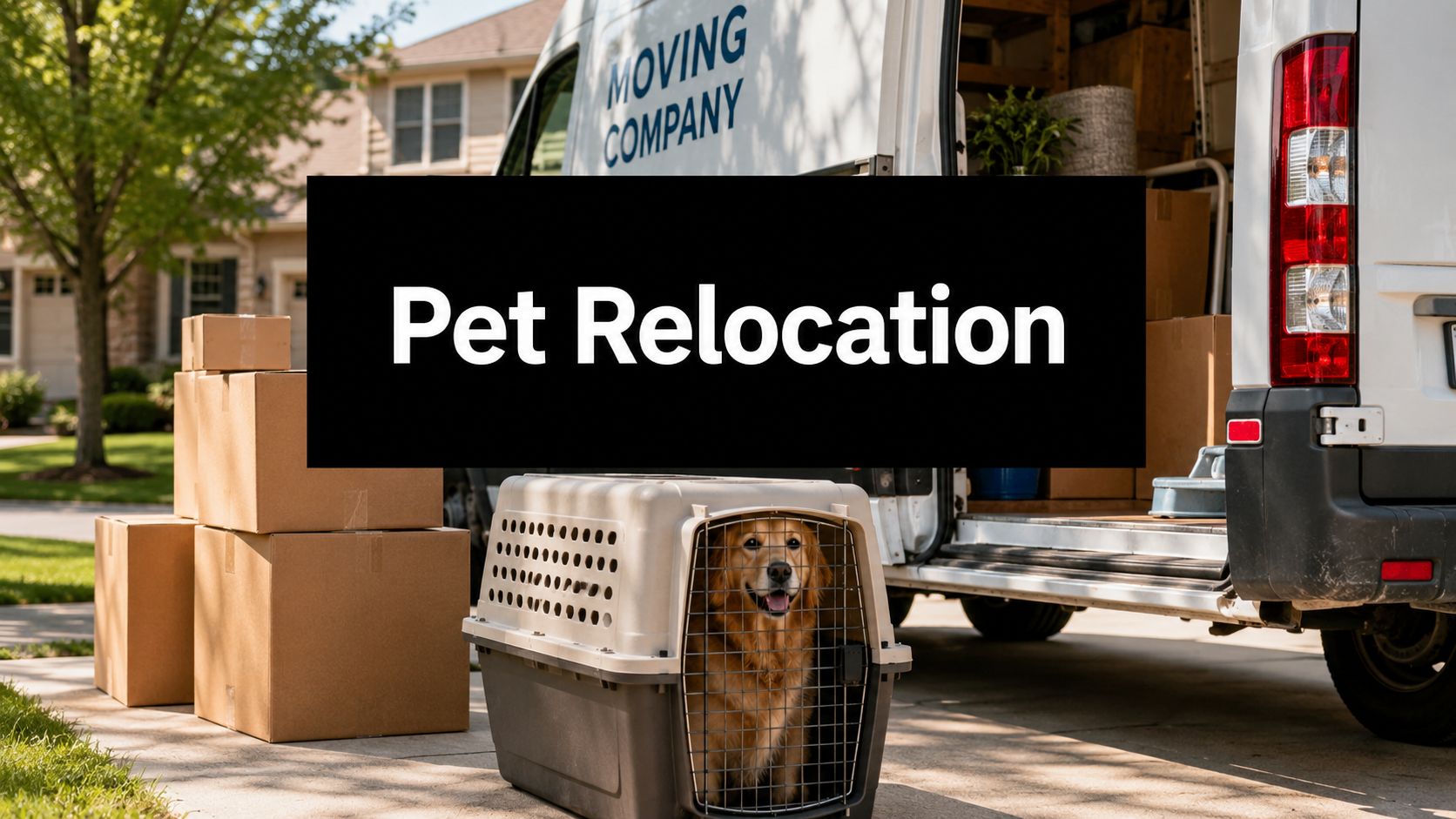
Moving day arrives with leashes tangled around appliance boxes, a cat carrier wedged behind the vacuum, and one uncomfortable realization: your pet's travel plan is still half-formed. You may know the destination and departure date, but safe pet relocation requires more than buying a ticket or filling out a form.
Treat the move like a military PCS logistics project. Someone must coordinate the route, veterinary preparation, documents, crate, weather, handoffs, customs, and arrival transport. This guide shows how to build that plan for domestic and international moves, then adapt it for military families, breeders, senior pets, expats, and busy owners.
Table of Contents
- What Pet Relocation Actually Means
- Ground Transport vs Air Travel
- Legal and Health Requirements You Must Meet
- Building Your Relocation Timeline
- What Really Drives the Cost
- How to Choose a Pet Transporter You Can Trust
- Special Considerations for Different Owners
- Relocation Checklist and Common Questions
What Pet Relocation Actually Means
Pet relocation is the coordinated movement of a live animal from one home to another. The work can include choosing ground or air transport, arranging veterinary care, preparing import documents, meeting airline requirements, planning quarantine or inspection, and organizing the final ride from an airport or border crossing to the new home.
That's why a pet move behaves more like a project than a reservation. A flight can be available, yet the move can still fail if the health certificate is mistimed, the crate is rejected, the route crosses a temperature restriction, or nobody is ready at arrival.
Three common relocation models
Self-relocation means you drive or fly with your pet. A small animal may travel in the cabin if the airline allows it and the carrier fits its requirements. A road trip gives you direct oversight, but you'll still need a safe restraint, suitable stops, records, and a realistic arrival plan.
Assisted domestic relocation may involve a professional ground transporter, pet-friendly lodging, several driving legs, and scheduled handoffs. This model can suit owners who are flying separately, moving across the country, or unable to manage a long drive.
International relocation often adds air cargo, import permits, destination-specific veterinary protocols, customs coordination, and possible quarantine or inspection. Requirements can differ by country, airline, route, and whether the owner travels with the animal.
IATA says millions of animals are carried safely and securely by air every year, while a widely cited industry milestone records 404,556 animals transported by airlines in 2019 (IATA guidance on clearer pet travel). The scale means established procedures exist, but it also means every handoff must be managed carefully.
For a practical household-move perspective, Get n Go Removals' guide for moving with pets is a useful companion resource. Use it alongside official destination and airline instructions, not as a substitute for them.
Project rule: A pet move is only as strong as its weakest handoff.
Ground Transport vs Air Travel
Ground and air transport solve different problems. They aren't just two prices for the same journey. Ground service offers continuity and frequent observation, while air transport can shorten a long-distance move but introduces airport handling, crate, weather, and routing dependencies.
| Factor | Ground Transport | Air Transport |
|---|---|---|
| Best fit | Domestic routes, multiple pets, large dogs, and pets restricted from airline travel | Long-distance or international moves, unaccompanied pets, and routes requiring customs handling |
| Supervision | A driver or attendant can remain closely involved throughout the journey | Care is divided among owner, airline staff, handlers, and receiving agents |
| Routing | Door-to-door or scheduled road legs | In-cabin, checked baggage, or manifested cargo |
| Weather exposure | Can be managed with climate-controlled vehicles and planned stops | Requires attention to airport conditions, airline restrictions, and transfer timing |
| Main trade-off | More travel time | Faster long-distance movement, with more formal procedures |
When ground transport makes sense
Ground service can be a practical choice for families with several pets, oversized dogs, or brachycephalic breeds that face airline restrictions. It also gives owners a continuous care plan, with scheduled feeding, exercise, updates, and direct delivery when the route supports it.
Ask how the transporter handles climate control, vehicle sanitation, overnight care, emergency veterinary access, and owner communication. A professional service should explain where the pet rests, how often care occurs, and what happens if road conditions disrupt the schedule.
Understanding the air lanes
Air travel usually falls into three broad arrangements:
- In-cabin travel: A small pet remains with the accompanying passenger in an airline-approved carrier, subject to the carrier's size, weight, and route rules.
- Checked baggage: A medium-sized pet travels on the same aircraft as a ticketed adult when the airline offers that service and accepts the animal.
- Manifested cargo: A large pet, an unaccompanied animal, or an international shipment may travel through the airline cargo system, often with customs and destination coordination.
Crate selection is part of the air decision. The Petmate Sky Kennel, when properly assembled with metal hardware and airline-compliant accessories, is suitable for domestic and international flights and is used by professional pet transporters.
Match the transport lane to your pet's size, health, breed, temperament, route, climate, and whether a trusted adult is traveling. Don't choose air just because it sounds faster, or ground just because it sounds simpler.
Legal and Health Requirements You Must Meet
Paperwork should be built as a layered compliance file, not gathered casually during packing. Each authority answers a different question: Is the pet medically fit to travel? Does the transport method comply? Will the destination admit the animal? Can the pet legally pass through or return?
Layer one covers veterinary readiness
Start with your veterinarian and confirm the destination's exact rules before scheduling the appointment. A domestic flight may require a current health certificate issued within 10 days, and vaccination records need to show the required immunizations, including rabies where applicable.
The destination may also require a microchip or tattoo check, a rabies antibody titer, parasite treatment, or a specific certificate format. The identification recorded by the veterinarian must match the identification on every other document.
Layer two covers federal and airline rules
For U.S. moves, USDA APHIS endorsement may be required for an interstate or international air shipment. In plain English, endorsement means a government review or validation of the veterinarian's paperwork. It doesn't replace the veterinary examination.
The crate must meet the relevant airline and IATA expectations. It should provide secure construction, ventilation, a functioning water container, and the required live-animal labels. IATA guidance calls for ventilation openings on all four sides, with at least 16% of the wall area ventilated (IATA pet travel requirements). The design should also preserve cross-ventilation when crates are positioned or stacked.

Layer three belongs to the destination
Import permits, quarantine arrangements, inspection procedures, parasite-treatment calendars, and breed restrictions can vary sharply. European requirements are also changing. Sources covering 2026 describe a new EU framework effective April 22, 2026, with phased certificate changes and stricter distinctions between non-commercial and commercial movement; UK-to-EU travel has also shifted toward an Animal Health Certificate rather than older pet-passport assumptions (2026 international pet travel rule changes).
Layer four covers transit and return
A connecting country may impose its own transit paperwork. Re-entry permits, transit visas, and return certificates belong in the file before departure.
“Manifested” means the pet is booked through the airline's cargo system rather than traveling as a passenger's cabin or baggage item. Before the crate closes, read every certificate for the pet's name, identification, dates, destination, and signature requirements. For a U.S.-focused reference, review the USDA pet travel requirements guide.
Building Your Relocation Timeline
Work backward from the arrival window, not forward from the day you feel ready. First confirm when the destination, airline, inspection office, or USDA process will allow the pet to arrive. Then schedule every dependency that must happen before that date.
A domestic flight often needs a substantial preparation runway, while an international move involving rabies testing or special certificates may need several months. Ground moves between nearby states can sometimes be arranged in a shorter window, but that doesn't remove the need to check health and transport rules.
Use a backward-counting schedule
| Time before departure | Main task |
|---|---|
| 12 weeks | Research route options and identify the earliest acceptable arrival window |
| 8 weeks | Schedule veterinary work and begin gathering export or import documents |
| 4 weeks | Confirm the transporter, continue crate acclimation, and review handoffs |
| 1 week | Recheck paperwork, prepare the travel kit, and confirm every appointment |
| Final days | Obtain time-sensitive certificates and verify the departure plan |

Protect the dependencies
A health certificate has a limited validity window. For domestic flights, the relevant window may be 10 days, and some EU entries use a shorter 7-day period. Rabies titer processing and destination waiting periods can also determine the entire schedule, so ask the veterinarian and destination authority which dates control your move.
Use the middle of the timeline for crate training, routine grooming, microchip verification, and document review. Your pet shouldn't encounter the crate for the first time on departure morning. The pet preparation checklist for travel can help turn those tasks into a repeatable routine.
Scheduling principle: Book the arrival process before you book the departure process. A pet can't complete a successful journey if nobody has planned the final inspection, pickup, or ride home.
What Really Drives the Cost
A relocation quote reflects a chain of decisions, not just mileage. The most useful way to evaluate it is to ask which variables change the work, the space required, the number of handlers, and the risk of disruption.
A 2026 industry data report places international relocation commonly at about $4,000 to $6,000 or more for one pet, $6,000 to $9,000 or more for multiple pets, and $10,000 or more for complex destinations, large breeds, or specialized routing (2026 international pet travel cost report). The same report gives an average of 1.43 pets per relocation across completed, quoted, and actively managed cases, which reinforces the need to request a multi-pet plan rather than multiplying a single-pet quote without asking questions.
Six variables change the quote
- Route: Distance, border crossings, airport selection, and destination handling all affect the plan.
- Pet dimensions: Air freight usually depends on the crate's external dimensions, not only the animal's body weight.
- Complexity: Layovers, weather restrictions, route changes, and special handling can add coordination.
- Documents: Veterinary certificates, government reviews, import permits, and customs work may carry separate fees.
- Crate: An owner-supplied compliant crate differs from a transporter-supplied or rented crate.
- Extra services: Door-to-door pickup, customs brokerage, quarantine coordination, boarding, and rebooking may be separate line items.
| Cost Driver | Domestic US | International |
|---|---|---|
| Main pricing influence | Distance, vehicle time, pet size, and delivery coverage | Airline routing, crate dimensions, documents, customs, and destination rules |
| Common complications | Multi-day driving, weather, boarding, and handoffs | Import permits, inspections, transit rules, quarantine, and rebooking |
| Quote questions | Is care door-to-door? What happens overnight? | Who handles customs? Which documents are included? |
| Potential additions | Crate rental, lodging, extended care, and route changes | Government fees, customs work, quarantine, boarding, and specialized routing |
A simple sanity check is base service fee plus distance factor plus complexity surcharge. Ask the provider to map every charge to one of those categories and identify conditions that could trigger a new fee, such as an overnight stay or a missed flight connection.
How to Choose a Pet Transporter You Can Trust
A careful owner should screen a transporter the way they'd screen anyone responsible for a family member's safety. Look for verifiable credentials, written scope, named contacts, and a clear response plan when weather, airline changes, or veterinary issues interrupt the itinerary.
Green flags and red flags
Green flags include USDA registration where applicable, IATA-trained staff, IPATA affiliation, a verifiable business address, itemized pricing, insurance documentation, and a single coordinator who can explain the move from intake through delivery. A transporter should also be willing to share its motor-carrier details when ground service applies, references for similar routes, and a written contract.
Red flags include cash-only deposits, no contract, vague promises that the company “handles everything,” pressure to ship immediately, reluctance to explain the airline or layovers, and a quote that omits customs, boarding, crate, or emergency procedures.

Verify before paying
Search the company's USDOT information through the Federal Motor Carrier Safety Administration when ground transport is involved. Check public business records and inspection information, request an insurance certificate, and ask for a video walkthrough of the kennel or vehicle facility if the provider operates from one.
Good removalist screening habits also apply to pet logistics. These reliable removalist selection tips can help you assess contracts, communication, and accountability across the wider household move.
Ask these questions before signing:
- Who is my named coordinator, and who will contact me during a disruption?
- Which services are included, and which events create additional charges?
- What is the emergency plan if the airline cancels, the vehicle breaks down, or my pet needs veterinary attention?
For a closer look at service structures, review this pet transport service overview. The right provider won't avoid difficult questions. They'll answer them before your pet travels.
Special Considerations for Different Owners
The animal's age, health, breed, legal status, and the owner's schedule should shape the route. A single generic checklist can miss the pressure points that matter most to different households.
| Owner Type | Top Priority | Common Pitfall |
|---|---|---|
| Military family | Align pet travel with official orders and the receiving duty station | Treating the household-goods move and pet itinerary as unrelated |
| Breeder | Coordinate age, identification, crate sizing, and registration records | Assuming a litter can follow the same plan as one adult animal |
| Senior-pet owner | Obtain veterinary clearance and reduce transfers and waiting | Choosing a route based only on price or speed |
| International family or expat | Confirm current embassy, consulate, airline, and destination rules | Relying on an old pet passport or generic online checklist |
Military families
Anchor the pet plan to the official reporting window and the family's broader move schedule. Ask the destination installation or relevant authority which veterinary endorsements, quarantine arrangements, carrier rules, and arrival services apply. Keep copies of orders and pet documents in separate digital and paper files.
Breeders and responsible organizations
Breeders, rescues, and shelters need an individual record for every animal. Confirm vaccination eligibility, identification, ownership or registration paperwork, and crate sizing before booking. A young animal may not meet the same health or documentation conditions as an adult, so never assume a group shipment is administratively identical.
Senior pets
Older pets deserve a pre-travel veterinary conversation focused on health status, mobility, anxiety, hydration, and medication timing. Sedation decisions must come from the veterinarian and comply with airline policy. Direct routing and climate-controlled ground service may reduce handling and waiting for suitable domestic moves, but the medical profile should drive the choice.
Expats and international families
Use the destination embassy, consulate, veterinary authority, and airline as the controlling sources. Confirm the microchip standard, import permit, certificate timing, parasite treatment, quarantine, and distinction between traveling with your pet and shipping the pet without you. Rules can change, so check them again close to departure rather than trusting an old guide.
Relocation Checklist and Common Questions
Keep this short list accessible during the final week:
- Confirm destination rules: Verify import, transit, inspection, quarantine, and return requirements.
- Schedule veterinary care: Ask which examination, vaccination, testing, and certificate dates apply.
- Complete government review: Obtain USDA endorsement or other required validation.
- Prepare the crate: Check fit, ventilation, fasteners, labels, water access, and acclimation.
- Confirm transport: Recheck the route, handoffs, contact numbers, and disruption plan.
- Pack the travel kit: Include water, records, food instructions, medication guidance, waste supplies, and a familiar item.

Are sedatives safe? Airline protocols generally discourage sedatives because they can affect an animal's ability to respond to travel conditions. Discuss any medication with your veterinarian before departure.
Can a pet fly in the cabin? Small pets may be allowed in the cabin if they meet the airline's carrier and route requirements. Approval isn't automatic, so confirm directly with the airline.
What happens if a flight is canceled? Your transporter should explain its rerouting, communication, care, and refund procedures before booking. Never assume every provider handles disruptions the same way.
What should happen on arrival? A named person should collect the pet, complete any inspection or customs step, and provide a direct, calm transfer to the new home.
Precious Pets Transport Services, LLC provides door-to-door domestic ground transportation and coordinates international pet relocation for families moving from Virginia, Washington, D.C., Maryland, and nearby states. If you want help organizing the route, care plan, documents, and handoffs, visit Precious Pets Transport Services, LLC to request an estimate and start a clear relocation plan.
Leave a Reply