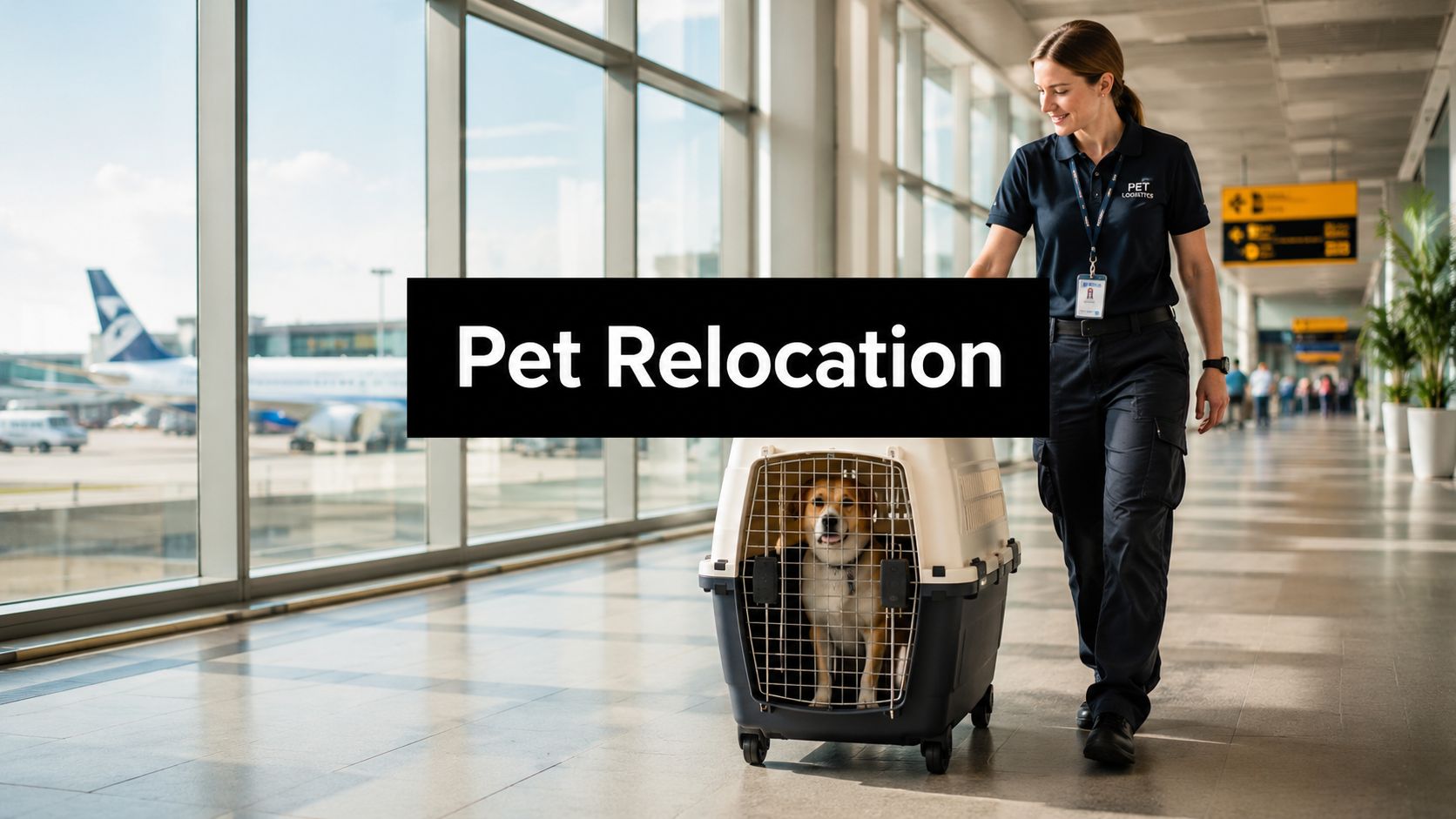
You've accepted a job in Germany, found a new home, and started sorting passports, school records, and furniture. Then someone asks when your two cats and medium-sized dog will arrive. A quick search suggests that you can book a flight, buy a crate, and bring them along. That plan leaves out the veterinary timing, destination rules, airline acceptance, temperature limits, customs handoffs, and ground transport that determine whether the move works.
Pet relocation companies manage those moving parts as one coordinated operation. They don't place an animal on a plane. They build a route around welfare requirements, documentation deadlines, crate specifications, airline policies, and the handoff at the destination. This guide follows that work from the first estimate through delivery, then helps you decide when professional coordination is worth paying for.
Table of Contents
- Why Pet Relocation Is Harder Than It Looks
- What Pet Relocation Companies Actually Do
- The Rules That Shape Every Move
- Services, Certifications, and What Drives the Price
- The Estimate to Delivery Timeline
- When a Pro Is Worth It and When You Can DIY
- How to Vet a Pet Relocation Company
- Matching the Right Service to Your Situation
Why Pet Relocation Is Harder Than It Looks
Take the family moving from Virginia to Germany with two cats and a medium-sized dog. The first conversation with a relocation coordinator may sound simple: where the pets live, where they're going, how many animals are traveling, and when the family expects to leave. The answers determine almost everything that follows.
The coordinator must identify the entry requirements for Germany, check whether each animal's microchip can be read under the destination's rules, and confirm the correct rabies sequence. The family's veterinarian needs to examine each pet and prepare the appropriate international health certificate. For a U.S. departure, the certificate generally goes through endorsement by a local USDA office after completion by a USDA-accredited veterinarian, so the timing has to match the departure window rather than the family's preferred appointment date. The coordinator may also need to arrange an import permit, rabies titer testing, or other destination-specific documents.
The transport plan is a separate puzzle. Each cat needs a correctly sized kennel, and the dog needs one that allows appropriate positioning and ventilation under the IATA Live Animals Regulations. The airline must accept the animals and the proposed routing. Ground transport may be required from the Virginia home to the departure airport, then from the arrival airport to the German address. With three pets, the company also has to consider whether they should travel together, how their temperaments affect kennel placement, and how feeding and arrival arrangements will be sequenced.

The work behind the booking
A relocation provider typically coordinates:
- Initial assessment: The company gathers origin, destination, species, breed, size, health, and schedule information.
- Documentation: Staff track veterinary examinations, vaccination records, microchip details, laboratory results, certificates, permits, and endorsements.
- Logistics: The provider selects transport legs, checks airline rules, sizes or sources kennels, and plans pickup and delivery.
- Travel execution: Drivers, airport handlers, and destination agents manage each handoff and communicate status to the owner.
That's why professional pet relocation is better understood as a regulated coordination business than as a courier service. IATA first released its Live Animals Regulations in 1969, working with international and national organizations and animal-welfare and transport experts. IATA also established its Live Animals and Perishables Board in 1969, creating an early formal structure for standardized live-animal air transport. The history is documented in IATA's account of live-animal transport standards.
Owners preparing for travel may also review separate protection options. For example, Spot Pet Insurance provides customizable accident and illness coverage for dogs and cats, with flexible reimbursement options, multi-pet discounts, and access to any licensed veterinarian.
What Pet Relocation Companies Actually Do
A pet relocation company acts like a project manager for an animal's journey. You provide the household details and the desired destination. The company turns that information into a sequence of veterinary, regulatory, transport, and delivery decisions, then keeps those decisions aligned as the departure date approaches.
For a domestic move, that may mean door-to-door ground transport in a climate-controlled vehicle, planned rest stops, feeding according to the pet's normal schedule, and direct communication during the trip. Some providers focus on regional or long-distance routes and may be the right fit when a pet shouldn't fly or when a family wants to avoid airport handling.
Air transport adds another layer. The company must match the pet to an airline's live-animal policy, confirm kennel dimensions, review routing and connection requirements, and coordinate airport drop-off and pickup. A flight booking by itself doesn't guarantee that the airline will accept the animal on the selected date, in the selected kennel, or under the expected weather conditions.
Full international coordination includes the regulatory work around the flight. The provider may organize veterinary appointments, country-specific forms, government endorsement, customs documentation, destination agents, and quarantine arrangements when the destination requires them. The best providers explain which tasks they perform directly and which depend on your veterinarian, airline, government office, or customs representative.
Domestic, air, and international services compared
| Service Type | Typical Scope | Paperwork Involved | Best For |
|---|---|---|---|
| Domestic ground transport | Home pickup, scheduled road travel, rest and care, destination delivery | Transport agreement, veterinary records when needed, identification details | Families moving within the United States, pets that should avoid flying, breeders, rescues, and shelters |
| Air transport | Airline booking, kennel preparation, airport coordination, arrival pickup | Airline forms, veterinary records, health documentation required by the carrier or route | Long-distance domestic travel and pets traveling by air |
| Full international coordination | Veterinary planning, flight or ground legs, government documents, customs and final delivery | Health certificates, endorsements, import permits or destination forms, customs paperwork, quarantine documents when applicable | Cross-border moves, military transfers, corporate relocations, and multi-pet households |
The provider's value isn't limited to carrying the animal. It's the management of handoffs, deadlines, and exceptions. If a flight changes, a certificate needs correction, or one pet's medical preparation takes longer than another's, a coordinator can adjust the plan before the problem reaches the airport.
The Rules That Shape Every Move
An international move can look simple until one date shifts. A rabies record, health certificate, government endorsement, airline booking, and departure date must fit together like connected gears. The destination sets the requirements, not the owner's preferred schedule. USDA guidance covers pet-travel rules for more than 130 countries, and almost all require an international health certificate from a USDA-accredited veterinarian within a limited period before departure. The completed certificate typically also needs endorsement by a local USDA office. The USDA guidance on navigating pet travel with APHIS explains why these steps require coordination.
Timing creates the first major constraint. A certificate issued too early may expire before travel, while a late veterinary appointment can leave too little time for government endorsement. A relocation company should place the veterinary visit, laboratory work, form completion, endorsement, airline booking, and departure on one working calendar. Owners can review USDA health certificate requirements for dogs for a plain-language explanation of the certificate process.
Microchips and rabies records must match
Many destinations and carriers require an ISO 11784/11785 microchip before rabies vaccination. The order matters. Authorities may treat the vaccination as invalid for entry if the required chip was not implanted and recorded first. U.S. State Department guidance notes that European Union transponders may not read non-ISO chips, creating a border problem if officials cannot identify the animal. The U.S. State Department guidance on pets and international travel explains this compatibility issue.
Before the rabies appointment, the veterinarian should scan the chip, record its number exactly, and confirm that the destination accepts its standard. A pet with a non-ISO chip may need an additional compatible chip or another approved identification arrangement. Resolving that question before vaccination and paperwork prevents an identification mismatch at the border.
Airline rules include care and weather
Air travel also imposes operational limits. Dogs and cats must be at least eight weeks old and weaned for at least five days. Older animals must receive food at least every 24 hours and water at least every 12 hours. Those requirements affect crate labels, feeding instructions, layover planning, and the information given to airline staff.
Weather can stop an otherwise compliant itinerary. U.S. animal transport rules require dogs and cats to remain between 45°F and 85°F, or 7.2°C to 29.5°C, for no more than four consecutive hours in holding or cargo areas. The limit falls to 45 minutes when animals move to or from aircraft or terminals, according to APHIS care and handling guidance for air travel.
Practical rule: A workable route must satisfy the pet's needs, document deadlines, airline procedures, weather limits, and every handoff at the same time.
Services, Certifications, and What Drives the Price
Relocation companies usually offer several service levels. A ground provider may handle home pickup and delivery, vehicle care, feeding, walks, litter access, and updates. An air-focused provider may arrange the airline segment, kennel, airport handoff, and destination pickup. A full-service international coordinator may add veterinary scheduling, import documentation, government endorsement, customs clearance, and quarantine planning.
Ask for a written scope before comparing prices. A base fee may cover planning and one transport leg, while kennel purchase, veterinary appointments, government fees, customs services, extra airport handling, overnight care, or destination delivery may be separate. A low initial estimate can become difficult to compare if one company includes door-to-door service and another quotes only the airline arrangement.
Credentials should connect to actual safeguards
Credentials matter when they explain who is accountable and what procedures the company follows. Depending on the service, ask whether the provider holds required USDA licensing, belongs to IPATA, carries documented insurance, uses background-checked drivers, and trains staff in pet first aid. Membership or licensing alone doesn't tell you everything, but a credible company should explain how those standards affect daily operations.
Look for written policies covering:
- Temperature decisions: When the provider delays, reroutes, or changes transport because of heat or cold.
- Animal care: How staff handle feeding, water, walks, litter access, rest, and overnight supervision.
- Kennel standards: How the company measures each pet and confirms proper ventilation, security, and room to stand, turn, and lie down.
- Contingencies: What happens after a cancellation, missed connection, document error, vehicle issue, or customs delay.
- Insurance and responsibility: Which company, carrier, or subcontractor is responsible during each handoff.
Price reflects coordination load
Pet relocation commonly ranges from hundreds to several thousand dollars, depending on distance, species, pet size, transport mode, route, documentation, kennel needs, timing, and the number of handoffs. This is a qualitative range, not a universal quote. A complex international move may cost more because it requires more coordination, not because the destination is farther away.
The fairest estimate separates transport, paperwork, care, government charges, and contingency handling instead of hiding them in one unexplained total.

The Estimate to Delivery Timeline
A pet move can look simple on a calendar: collect the animal, put it on a flight, and deliver it. The estimate reveals why that picture is incomplete. A serious provider starts with the origin, destination, species, breed, number of pets, approximate size and weight, health considerations, preferred dates, and requested service, whether ground, air, or door to door. For multiple animals, each pet needs a separate profile. One animal's vaccination status, temperament, or kennel requirement can alter the shared schedule.
The written plan should function like a dispatch sheet. It should identify the transport method, proposed route, included services, outstanding documents, responsibilities for the owner and veterinarian, and conditions that could change the quote. If no one can explain who handles airport delivery, endorsement, customs, or the final trip to the door, the plan is not ready to operate.
Preparation happens in parallel
After booking, veterinary work and paperwork move on separate tracks. Depending on the destination, the owner may arrange a microchip check, rabies vaccination, blood testing, parasite treatment, or final examination. A practical reference for the medical side is this guide to vet prep for international pet travel. The coordinator then fits those appointments into the airline, government, and delivery timetable.
Kennel preparation also starts early. The company can explain the required dimensions and fittings, but the owner must help the pet enter, rest, and eat inside the kennel before departure. Familiarity reduces one avoidable source of stress. Introducing the kennel on travel day leaves no time to correct a poor fit or an anxious response.

Travel day is a controlled handoff
On departure day, the provider checks the pet, kennel, documents, feeding instructions, route, and weather. Air moves require an airport handoff and monitoring for schedule changes. Ground moves require the driver to follow the agreed care plan and send updates under the company's policy. The owner should know what to bring, where the handoff occurs, and how progress reports will arrive.
Weather can change the plan, not merely make it inconvenient. Airline handling rules may limit when pets can remain in holding or cargo areas, and restrictions on heat or cold can require a different date, route, or booking. A provider that treats temperature as a scheduling detail has missed a welfare condition that can affect the entire move.
International delivery may add customs inspection, document review, veterinary checks, and quarantine when required. The provider then completes final delivery or coordinates a destination agent. Domestic moves use the same basic handoff sequence without the international endorsement and customs stages. For a longer domestic route, owners can review this guide to long-distance pet transport.
Start planning weeks before a domestic move and often months before an international move. Lead time varies by route and requirements, but early coordination leaves room to correct a chip record, repeat a test, adjust a kennel, or secure a workable flight.
When a Pro Is Worth It and When You Can DIY
“Just book a flight” works only when the owner can safely manage every requirement around that flight. A healthy, well-traveled dog making a straightforward domestic move may be a reasonable DIY project if the owner has time to compare airline rules, arrange care, prepare the kennel, and handle disruptions. A short ground move may also be manageable when the owner can drive and the pet's needs are uncomplicated.
The decision changes when the route crosses a border, involves several pets, or depends on strict timing. An international move may involve a microchip and rabies sequence, a health certificate, USDA endorsement, destination forms, possible laboratory work, airline acceptance, customs, and arrival transport. If one pet needs additional veterinary preparation while another is ready, the owner must coordinate separate timelines without allowing either record to undermine the group's travel plan.
Count the risks outside the airline quote
DIY planning can conceal costs that don't appear in the first transport price:
- Missed deadlines: A document may be completed outside the destination's acceptance window.
- Denied boarding: An unreadable chip, incorrect kennel, incomplete form, or airline restriction can stop the trip at the airport.
- Weather disruption: A heat or cold restriction may require a new route, date, or booking.
- Arrival problems: Incorrect documents can lead to inspection delays, extra arrangements, or quarantine risk.
- Owner bandwidth: The family may be managing housing, employment, school, and personal travel at the same time.
The market's service growth reflects how much work now surrounds transport. Current estimates place the global pet travel services market at USD 2.42 billion in 2026, projected to reach USD 4.35 billion by 2033, with an 8.7 percent CAGR and North America holding a projected 38.8 percent share, according to Coherent Market Insights' pet travel services market estimate. The same service layer now includes digital booking, documentation support, tracking, insurance options, and health or biosecurity requirements.
Professional coordination isn't automatically necessary. It becomes persuasive when the cost of a mistake, delay, missed departure, or animal-welfare compromise is greater than the provider's fee. You're paying for transport, but also for someone to identify and manage failure points before they become expensive.
How to Vet a Pet Relocation Company
Start with accountability, not polished language. Ask whether the company is the actual transport operator or a broker, who handles each segment, and which parts are subcontracted. Request written evidence of required licensing, relevant IPATA membership, insurance coverage, driver screening, pet first-aid training, and policies for feeding, temperature, overnight care, and cancellations.
A provider should answer these questions directly:
- Who physically transports my pet on each leg?
- Which tasks are included in the estimate, and which are add-ons?
- How do you select and verify kennel size?
- What happens if weather makes the planned route unsafe?
- What happens if the airline cancels or changes the flight?
- Who manages veterinary documents and USDA endorsement when required?
- How do you handle customs, inspection, or quarantine at arrival?
- How are feeding, water, walks, and litter access recorded?
- Will a driver or handler remain with the pets during overnight stops?
- How do you coordinate households with multiple pets and different needs?
The last question deserves special attention. Recent market data reports an average of 1.43 pets per relocation, alongside more than 15,000 cat travel requests and more than 30,000 dog requests, as reported by CapRelo's pet relocation industry discussion. Those figures support a practical conclusion: providers should explain staggered feeding, kennel sizing, temperament separation, and arrival sequencing rather than treating a household as one interchangeable shipment.
A quick comparison method
Create a short sheet for two or three finalists and mark whether each provider offers:
- Verified credentials: Licensing or membership information you can confirm.
- Clear responsibility: Named operators for pickup, transport, airport handling, customs, and delivery.
- Written welfare procedures: Temperature, food, water, rest, litter, and overnight policies.
- A disruption plan: Specific responses to cancellations, delays, weather, and document problems.
- Multi-pet planning: Separate instructions and schedules for every animal.
For additional context on what to ask a provider, review this guide to pet transport services. The strongest answer isn't necessarily the longest. It's the one that identifies the risk, names the responsible person, and explains the backup plan.
Matching the Right Service to Your Situation
Military and government families need providers comfortable with fixed transfer dates, several pets, and country-specific entry rules. Busy professionals and senior owners often benefit from door-to-door coordination that removes unnecessary handoffs. Breeders, rescues, and shelters may need scheduled multi-animal ground transport, sanitized kennels, and a clear plan for separating pets by temperament and care needs.
Families leaving Virginia, Washington, D.C., Maryland, or nearby states for international destinations should look for a provider that understands USDA endorsement timing and the route's documentation pathway. For any move, ask one practical question: would the company's fee be smaller than the cost of getting the move wrong? Request a written estimate, compare the included services, and don't book until you understand who is responsible at every handoff.
Precious Pets Transport Services, LLC provides door-to-door domestic ground transportation and coordinates international pet relocations, with climate-controlled vehicles, sanitized kennels, vetted drivers, and communication throughout the journey. Visit Precious Pets Transport Services, LLC to request an estimate and discuss the transport plan for your pets.
Leave a Reply