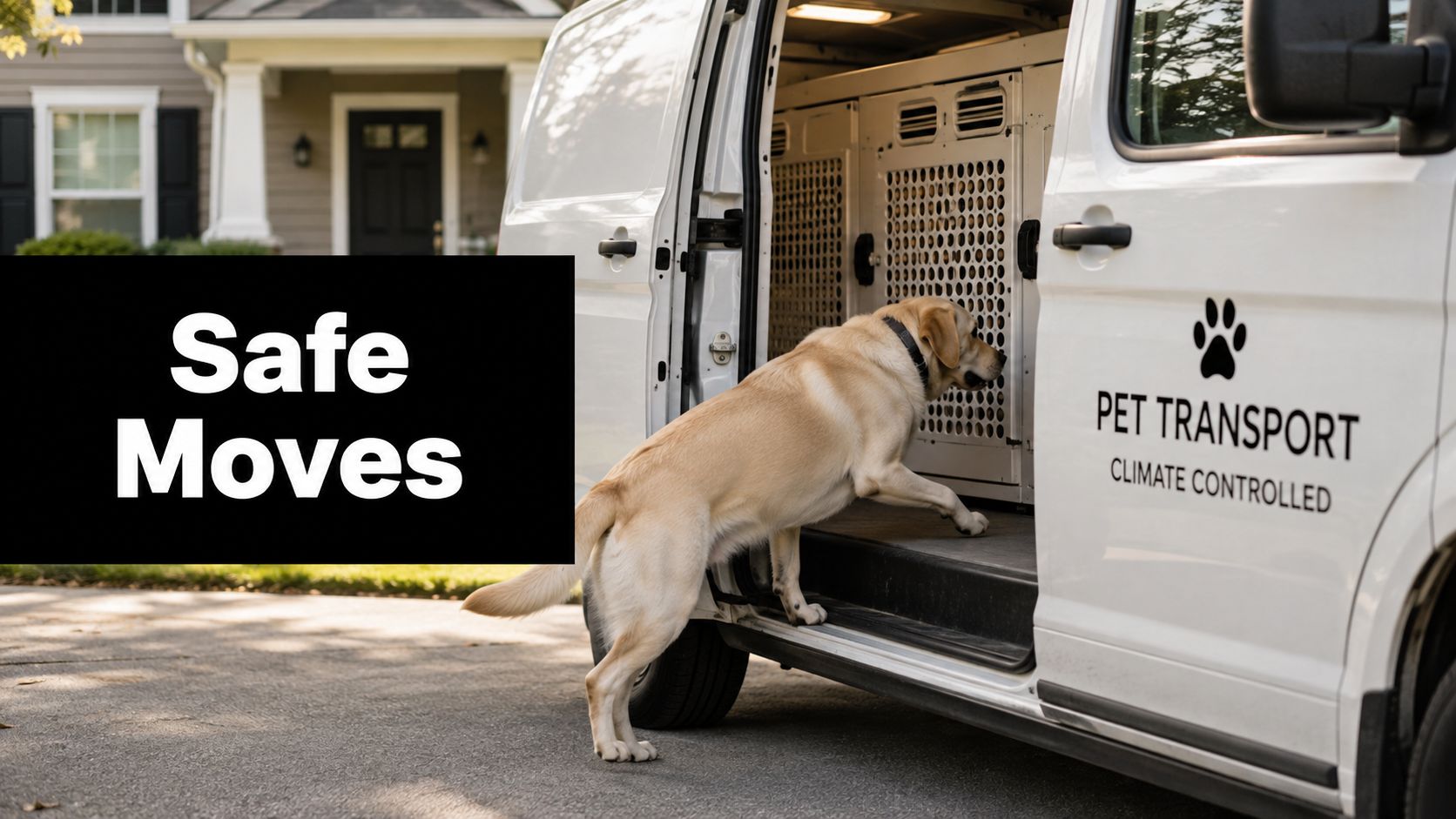
You're standing beside a climate-controlled van, holding your dog's leash while a handler checks the kennel, confirms the destination address, and asks which bowl your pet prefers. Your move is already stressful, and the last thing you need is uncertainty about who will provide water, who'll handle an overnight stop, or whether the paperwork is complete.
A transport pet service should give you more than a vehicle and a pickup time. It should coordinate the journey from your home to the new address, with clear responsibility for handling, welfare, documentation, communication, and delivery. That matters for domestic relocations, international moves, military transfers, rescues, breeders, and any family that can't safely or conveniently manage the trip alone.
Table of Contents
- What a Transport Pet Service Does
- Ground and Air Transport Options Compared
- Safety Standards and Licensing Explained
- Domestic and International Move Timelines
- What Drives the Cost of Pet Transport
- Vetting Questions to Ask Any Provider
- Health Prep and Kennel Packing Checklist
- How Precious Pets Transport Services Fits In
What a Transport Pet Service Does
A Labrador steps cautiously into a climate-controlled van. The handler offers water in a familiar blue bowl, waits for the dog to settle, and then secures the kennel. The family knows who collected the pet, where the vehicle is headed, and how updates will arrive.

A professional transport pet service coordinates a ground or air move from pickup to final delivery. The work can include route planning, travel schedules, veterinary documents, handlers, condition monitoring, and delivery to a named address. Door-to-door ground transport also requires attention to overnight care, climate thresholds, hydration cycles, and what happens when a delay changes the plan.
The people behind the journey
A reliable operation assigns clear responsibilities instead of treating the trip as an informal handoff.
- Route planner: Builds the itinerary around distance, road conditions, airline restrictions, rest periods, border requirements, and the pet's needs.
- Primary handler: Receives the animal, manages daily care, and remains accountable for the main leg.
- Backup handler: Provides continuity if illness, vehicle trouble, or an unexpected delay affects the original plan.
- Dispatcher: Coordinates updates, emergency decisions, and communication among the family, drivers, veterinarians, and destination contacts.
Handlers should also record feeding, water offers, medication details when applicable, rest periods, and the pet's condition. Ask how the provider responds if temperatures fall outside its operating range, a vehicle must stop overnight, or a handoff becomes necessary.
This service supports military families on permanent-change-of-station orders, relocating professionals, breeders moving show animals, rescues sending pets to foster networks, and seasonal travelers who move between homes. It can also help senior pet parents and families whose pets would struggle with a complicated airport itinerary.
What the service includes
With door-to-door ground transport, the provider manages pickup, vehicle travel, rest stops, care during the route, and delivery. Airline cargo covers the flight, while owners may still need to arrange airport transfers, crate rules, cargo acceptance, destination collection, and documentation. Those separate tasks can create unexpected costs, especially when veterinary examinations or corrections to paperwork become necessary.
A useful comparison is arranging separate movers versus hiring one relocation coordinator. If veterinary appointments are part of the preparation, resources for appointment scheduling for pet clinics can help keep health checks aligned with the transport date. The provider should state what is included, what is billed separately, and who pays when the itinerary changes.
Ground and Air Transport Options Compared
Choose the service tier by considering distance, travel time, pet temperament, owner availability, and the number of handoffs. A short ground trip may need little infrastructure. A cross-country move requires a more deliberate care plan.
For a same-state journey under 300 miles, a direct van run is often the simplest choice. A senior cat moving from Boston to Washington, D.C., may do better in a quiet vehicle with familiar bedding than through separate home, airport, cargo, and destination transfers. The provider can collect the cat at the old residence and deliver it to the new one.
Regional multi-state trips, extending up to 1,500 miles, need more planning. Consider two medium-sized dogs traveling from Texas to Montana. A professional service may schedule a hotel overnight, maintain the dogs' normal feeding pattern, and use a handler who understands how to manage exercise and rest outside the vehicle.
Long-haul ground transport can require overnight handler handoffs, especially when the route crosses several regions. Ask how the provider protects continuity. A handoff should include written instructions, medication details if applicable, feeding information, contact numbers, and a direct record of the pet's condition.
| Service Type | Distance | Best For | Owner Effort |
|---|---|---|---|
| Local ground van | Same-state, short route | Senior cats, anxious dogs, direct household moves | Low |
| Regional ground transport | Multi-state route | Families moving with one or more pets | Low to moderate |
| Long-haul ground transport | Cross-country journey | Owners avoiding airports and complex transfers | Low, but planning is important |
| Private air charter | Time-sensitive or specialized move | Pets needing a tailored flight arrangement | Moderate, depending on coordination |
| Commercial airline cargo | Long domestic or international routes | Pets traveling without the owner | Moderate to high |
| In-cabin travel | Owner flies with a smaller pet accepted by the airline | Owners who want to remain with the animal | High, because the owner manages the itinerary |
A large mixed-breed dog moving from Hawaii to California may require air travel because ground transport can't connect the islands. In that situation, airline rules, crate specifications, temperature controls, and airport handling become central. A practical overview such as the Glo More Grooming pet air guide can help owners understand the air-travel side before comparing providers.
Owners preparing for domestic or international travel may also consider Spot Pet Insurance, which provides customizable accident and illness coverage for dogs and cats, with flexible reimbursement options, multi-pet discounts, and access to any licensed veterinarian.
Safety Standards and Licensing Explained
Safety standards become easier to understand when you connect each rule to a real decision in the vehicle, kennel, or airport. USDA and APHIS requirements address commercial animal transport and welfare. IATA Live Animals Regulations guide air-travel equipment and handling. IPATA membership reflects participation in a professional network that coordinates pet shippers across borders.

Translate the welfare rules into operations
USDA/APHIS guidance requires potable water at least every 12 hours, food at least every 24 hours for dogs and cats aged 16 weeks and older, and observation at least every four hours when the cargo area is accessible. If transit exceeds 24 hours, kennels must be cleaned. The guidance also prohibits exposure above 85°F, or 29.5°C, and below 45°F, or 7.2°C, for more than four hours. These requirements are summarized in the official animal welfare in transport guidance.
The AVMA guidance referenced in that material adds a relative humidity range of 30% to 70%, the same four-hour upper and lower temperature limits, and an overnight rest stop with exercise and elimination outside the vehicle for trips longer than 14 hours. These aren't abstract compliance details. They affect departure times, route selection, vehicle monitoring, rest-stop planning, and whether a provider should delay travel during severe weather.
Practical rule: A climate-controlled van is only one part of thermal safety. The schedule, ventilation, humidity, monitoring, and rest stops matter just as much.
Kennels and professional accountability
Transport enclosures should let an animal stand and turn around without giving it enough excess space to be thrown against the walls. They should be secure, smooth-sided, cleanable, disinfectable, and ventilated without creating dampness or harmful drafts. U.S. air-transport standards generally limit shared housing, with no more than one dog or cat aged six months or older in a kennel, while up to two small puppies or kittens of comparable size may share.
Ask a provider to show you the equipment before booking. You can also ask for the company's USDA registration or certificate information, whether its equipment follows applicable IATA requirements, and whether it participates in IPATA. IPATA reports that its membership grew from six U.S. pet shippers to more than 485 members in over 90 countries, with services reaching all major airports worldwide. It also states that more than four million pets and live animals travel by air each year, context that explains why formal coordination and consistent handling practices developed across the industry. IPATA's organizational history and membership information provides that background.
Domestic and International Move Timelines
A domestic move is manageable when you work backward from departure. International travel adds destination rules, government endorsements, laboratory timing, and customs coordination, so a late start can create delays that no driver can solve.
A domestic planning calendar
Eight weeks before departure: Gather veterinary records and contact providers for quotes. Confirm the pet's age, size, temperament, destination, pickup address, and preferred travel dates. Ask what documents the carrier needs and whether the route includes an overnight stop.
Six weeks before departure: Select and fit the kennel. Your pet should be able to stand, turn, and rest naturally. Begin short, positive kennel sessions at home, using familiar bedding and treats rather than introducing the crate on departure day.
Four weeks before departure: Schedule the veterinary appointment and ask which health certificate rules apply. Some certificates have narrow validity windows, so the correct appointment date depends on the travel method and destination.
Two weeks before departure: Finalize the pickup window, destination contact, feeding instructions, medication directions, emergency contacts, and communication plan. Confirm whether the provider will collect the pet at the residence or require terminal delivery.
During travel week: Confirm the microchip information, identification tags, feeding routine, water instructions, kennel label, and driver contact. Give the provider a recent photograph and retain copies of all documents.
Extra checkpoints for international travel
International preparation can involve a microchip, rabies vaccination timing, a serologic titer test, parasite treatment, an import permit, a USDA-endorsed health certificate, and certified translations. Requirements vary by destination, and some countries impose waiting windows after a blood test or vaccination. Confirm the rules with the destination authority and your veterinarian before paying for a nonrefundable itinerary.
A road journey can compress travel into hours of driving, but that doesn't eliminate border requirements. Ground flexibility may help with pickup timing, yet a missing endorsement or permit can still stop the move at the border. For a practical planning reference, review this guide to long-distance pet transport.
Recent EU guidance also emphasizes that non-commercial pet movement remains controlled, that pets travel under the owner's direct responsibility, and that non-commercial moves are limited to five animals in one vehicle. The IATA pet travel guidance is useful for understanding how airline and destination requirements can overlap.
What Drives the Cost of Pet Transport
A quote reflects much more than mileage. Two families moving dogs of similar size can receive very different prices because one requests direct door-to-door service while the other accepts terminal delivery, flexible dates, and a shared route.
The main cost drivers include:
- Distance: Longer routes require more driving time, fuel, vehicle use, and staff scheduling.
- Pet size and crate weight: Larger animals need more vehicle or cargo space, and heavier crates affect handling.
- Number of pets: Multiple pets may reduce the per-animal share of a route, depending on the provider's policy.
- Service type: Ground, airline cargo, in-cabin travel, and private charter involve different staff, equipment, and booking costs.
- Delivery model: Door-to-door service usually involves more coordination than terminal-to-terminal collection.
- Overnight care: Hotel, boarding, exercise, feeding, and additional handler time add to a long-haul itinerary.
- Climate planning: A provider may need a different route or schedule to avoid unsafe heat or cold.
- Documentation: USDA endorsements, international health certificates, permits, translations, customs, and laboratory requirements can create separate charges.
- Urgency: Express arrangements may carry fuel, staffing, or scheduling surcharges.
| Cost Driver | Impact on Quote | Typical Range |
|---|---|---|
| Regional ground move | Shorter route with fewer care and staffing demands | Under $500 |
| Coast-to-coast ground move | Extended driving, rest planning, and possible overnight care | $800 to $2,000 |
| International door-to-door move | Air or ground coordination, documentation, customs, and destination requirements | Often starts at $3,000 |
| Government endorsement | Destination-dependent paperwork and processing | USDA base fee of $101, with some cases reaching $173 or more |
| Medical or laboratory documentation | Veterinary appointments, testing, and destination rules | Varies by pet and destination |
The ranges above are planning examples, not guaranteed quotes. Regional and coast-to-coast figures are described in the provided industry guidance, while the USDA endorsement amounts come from a 2025 industry update summarized in the verified data. That update reported a base endorsement fee of $101, with some destinations reaching $173 or more when laboratory testing is involved. Requirements can change, so confirm the current charge before budgeting.
You can control some variables. Flexible departure dates may make route planning easier. Preparing records early can reduce rush work. Comparing door-to-door and terminal options can show whether the convenience matches your budget. Don't choose the lowest number until you know what care, monitoring, overnight service, and documentation are included.
Vetting Questions to Ask Any Provider
Treat the provider interview like a safety audit. Ask the same questions to every company, record the answers, and compare written contracts rather than relying on a friendly phone call.
Credentials and insurance
Start with documentation that the company should be willing to share before you book:
- USDA APHIS registration: Ask for the registration or certificate number and confirm what type of transport activity it covers.
- IATA equipment and procedures: Ask whether the crates, labels, ventilation arrangements, and airline process follow applicable Live Animals Regulations.
- IPATA participation: Ask whether the company is a member and which partners handle international legs.
- Commercial insurance: Request proof of liability coverage and ask whether the policy covers animals while they're in transit, during overnight care, and during handoffs.
The goal isn't to collect logos. It's to connect each credential to an actual safeguard. A registration number supports accountability. Appropriate equipment helps prevent injury. Insurance clarifies what happens if a serious incident occurs.
Operations and communication
Ask how many pets each driver handles, how long the vehicle travels before a rest period, and which temperature or weather conditions trigger a delayed departure. Find out whether the company has emergency veterinary contacts along the route and who makes medical decisions if you can't be reached immediately.
Then clarify the communication plan. Ask how often updates arrive, whether the provider sends pickup and delivery confirmations, what the cancellation and refund terms say, and how delays affect the quoted price. Put every answer in writing.
A provider that won't share registration information before booking isn't giving you enough information to make an informed decision.
For another checklist focused on service coordination, review this guide to pet transportation services. Use it to organize questions before requesting estimates, not after you've already paid a deposit.
Health Prep and Kennel Packing Checklist
Health preparation and kennel packing belong in the same plan. The veterinarian confirms whether your pet is fit to travel, while the kennel and supplies help the animal remain stable during the journey.
Start with the veterinary window
Ask the destination authority, airline, and provider which vaccinations, parasite treatments, certificates, and tests apply. Domestic and international rules can differ, and some destinations require repeated testing or specific timing. Don't assume a current rabies certificate automatically satisfies every entry condition.
Build a folder with:
- Veterinary records: Include vaccination history, prescriptions, allergies, and relevant medical notes.
- Identification details: Confirm the microchip number, collar tag, emergency contact, and destination address.
- Travel documents: Keep originals and copies of the health certificate, permits, itinerary, and provider agreement.
- Care instructions: Write down feeding amounts, timing, medication directions, fears, triggers, and calming routines.
Make the kennel familiar
Choose a kennel with enough room for your pet to stand and turn, but don't wait until travel day to introduce it. Leave the door open at home, place familiar bedding inside, and reward calm behavior. Practice short periods of enclosure time before extending the sessions.
Check the fasteners, ventilation, absorbent material, water arrangement, and label. A provider may have specific crate requirements, especially for airline travel, so ask before purchasing equipment. This guide to international pet travel kennel requirements can help you create questions for the transporter and veterinarian.
Pack for the actual handoff
On departure day, prepare food according to the provider's instructions rather than making a sudden change. Include approved comfort items, a spare leash, a recent photograph, printed itinerary, emergency contact card, medication if prescribed, waste bags, and a cleanup kit for the kennel.
Label every item with the pet's name and your contact details. Keep one small owner bag separate from the kennel so the driver can access documents and instructions without disturbing the animal.
How Precious Pets Transport Services Fits In
The standards above become useful only when a provider turns them into repeatable actions. A company that advertises climate control should also explain how it monitors conditions, what happens during extreme weather, and how it changes a route when the planned schedule could expose animals to unsafe temperatures.
Precious Pets Transport Services, LLC presents its operation around USDA licensing and insurance, door-to-door ground transportation, climate-controlled vans, sanitized kennels, and bottled water. Its stated care model includes walking dogs at least four times daily, giving cats regular litter box access, and feeding pets according to their normal home schedules. Those practices address the practical parts of a long ground move, not only the booking stage.
What a booking can look like
A typical inquiry starts with the pet's size, age, temperament, health needs, pickup location, destination, preferred dates, and travel constraints. The provider can then discuss the route, likely care schedule, documentation, vehicle arrangements, and delivery process before issuing an estimate.
On pickup day, the handler confirms the pet's identity and supplies, reviews instructions, and records the destination contact. During transit, the owner should receive the updates promised in the agreement. At delivery, the receiving person checks the pet, supplies, and documents before the handoff is closed.
The company states that its professional drivers undergo background checks, receive pet first-aid training, and remain with animals overnight. It also states that it has been an IPATA member since 2013 and coordinates international moves from Virginia, Washington, D.C., Maryland, and nearby states. Those details matter because overnight responsibility and international coordination are separate operational capabilities, not automatic features of every ground carrier.
Where the model fits
Door-to-door ground transport can suit regional relocations, senior pets, anxious animals, families without airline flexibility, military households, and owners who want one coordinator instead of separate cargo agents, couriers, and customs contacts. It may not suit every route or every deadline. Island moves, highly urgent international itineraries, airline-mandated travel, or pets requiring specialized medical transport may need a different combination of veterinary and air services.
Before booking, ask the company to confirm that it can handle your specific route, dates, documents, pet profile, and overnight requirements. A clear answer is more useful than a broad promise.
Precious Pets Transport Services, LLC offers USDA-licensed and insured domestic and international pet relocation, including door-to-door ground transport with climate-controlled vehicles, overnight care, and coordinated travel support. If your move involves a senior pet, a long-distance route, or complicated handoffs, visit Precious Pets Transport Services, LLC to request details for your journey.
Leave a Reply