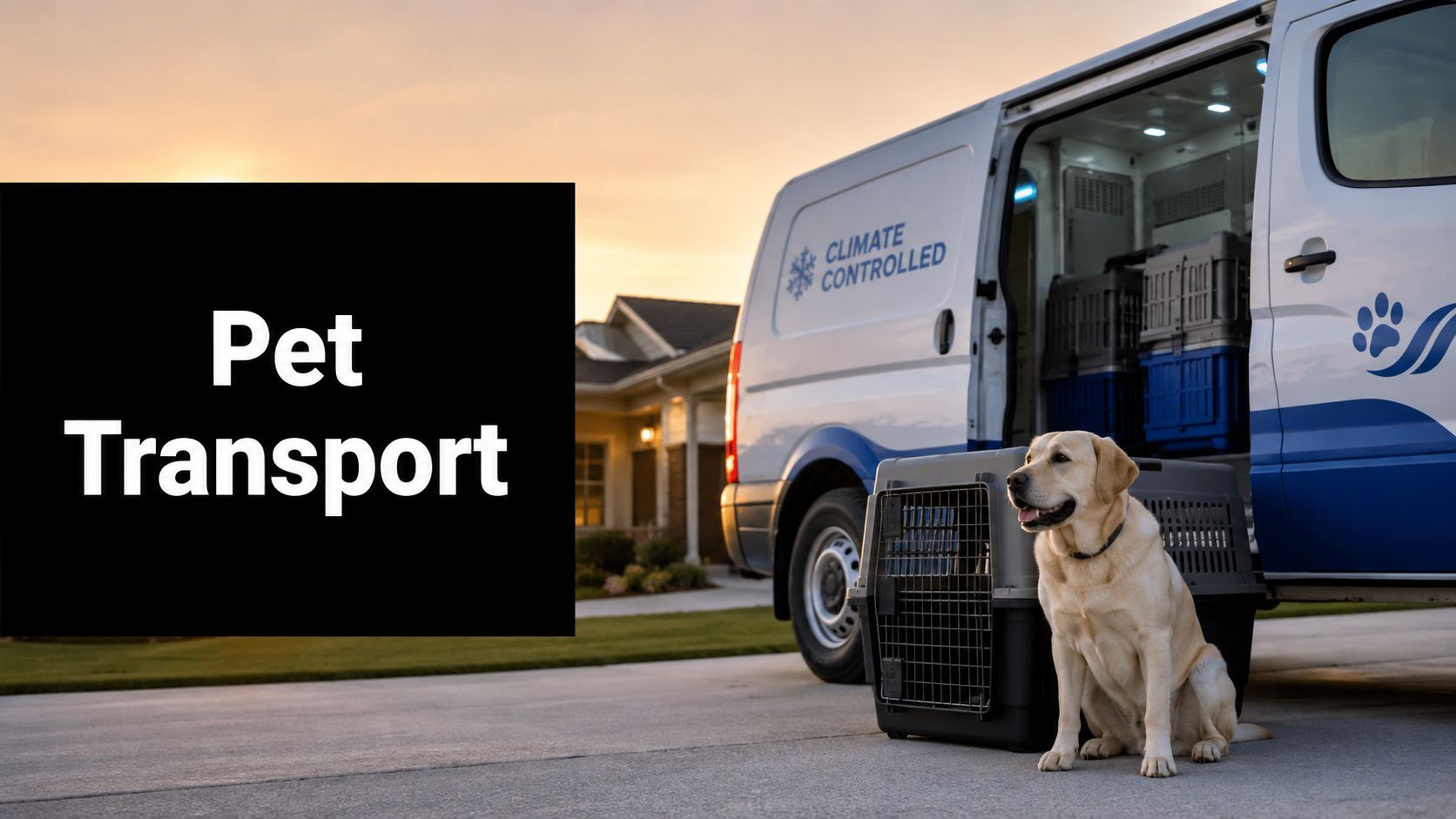
You've accepted the new job, booked the movers, and discovered the family sedan can't realistically carry a nervous Labrador, two cats, their crates, luggage, and everything else needed for a cross-country move. Or perhaps your orders send you overseas, and the airline checklist is only the first problem. The harder question is what happens between the front door and your pet's new home.
A professional pet transport service manages that gap. It coordinates documents, veterinary requirements, crates, drivers, airline handlers, overnight care, tracking, and delivery. The reliable providers can explain every handoff. The risky ones offer vague promises and ask you to trust a process they won't describe.
Table of Contents
- What a Pet Transport Service Does for You
- Vetting a Pet Transport Service the Right Way
- Paperwork, Vaccinations, and Health Certificates
- Crate, Comfort, and Day-Before Preparation
- Handoff, Transit, and Tracking Your Pet
- Costs, Insurance, and Military Reimbursement
- Special Situations and Your Final Checklist
What a Pet Transport Service Does for You
A pet taxi handles a local ride. An airline cargo booking reserves space, but can leave you responsible for veterinary paperwork, crate compliance, terminal handoff, and arrival coordination. A full-service pet transport service manages the connected journey from your home to the destination, with clear responsibility at each stage.
For a Labrador moving from Texas to Washington, the plan may include an intake call, route assessment, veterinary document review, crate selection, door pickup, climate-controlled ground transport, scheduled water and rest stops, overnight care, GPS updates, and delivery to the new house. If air travel is required, the provider may arrange cargo acceptance, labeling, health documents, and the handlers assigned to each airport leg.

Service levels are not interchangeable
A trustworthy provider should identify exactly what it owns:
- Ground relocation: A trained driver collects the pet, maintains the vehicle environment, provides planned care, and records every transfer.
- Air coordination: An air specialist checks the route, airline acceptance rules, crate requirements, and document package. IATA identifies its Live Animals Regulations as the worldwide standard for live-animal transport by commercial airlines (IATA Live Animals Regulations).
- International relocation: The coordinator connects your veterinarian, USDA endorsement process, airline, customs representative, and destination handlers.
- Door-to-door care: One company remains accountable for the full chain rather than leaving you to resolve gaps between separate vendors.
Private air travel can be another option. Owners may review resources such as fly with pets via Haute Jets when considering cabin arrangements, while still confirming destination rules and veterinary documents.
Practical rule: If a provider cannot draw your pet's journey as named handoffs, it has not shown you an operating plan.
Before booking, ask whether the company uses an IPATA-listed ground partner, who controls the airline leg, where the animal stays overnight, and who contacts you if weather or an airline decision changes the itinerary. Military families, senior-pet owners, and multi-pet households should demand this same chain-of-custody detail. You are paying for accountability, not just mileage.
Vetting a Pet Transport Service the Right Way
A polished website proves very little. Before you pay a deposit, require named people, supporting documents, and written answers about every handoff. The provider should explain what happens from pickup to delivery, not only describe its mileage or airline experience.
Questions to send before booking
Who is legally responsible for each leg? Request the company's legal name, applicable USDA credentials for air work, and its DOT number for ground operations. If subcontractors are involved, get each company's name and assigned role.
What insurance is active? Ask for proof of commercial liability and transit mortality coverage. Have the provider state exclusions for illness, pre-existing conditions, delays, and airline refusal.
Who physically handles my pet? Get the driver's name, experience, contact method, and confirmation of whether one attendant stays involved from pickup through delivery.
Where does my pet stay overnight? The answer should identify a vetted private home, licensed kennel, or documented facility. “The driver will figure it out” is a reason to walk away.
Which airlines, handlers, and ground partners do you use? Specific names let you check the chain of custody instead of accepting a broad claim about airline experience.
How do you handle my animal's needs? The provider should ask about species, breed, age, medical conditions, feeding routine, crate size, and route risks. Dog experience does not qualify a company to transport reptiles, birds, rabbits, or other exotic pets.
What communication will I receive? Ask for GPS access when available, stop photos, a defined text or call window, and a written emergency protocol. For air shipments, the provider should identify the 24-hour emergency contact, explain who answers, and state what happens after a delay or route change, consistent with the IATA Live Animals Regulations.

Red flags that should end the conversation
Reject a provider that refuses a written estimate, avoids insurance questions, will not identify subcontractors, or pressures you to skip a veterinary examination. Reject vague guarantees too. A promised arrival time means little unless the company explains how it handles airline decisions, weather, customs, and route changes.
Verify claimed IPATA membership in the organization's directory rather than trusting a copied logo. Membership can help screen providers, but it does not replace references, insurance verification, and route-specific questions.
Request references from recent moves involving a similar pet, distance, and transport mode. This matters for military families with fixed reporting dates, senior pets needing closer monitoring, and multi-pet households requiring coordinated handoffs. A company experienced with dogs across one state may still be unprepared for a senior cat, brachycephalic breed, exotic animal, or international customs transfer. The February 2025 DoD policy changes what eligible military families may recover, not what a provider can safely promise. Get the chain, responsibility, and exclusions in writing before booking.
Paperwork, Vaccinations, and Health Certificates
A healthy pet can still miss its departure because one form is wrong, unsigned, or outside its validity window. Start by classifying the move correctly. Domestic and international transport follow different rules, and a reliable provider should explain which authority controls each document.
In the United States, APHIS doesn't regulate interstate movement when owners move their own pets. The receiving state or territory sets domestic entry requirements. APHIS regulates international pet travel and publishes guidance for dogs, cats, ferrets, rabbits, rodents, hedgehogs and tenrecs, reptiles, amphibians, and some birds (USDA APHIS state-to-state guidance).
A domestic ground relocation may depend on the destination state's rules and the carrier's policies. An international journey can require an accredited veterinarian, destination-country forms, USDA endorsement, airline documentation, and customs coordination through the Veterinary Export Health Certification System. Ask the provider who checks each requirement and who owns the deadline. Vague answers are a warning.
Build the document file before the itinerary
Keep one digital folder and one printed packet. Include vaccination records, rabies documentation, microchip information where required, medical records, ownership details, emergency contacts, feeding or medication instructions, and the provider's itinerary. Give the transporter copies before pickup, while keeping the originals accessible.
Your veterinarian should confirm which vaccines and tests the destination requires. A routine medical record may not satisfy an airline or foreign authority. Country and territory rules can add forms, timing windows, tests, import permits, or quarantine conditions.
For a practical explanation of the federal certificate process, review this guide to a USDA health certificate for dogs. Then confirm current destination instructions with APHIS and your accredited veterinarian. Airlines and countries may impose requirements beyond baseline industry rules, so the transporter must verify the actual route rather than hand you a generic checklist.
| Document | Domestic Ground | Domestic Air | International |
|---|---|---|---|
| Vaccination and rabies records | Often required by the destination state or provider | Commonly required by the airline and destination | Required according to destination-country rules |
| Veterinary health certificate | May be required by state, carrier, or contract | Commonly required for airline acceptance | Usually required, with timing and endorsement rules set by authorities |
| USDA endorsement | Generally not applicable to ordinary interstate movement | Depends on route and airline | May be required for export documentation |
| Microchip and import paperwork | Destination-specific | Airline and destination-specific | Frequently destination-specific |
| Emergency and feeding instructions | Should travel with the pet | Should accompany the shipment | Essential for handlers and connecting facilities |
Treat every deadline as operational. A missing signature or expired document can stop a shipment even when the animal is healthy. Ask for a written document checklist, the person responsible for each submission, and confirmation that the file is complete before handoff.
Crate, Comfort, and Day-Before Preparation
The crate is part of the transport system, not a piece of luggage. Your pet must be able to stand, turn, sit, and lie down without crowding, while the crate must meet the airline's construction and ventilation rules for that route.
For air cargo, rigid plastic is the normal starting point. For ground transport, a heavy-duty wire or fiberglass enclosure may work when it's stable, secure, and appropriate for the vehicle. IATA specifies technical requirements including ventilated area of at least 16% of the total surface of the four sides, minimum welded wire mesh thickness of 2.5 mm for dogs and 2.0 mm for cats, live-animal labeling, and sufficient water provision (IATA Live Animals program).
Prepare the crate before travel day
Start acclimation well before pickup, ideally over one to four weeks. Feed occasional meals near or inside the open crate, then gradually close the door for calm periods. A pet seeing the crate for the first time on departure morning is being asked to manage confinement and relocation stress at the same time.
The Petmate Sky Kennel is one option used for airline travel. When properly assembled with metal hardware and airline-compliant accessories, it's suitable for domestic and international flights, and its durable, well-ventilated design is used by professional pet transporters.

Use a familiar towel or unwashed shirt, a quiet non-squeak toy, and an absorbent puppy pad secured to the floor. Follow the transporter's feeding instructions, but a light meal several hours before pickup and water closer to departure are commonly planned around the animal's normal routine. Don't place a loose bowl, food, or unsafe object in the crate unless the airline or provider specifically directs you.
Sedation deserves a firm warning. IATA discourages sedatives and tranquilizers because of adverse-effect risks during transport (IATA Live Animals Regulations). Ask your veterinarian about anxiety management instead of medicating on your own. For additional crate specifications, consult this guide to international pet travel kennel requirements.
Before pickup, attach current identification details to the collar, place medical records in a plastic sleeve, and secure the sleeve to the crate top. A home air-quality resource such as a pet air purifier for homes may support comfort before departure, but it doesn't replace ventilation, veterinary guidance, or a compliant crate.
Handoff, Transit, and Tracking Your Pet
A well-run ground move starts before the van leaves. For a large dog traveling a long interstate route, the driver should confirm identity, inspect the crate, record its condition, and explain the first planned stop. The owner should know who has custody, where the vehicle is headed, and how updates will arrive.
At pickup, I'd expect a microchip or document check, a photograph of the crate and seals where used, and a written handoff record. The driver should note medication instructions, feeding preferences, mobility concerns, and the pet's condition before departure. That record protects the animal and gives the receiving team a baseline.
A day on the road
The vehicle should be climate-controlled and arranged so crates remain stable, ventilated, and protected from shifting luggage. A sensible schedule includes a morning loading check, a water and potty break, a shaded rest period, and a documented leg change if another vetted driver takes over.
Overnight care matters more than glossy branding. Your provider should identify whether the pet stays with the driver, in a licensed kennel, or in another pre-vetted setting. Pets should not be left unattended in a parked vehicle or treated as cargo between route segments.
Ask for the custody log. It should show who received the pet, when care occurred, where the pet stayed, and who accepted delivery.
GPS access can be useful, but tracking isn't the same as supervision. Ask whether updates include stop photographs, written care notes, and a defined daily contact window. A provider should also tell you what happens when a route changes, a vehicle has a mechanical problem, or a pet needs veterinary attention.
Air transport has a different chain. The owner or coordinator usually delivers the animal to a freight terminal before departure, and the airline controls the airport handoffs. Reconnection at arrival depends on the booked service and local handling arrangements, so get the receiving procedure in writing.
At delivery, inspect your pet before signing. Offer water promptly, keep the first evening quiet, and allow a decompression period before bathing, strenuous exercise, or introducing a crowded schedule.
Costs, Insurance, and Military Reimbursement
A quote should explain its assumptions instead of leading with one attractive number. Distance, route complexity, pet size, transport mode, seasonal constraints, overnight care, customs work, and document coordination can all change the final price.
Compare quotes by the work they cover. A low estimate may leave out pickup and delivery, crate handling, veterinary coordination, airline terminal fees, overnight boarding, customs brokerage, emergency changes, taxes, or third-party charges. Ask the provider to list every included service and every pass-through cost.
Compare the quote by what it includes
| Transport Mode | Domestic Range | International Range | What Is Included |
|---|---|---|---|
| Ground-only relocation | Varies by distance, route, pet size, and care requirements | Not usually the primary international option | Driver, vehicle, scheduled care, and delivery |
| Air cargo | Varies by airline, crate, route, and handling | Varies by destination, airline, documents, and customs | Airline movement, terminal handling, and required paperwork |
| Door-to-door coordination | Higher when it includes multiple providers | Highest when export and arrival services are included | Pickup, document management, transport legs, and final delivery |
For a closer look at comparing cross-country estimates, use this guide to how much it costs to ship pets across the country. Normalize the inclusions before deciding that one quote is cheaper.
Insurance requires the same discipline. Carrier liability may be limited, and supplemental policies can exclude illness, age, breed, pre-existing conditions, or unattended animals. Ask whether coverage pays veterinary expenses, mortality, delay-related costs, or only damage caused by the carrier. Get exclusions and claim requirements in writing.
What the February 2025 DoD policy changes
The February 2025 DoD policy allows reimbursement for certain pet transportation costs, capped at $550 for a CONUS PCS move and $2,000 for an OCONUS PCS move for one cat or dog (DoD pet transportation reimbursement announcement). The reimbursement is not an automatic provider discount, and qualifying expenses depend on the applicable rules.
Military families should confirm eligibility with their transportation office, obtain required approvals, use a documented provider, and keep itemized receipts. Ask the provider to separate transport, crate, veterinary, boarding, and administrative charges so the claim is easy to review. Do not assume routine veterinary care, grooming, or an avoidable boarding delay qualifies for reimbursement.
Special Situations and Your Final Checklist
Standard advice fails when the animal, route, or funding rules change. Military families should choose a provider familiar with CONUS and OCONUS moves, confirm which receipts and approvals support the DoD claim, and ask the transportation office about required timelines before booking a nonrefundable itinerary.
Senior pets need a veterinary conversation focused on mobility, heart and respiratory health, anxiety, hydration, and recovery. A provider should be willing to adjust the route, add monitoring, and use climate-controlled ground transport when air travel creates unnecessary risk. Don't accept “all pets travel the same way” as an answer.
Multi-pet families should compare a shared ground route with separate air arrangements. Combining pets only makes sense when each animal has an appropriate crate, the vehicle can safely accommodate them, and the provider can maintain individual feeding, medication, and emergency records.
Choose the route around the animal
Ground-only relocation can be the more practical choice for cats, brachycephalic breeds, and anxious dogs when an airline won't accept the animal or the handling environment is unsuitable. Route length matters, but so do heat exposure, transfers, overnight arrangements, and the pet's ability to tolerate confinement.
Use this final checklist before authorizing pickup:
- Veterinary review: Confirm fitness for travel and destination requirements.
- Vaccinations: Gather current records and rabies documentation.
- Export approval: Secure USDA endorsement when the international route requires it.
- Crate preparation: Measure, assemble, label, and complete acclimation.
- Identification: Update tags, microchip records, and destination contact details.
- Emergency contacts: List your veterinarian, provider, destination caregiver, and alternate decision-maker.
- Written itinerary: Share dates, handoffs, care instructions, and delivery details with family or a trusted sitter.
- Insurance and receipts: Obtain policy terms, itemized estimates, and payment records.

The provider should welcome these questions. Clear custody records, realistic contingency planning, and written documentation matter more than a promise that the move will be effortless.
Precious Pets Transport Services, LLC provides door-to-door domestic and international pet relocation, including climate-controlled ground transportation, coordinated travel requirements, and communication throughout the journey. If you need a provider to help plan a military move, senior-pet relocation, or cross-country handoff, visit Precious Pets Transport Services, LLC and request an estimate based on your pet and route.
Leave a Reply