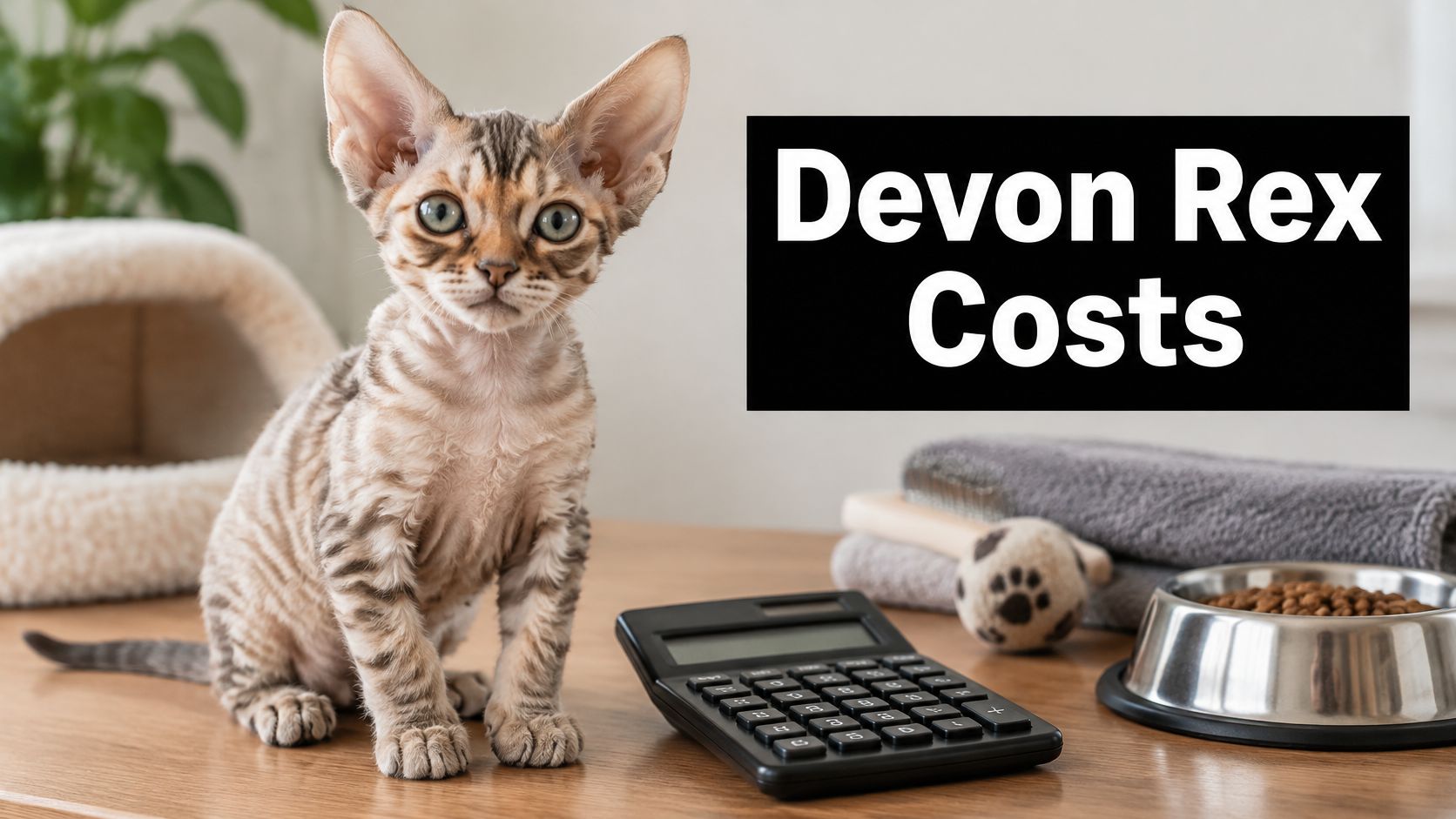
A breeder's published Devon Rex price is about $2,450, while the working range is $1,200 to $5,000. Adoption usually costs $300 to $600. Treat these as price tiers, not the whole first-year bill.
The lowest listing can cost more overall if the kitten comes without vaccine or parental health-test records. Compare a $1,200 kitten with no records against a $2,450 kitten with those records: the cheaper price leaves care and testing costs to cover, so budget for them before paying a deposit. Include supplies, routine veterinary care and transport in your first-year plan.
Table of Contents
- Devon Rex Price at a Glance
- Devon Rex Price by Tier and Cost Drivers
- Health Testing Costs and What They Protect
- Total First-Year and Ongoing Budget
- Adoption and Rescue as Lower-Cost Options
- Checklist Before Paying a Deposit
Devon Rex Price at a Glance
A $1,200 kitten may still need veterinary examinations, vaccinations, a microchip and spay or neuter surgery in its first year. Set the purchase price beside those costs before deciding what you can afford. A breeder's published price of about $2,450 gives you one U.S. planning benchmark. It reflects that breeder's listing, while your final price can vary with pedigree, location, coat quality, registration, health screening and whether the kitten is sold as a companion or with breeding rights, factors outlined on The International Cat Association's Devon Rex page.
A working breeder range runs from roughly $1,200 for a pet-quality kitten to $5,000 for show, breeding or rare-color lines. Adoption through a shelter or rescue typically costs less, though Devon Rex cats are uncommon in general shelters, so finding one may take patience.
Budget for the full first year, including transport, veterinary care, supplies, insurance, food and litter. If you're relocating, include travel arrangements and veterinary paperwork. The lowest purchase price can leave you with more care costs to cover, especially when health records or included services are missing.
Choose the price tier that matches your plans. A companion, a show prospect and a cat with breeding rights call for different budgets. The sections ahead compare those tiers, explain health testing, and lay out first-year costs and adoption options.
Devon Rex Price by Tier and Cost Drivers
The gap between a companion kitten and one sold with breeding rights can reach several thousand dollars. Use the tiers below to compare what a listing claims to offer, then budget for the first year as part of the same decision. The cheapest kitten with no health records may bring extra veterinary costs and uncertainty after purchase.
| Tier | Typical price (USD) | What the price usually includes | Best for |
|---|---|---|---|
| Pet quality (companion) | $1,200–$3,000 | Veterinary care before sale; no breeding rights | Companion owners |
| Major U.S. market reputable breeder | $1,800–$5,000 | Inclusions depend on the breeder | Most first-time buyers |
| Show quality | $3,000–$5,000 or more | Pedigree and conformation review | Cat shows |
| Breeding quality, with breeding rights | $3,000–$5,000 or more | Pedigree and breeding rights; terms depend on the contract | Breeding programs |
| Rare-color or heavily tested lines | Up to about $5,000 | Extended health testing and pedigree documentation | Specialist buyers |
| Adoption through a breed-specific rescue or shelter | $300–$600 | Adoption fee; services depend on the organization | Adult cats and budget-conscious owners |
Breeders set their own prices, so use these bands as starting points. Petful's Devon Rex price guide lists reputable-breeder kittens in major U.S. markets at $1,800–$5,000, with show- or breeding-quality cats at $3,000–$5,000 or more. Adoption may cost $300–$600 when a Devon Rex is available through a shelter or breed-specific rescue. In 2025, PetsRadar reported prices of up to about $3,000, while LoveMoney reported $2,500–$5,000.
Why the tiers differ
A higher price should have a clear reason. Devon Rex cats trace their modern lineage to Kirlee, a curly-coated kitten born in Devon, England, in 1960. The Governing Council of the Cat Fancy's Devon Rex profile says all Devon Rex cats trace their ancestry to him. Limited litters and careful breeding can constrain availability.
The same profile records breed recognition in 1967 and the first Devon Rex cats arriving in the United States in 1968. Pedigree documents and registration help establish lineage. Ask the breeder which records come with the kitten rather than assuming they are included.
Purpose matters, too. A show prospect is assessed for pedigree and conformation potential. Breeding rights may bring a higher price and a breeding contract. A breeder's reputation, location, waiting lists and the kitten's coat quality can also affect the asking price.
Care before sale has a cost. Health screening, vaccinations, deworming, veterinary examinations and early socialization all require time and money. Yet a listing price may leave out transport, supplies and veterinary care after the kitten comes home. For a Devon Rex, those first-year expenses belong in the same budget as the purchase price. A low-cost kitten without health records may therefore cost more overall than a better-documented kitten with a higher initial price.
Ask the breeder to explain what supports the price and what care has already been completed. If the answer is vague, keep looking. Planning for a pet's full costs matters across breeds, as outlined in our Cane Corso cost guide.
Health Testing Costs and What They Protect
The lowest kitten price can become the costliest choice in the first year when health records are missing. Compare the purchase price with the screening already completed: paying more for documented testing can help you budget for inherited risks instead of discovering missing care after bringing your kitten home.
The Devon Rex health-cost guide lists a hereditary-myopathy DNA test at about $50–$130 and broader Devon Rex DNA panels at about $84–$115, depending on the laboratory and included conditions. HCM screening requires separate cardiac imaging. An echocardiogram may cost roughly $400–$900, with follow-up screening recommended as the cat ages.

Patellar luxation and dental disease can also bring treatment costs. Dental care may run about $200 to $1,500, depending on what is needed, according to the Petful guide to Devon Rex kittens. For example, a buyer who chooses a kitten without a hereditary-myopathy test may need to pay about $50–$130 for that test.
| Screen or treatment | Typical cost (USD) | What it protects against |
|---|---|---|
| Hereditary-myopathy DNA test, single | $50–$130 | Inherited muscle disease |
| Broader Devon Rex DNA panel | $84–$115 | Several breed conditions; panel depends on the lab and tests included |
| Echocardiogram for HCM | $400–$900 | Heart disease; follow-up screening as the cat ages |
| Dental treatment | $200–$1,500 | Dental disease, when treatment is needed |
Ask for the lab reports themselves. A verbal claim that the parents are healthy cannot show which tests were performed. Check the purchase contract for congenital-disease coverage and get a written list of veterinary care the breeder has arranged. Use the checklist before paying a deposit.
Ask for proof before arranging transport. If a breeder refuses to provide health records, factor that uncertainty into the price and your first-year budget.
Total First-Year and Ongoing Budget
A kitten's first month costs more than its second year, so budget for the first month first. The purchase price is only one part of the total: supplies, veterinary care and the recurring cost of food and litter all belong in the same budget.
| Cost item | Typical range (USD) | When you pay |
|---|---|---|
| Initial veterinary exam and vaccinations | Get a quote from a local clinic | First one to two months |
| Microchip | Get a quote from a local clinic | First veterinary visit |
| Spay or neuter | Get a quote from a local clinic | Usually before six months |
| Starter supplies, including litter tray, litter, bed, scratch post, carrier and toys | About $200–$400 | Before arrival |
| Routine annual ownership, including food, litter, checkups and preventive care | $700–$2,000 per year | Every year |
| Cardiac imaging for HCM screening | $400–$900 | For screening, then as advised |
| Dental treatment | $200–$1,500 | When needed |
| Relocation transport | Get a quote for the route | Before the move |
| Pet insurance premium | Get a quote based on provider and age | Monthly or annually |
The Petful Devon Rex kitten cost guide estimates routine annual ownership at about $700–$2,000. First-year spending can rise with veterinary exams, vaccinations, microchipping, spay or neuter, and supplies. Ask local clinics for quotes on unpriced procedures, since fees depend on the services included and your location.

Build your total before you commit
Start with the costs due before or soon after your kitten arrives: supplies, an exam, vaccinations, microchipping and planned sterilization. Then add yearly food, litter, checkups and preventive care. These expenses sit outside the breeder's price unless the contract specifically includes a service.
A low purchase price can lose its appeal if the first-year budget leaves no room for care. Cardiac imaging and dental treatment may not be needed immediately, but include them in your planning rather than assuming every veterinary cost is covered. Ask a veterinarian which screening is appropriate, and get a transport quote for the actual route before setting a move date.
- Add the acquisition price to first-year veterinary costs and starter supplies.
- Add routine annual ownership so food, litter, checkups and preventive care are budgeted from the start.
- Add transport and an emergency reserve. Set aside at least $1,000 as a conservative first-year planning rule, not as a quoted veterinary charge.
- Confirm the total before agreeing to relocation. Insurance may not cover every condition or expense, so read the policy terms and check when coverage begins.
Spot Pet Insurance offers accident and illness coverage for dogs and cats, with customizable options. Compare policy details and quotes for your cat's age and needs. Use our pet insurance guide to identify questions to ask before choosing a policy.
Adoption and Rescue as Lower-Cost Options
A rescue adoption fee is lower, but it comes with less documented medical history than a breeder contract. Your choice of price tier and first-year budget therefore go together: a kitten with no health records may cost more to care for after adoption or purchase.
| What to compare | Breeder purchase | Adoption or rescue |
|---|---|---|
| Price | Higher, with price shaped by quality and contract terms | Lower adoption fee |
| Age | Often a kitten | Adult cats may be available |
| Health records | Ask for parental testing and kitten veterinary records | Ask what medical history and care the rescue can document |
| Availability | A breeder may have a waitlist | Devon Rex cats are uncommon in general shelters, so availability is inconsistent |
According to Petful's Devon Rex price guide, adoption fees are typically about $300–$600 when an adult or breed-specific rescue cat is available. An adult cat may already be spayed or neutered, vaccinated and microchipped, reducing some care to arrange after adoption. Check which of these services are documented before setting your budget.
Search breed-specific rescues, breed-club referral lists and cat-fancier networks, then check general shelters as a backup. Expect to wait: Devon Rex cats are uncommon in shelters, and kittens may not be available. Adult cats can also need time and care as they settle into a new home, so consider whether your household is ready for an older companion.

Choose adoption if you want an adult companion and can wait for a suitable match. If you need a kitten with a specific coat type or want breeding rights, budget for a breeder instead. In either case, missing health records mean you should leave room in your first-year budget for care you may need to arrange yourself.
Checklist Before Paying a Deposit
Before paying, make sure the price, your budget and the contract fit together. Use this checklist to spot unanswered questions while you still have time to walk away.
- Health terms: Get the contract's coverage for congenital disease in writing, including any exclusions and time limits.
- Your budget: Include the purchase or adoption fee, first-year care, recurring costs, transport and an emergency reserve of at least $1,000.
- Sale type: Confirm whether you're buying a companion cat or paying for breeding rights, and read the contract that applies.
- Travel plan: For a domestic or international move, get a route-specific transport quote in writing and confirm veterinary paperwork before setting a date.
A price far below comparable listings, especially with no health records, is a reason to ask more questions. Don't pay under pressure before seeing the kitten and the documents. Walk away if the seller refuses to answer reasonable health questions.
Choose the tier that fits your purpose, then verify the records before you pay.
If your Devon Rex is moving home with you, Precious Pets Transport Services, LLC offers domestic and international pet relocation, including door-to-door ground transport and help coordinating travel requirements. Request an estimate for your route before you set a move date.
Leave a Reply