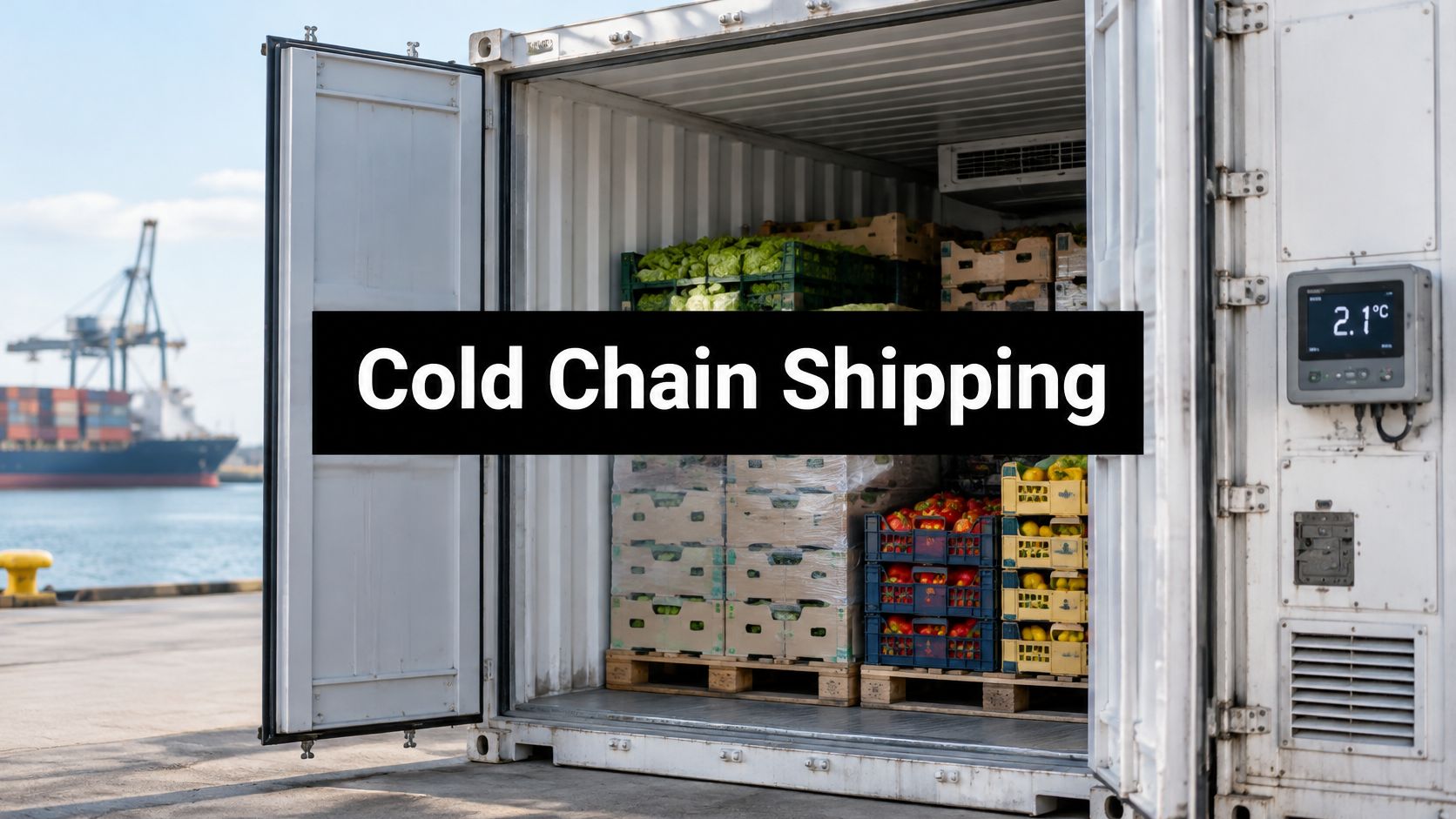
You're arranging a shipment of bananas that must arrive firm and marketable after a long sea journey. The carrier asks for a temperature setpoint, and you realize the number on the booking form doesn't answer your biggest question: will everything inside stay at that temperature?
For a family moving a pet, the question is even more important. Temperature controlled shipping containers can protect sensitive freight, but keeping a living animal comfortable requires more than refrigeration.
Table of Contents
- What Temperature Controlled Shipping Containers Are and Who Uses Them
- Container Types and Temperature Ranges Compared
- How a Reefer Unit Holds a Set Temperature
- Container Sizes, Specs and Cost Drivers
- Regulations for Food, Pharma and Live Cargo
- Live-Animal Temperature Limits and Airflow
- Pack, Monitor and Check a Load Before Booking
What Temperature Controlled Shipping Containers Are and Who Uses Them
A temperature-controlled shipping container is an insulated enclosure designed to maintain a specified internal temperature range during transport. At ocean-freight scale, it's usually a steel container with built-in refrigeration, commonly called a reefer.
Think of an active reefer as a portable refrigerator with a compressor. A passive insulated container works more like a thermos: its insulation slows heat transfer, while coolant helps preserve the starting conditions. The phrase covers both, although a parcel-sized medical shipper and a maritime reefer aren't interchangeable equipment.
The difference becomes clear while loading produce for export.

Why reefers matter
According to UNCTAD's cold-chain overview, approximately 139 million tonnes of perishable food were transported by sea in 2022, and an estimated 88% of that volume moved in reefer containers. That makes them the dominant maritime method for transporting perishables, not specialized equipment used only for unusual shipments.
The purpose isn't to make cargo cold. It's to protect the product's required conditions despite outside heat, vessel operations, port waits, and transfers between vehicles. Some products need cooling; others need protection from freezing.
Typical users include:
- Produce exporters, protecting fruit and vegetables from premature deterioration.
- Meat, seafood, and dairy shippers, maintaining conditions appropriate to their products.
- Pharmaceutical distributors, moving medicines and other temperature-sensitive healthcare goods.
- Specialist animal transporters, using purpose-designed environmental systems rather than treating animals as ordinary refrigerated freight.
Protection across the journey
Say your bananas leave a temperature-controlled warehouse in good condition. A suitable container helps preserve that condition, but it can't undo poor handling before loading or guarantee careful treatment after unloading.
That's why buyers should think in terms of a cold chain, meaning the connected storage, transport, and handling arrangements around the shipment. The container is an important part of that chain, not a replacement for it.
For pet owners, the useful lesson is the same: choose the transport system around what's traveling inside, rather than assuming a climate-controlled label describes the entire service.
Container Types and Temperature Ranges Compared
| Container type | Typical temperature range | How it holds temperature | Typical cargo |
|---|---|---|---|
| Chilled reefer (active) | Product's specified chilled storage range | Integrated refrigeration unit | Dairy, meat, seafood |
| Produce reefer (active) | Commodity-specific range that avoids chilling damage | Refrigeration with managed airflow | Bananas, citrus, tropical fruit |
| Frozen reefer (active) | Product's specified frozen storage range | Integrated refrigeration unit | Frozen meat, fish, ice cream |
| Ultra-low reefer (active) | Product requirement within the unit's verified operating limits | Specialized low-temperature refrigeration | Specialty biologics and selected vaccines |
| Hybrid reefer (active with backup) | Required chilled or frozen range | Refrigeration with an engineered backup supply | Shipments crossing planned power gaps |
| Insulated container (passive) | Validated packaging range for the planned journey | Insulation with gel packs or phase-change material | Pharmaceuticals and samples |
| Dry-ice insulated container (passive) | Validated deep-frozen range for the packout | Insulation with dry ice | Compatible frozen samples and specimens |
| Ambient-controlled container | Product's labeled controlled-ambient range | Cooling or heating, with humidity management where specified | Chocolate, cosmetics, selected pharmaceuticals |
Active cooling versus passive protection
An active unit removes heat using powered machinery. It can support an extended journey when its capacity, operating range, power supply, and maintenance arrangements suit the route.
It cannot hold every possible temperature under every condition. Ask for the actual equipment specification, not just confirmation that the container is refrigerated.
Passive packaging has a different limitation: its thermal protection is finite. Coolant quantity, conditioning, insulation, payload, outside conditions, and packing arrangement all affect how long it works.
A supplier's validated packout tells you which combination has been tested. Adding extra gel packs without checking that design can freeze sensitive contents rather than improve protection.
Buying rule: Match the equipment to the product's labeled storage requirement and the expected journey, including delays. Don't select a temperature because it's cheaper or convenient.
Similar names can hide different capabilities
A hybrid unit adds resilience only if its backup can operate the necessary equipment for the planned interruption. A battery that powers a logger isn't the same as a battery that runs refrigeration.
Likewise, ambient-controlled equipment isn't necessarily a refrigerated container set warmer. Ask whether it can cool, heat, manage humidity, or only reduce exposure to outside conditions.
Dry ice also needs separate handling consideration. It releases carbon dioxide as it sublimates, so packaging and ventilation must account for gas release. It isn't an improvised cooling solution for a pet enclosure.
For produce, colder isn't always safer. Chilling-sensitive fruit can suffer damage at temperatures that suit other foods, while frozen products need protection against warming and thawing. Your commodity specification should settle the setting before you request equipment.
How a Reefer Unit Holds a Set Temperature
A reefer works much like an air conditioner: it absorbs heat inside the container and releases that heat outside. The refrigeration unit typically sits at the container's front, while fans move air through the load space.
The cooling circuit and the airflow circuit work together.

Follow the air and the heat
Warm return air travels back from the cargo area to the unit. At the evaporator coil, refrigerant absorbs heat from that air.
The compressor circulates refrigerant through the system, and the condenser releases heat outdoors. Fans send conditioned supply air through the container's floor channels and cargo arrangement before it returns to the unit.
The controller compares sensor readings with the selected setpoint and adjusts operation. Depending on equipment and operating mode, it may regulate using supply-air or return-air measurements, so ask what the displayed value actually represents.
A display reading is an air measurement at a particular location. It isn't automatically the temperature at the center of a carton.
What interrupts the process
- Blocked circulation: Pallets, loose wrapping, or cargo against return-air paths can leave areas poorly served by conditioned air.
- Frost and moisture: Moisture entering through open doors can contribute to evaporator frost. Defrost restores performance, but its effect on readings needs to be understood when reviewing logs.
- Lost power: Without a suitable electrical supply or generator, active cooling stops. Insulation slows subsequent temperature change but doesn't replace refrigeration.
At a terminal, someone must arrange the electrical connection. On an inland leg, the plan may require a generator, compatible connections, and fuel.
Ask who confirms that power has been restored after every transfer. A booking that includes a reefer doesn't necessarily describe who checks its plug, generator, or alarm status during a delay.
For ground pet travel, a temperature-controlled Sprinter van uses a different vehicle arrangement. The relevant comparison is how its climate system serves the occupied space and how the operator manages stops, not whether it resembles maritime refrigeration.
Container Sizes, Specs and Cost Drivers
| Container size | Approx. internal volume |
|---|---|
| 20 ft reefer | Confirm usable capacity from the offered unit's equipment sheet |
| 40 ft reefer | Confirm usable capacity after refrigeration equipment and loading clearances |
| 40 ft high-cube reefer | Confirm usable capacity and whether the load can use the additional height safely |
Nominal container size isn't a packing plan. Request the internal length, width, height, door opening, permitted loading height, and payload for the exact equipment being offered.
Insulation and refrigeration equipment reduce usable space compared with the outside dimensions. Door openings can also limit whether a tall pallet will enter, even when the interior appears large enough.
Read capacity as usable space
Payload is the permitted cargo weight after subtracting the container's tare weight from its maximum gross weight. The practical shipment limit must also respect the route's vehicle, axle, and handling restrictions.
Volume alone can mislead you. Cartons may fit geometrically while blocking circulation, exceeding floor-loading limits, or preventing safe unloading.
Ask the supplier to review a pallet layout rather than approving a carton count alone. Include packaging dimensions, gross weights, stacking restrictions, and any requirement to keep goods upright.
For live animals, don't convert freight capacity into kennel capacity. Access for care, safe restraint, ventilation, and separation may determine the arrangement before weight or volume becomes relevant.
Specifications worth checking
- Operating capability: Verify both the required range and performance under the route's expected outside conditions.
- Power compatibility: Identify the electrical supply, connectors, generator arrangements, and backup responsibilities.
- Defrost operation: Ask how the unit defrosts and how operators recognize normal cycles in its records.
- Monitoring access: Confirm whether you receive downloadable logs, live alerts, or both.
- Physical condition: Inspect door seals, drains, floor channels, interior cleanliness, and visible damage.
Compare complete quotes
Rental price is only part of the cost. Trip duration, powered storage, equipment positioning, inspection, cleaning, terminal handling, monitoring, and backup arrangements can all affect the final bill.
A colder setpoint can increase refrigeration demand, but don't assume a fixed cost difference between chilled and frozen service. Outside temperature, equipment condition, cargo preparation, and operating practices also matter.
Ask competing providers to quote the same cargo requirement, route, monitoring service, and delay allowance. Otherwise, the cheaper quote may simply leave out a necessary task.
Request a written description of exclusions and delay charges. In particular, identify who pays for extended terminal power, generator fuel, emergency storage, and a failed delivery.
Regulations for Food, Pharma and Live Cargo
The governing requirements depend on what you're shipping, where it travels, and which organization takes responsibility at each stage. A container suitable for food freight isn't automatically suitable for medicines or animals.
Separate the product requirement from the equipment requirement. You may need appropriate storage conditions, sanitary handling, qualified equipment, transport documentation, and an agreed response when conditions leave the permitted range.
Different cargo needs different evidence
| Cargo category | What to establish before booking |
|---|---|
| Food | Applicable sanitary transport duties, cleaning arrangements, temperature instructions, and records |
| Pharmaceuticals | Approved storage conditions, equipment qualification, excursion assessment, and release responsibilities |
| Live animals | Species-specific transport requirements, suitable enclosures, ventilation, care, and emergency access |
For food, ask who checks that the previous load, cleaning process, and current cargo are compatible. A clean-looking interior doesn't establish that the full handling process is suitable.
Packaging matters too. Crayex Corporation's information on food and pharmaceutical packaging films can help buyers consider the protective packaging layer alongside the transport enclosure; film packaging doesn't replace a qualified temperature-control system.
Check every transport leg
For pharmaceuticals, give the carrier the product's approved shipping instructions rather than asking them to select a generic refrigerated service. Name the person authorized to assess an excursion and decide whether the shipment can be released.
For an international move, check the requirements at origin, transit points, and destination. An acceptable sea leg doesn't establish that an inland truck, temporary warehouse, or customs holding area is appropriate.
- Assign responsibility: Record who supplies instructions, accepts the load, reviews alarms, and authorizes corrective action.
- Keep relevant evidence: Retain temperature logs, calibration records, handover documents, and incident reports.
- Confirm retention requirements: Obtain the applicable recordkeeping period from the responsible authority or customer rather than assuming a universal rule.
Live animals require a separate welfare assessment. Freight compliance alone doesn't establish that the journey is safe for a pet.
Live-Animal Temperature Limits and Airflow
A living animal produces heat and moisture, needs fresh air, and can become distressed even when a nearby thermostat looks acceptable. Its condition, age, species, enclosure, and journey circumstances all affect the transport plan.
For covered U.S. animal transport, the federal animal-transport rules require sufficient air for normal breathing and auxiliary ventilation at or above 75°F, with temperatures generally kept between 45°F and 85°F, subject to applicable exceptions and veterinary acclimation documentation. These are regulatory boundaries for covered transport, not a comfort target for every pet.
Ventilation isn't the same as cooling
IATA's live-animal guidance treats temperature, ventilation, hydration, journey duration, and container design as connected welfare factors. Cooling recirculated air doesn't by itself establish adequate fresh-air exchange.
Sealing an enclosure to conserve energy can therefore create a different problem. So can directing cold supply air onto a kennel while another kennel sits in a warm pocket.
An animal needs a suitable environment where it rests, not merely an acceptable average reading somewhere in the vehicle.
Automated operation is useful only when someone supervises alarms and can intervene. An energy-saving mode appropriate for packaged freight may be inappropriate for an occupied enclosure.
Choose an animal transport service, not just a cold box
For a household pet moving by road, purpose-equipped ground transport is generally a more relevant option than a freight container. Look for climate-controlled vehicles, sanitary kennels, direct care, and practical access during the journey.
Ask providers:
- Airflow: How do you maintain fresh-air exchange around occupied kennels?
- Checks: Where are conditions measured, and who observes the animals?
- Response: Who receives alarms during stops and overnight?
- Failure planning: Where will pets go if the cooling system or vehicle fails?
Use this guide to temperatures that are unsafe for dogs to prepare questions for your veterinarian rather than choosing limits by guesswork.
Financial preparation is separate from transport safety. Spot Pet Insurance offers customizable accident and illness coverage for dogs and cats; review the policy terms separately from the carrier's service agreement.
Pack, Monitor and Check a Load Before Booking
A good loading plan turns the product requirement into instructions a warehouse team and carrier can follow. Prepare it before equipment arrives, with the packing arrangement, monitoring positions, handover checks, and response responsibilities written down.
The workflow starts with the product label, not the container controls.

Prepare and verify the load
Confirm the product requirement. Record the permitted range, handling restrictions, and any exposure limits specified by the product owner. Resolve conflicting instructions before loading.
Prepare the equipment and cargo separately. Bring cargo to its required transport condition before loading. Arrange container preparation and pre-cooling according to the equipment instructions and loading environment, rather than assuming a universal preparation time.
Use an approved loading pattern. Keep supply and return paths clear, respect loading marks, and secure cartons so they can't shift into circulation channels. Choose clearances from the equipment's loading instructions, not a generic gap copied from another container.
Validate sensor positions. The World Health Organization's temperature-mapping tool describes recording and spatially mapping temperatures throughout a cold-chain enclosure. Use calibrated loggers at representative locations, including doors, corners, the evaporator outlet, floor areas, and suspected warm zones, under realistic operating conditions.
Mapping tells you whether the planned arrangement performs as intended. It can reveal a warm location hidden by the controller reading or show that recovery after a door opening takes longer than expected.
For an animal enclosure, test with the intended kennel arrangement because the kennels change circulation. Repeat the assessment when equipment, seasonal conditions, or loading patterns materially change.
Make monitoring actionable
Set meaningful high and low alarms. Base thresholds and response delays on the product's permitted conditions, sensor uncertainty, and the time needed to intervene. Avoid settings that either conceal a developing problem or produce constant nuisance alarms.
Control transfers. Have the receiving team, handling equipment, and onward vehicle ready before opening doors. Record power disconnection and reconnection events so reviewers can connect temperature changes with operational events.
Review conditions at handover. Identify the equipment and logger, check alarm status, and note who accepted responsibility. Continuous records are more useful than an arrival photograph of the thermostat.
Define the excursion response. Name the person who answers the alert, the person who can authorize action, and the place where the cargo can be moved. Include instructions for quarantine or rejection when product suitability is uncertain.
For repeated routes, compare temperature traces with door events, terminal waits, and power interruptions. Faberwork LLC's resource on improving logistics through data analytics offers context for organizing operational information so teams can identify recurring problems.
Animal care needs its own instructions alongside environmental monitoring. A reptile owner preparing a bearded dragon travel tank should resolve species-specific enclosure and heating needs rather than borrowing a dog's transport plan.
The pre-booking check
Before confirming, obtain written answers to the following:
- Equipment readiness: Is the selected unit suitable, clean, inspected, and supported by the required documentation?
- Load compatibility: Has the proposed configuration been assessed for the product or animal involved?
- Journey continuity: Who supplies power and appropriate holding conditions during waits and transfers?
- Alert ownership: Will an identified person receive and act on warnings throughout the journey?
- Contingency access: Is there a realistic alternative holding location or onward transport arrangement?
A setpoint is an instruction. A dependable service includes the people and procedures that keep that instruction meaningful.
Precious Pets Transport Services, LLC offers door-to-door pet ground transportation using climate-controlled vans and sanitized kennels, along with coordination for international relocations. To discuss your pet's route, care needs, and travel arrangements, visit Precious Pets Transport Services, LLC and request an estimate.
Leave a Reply