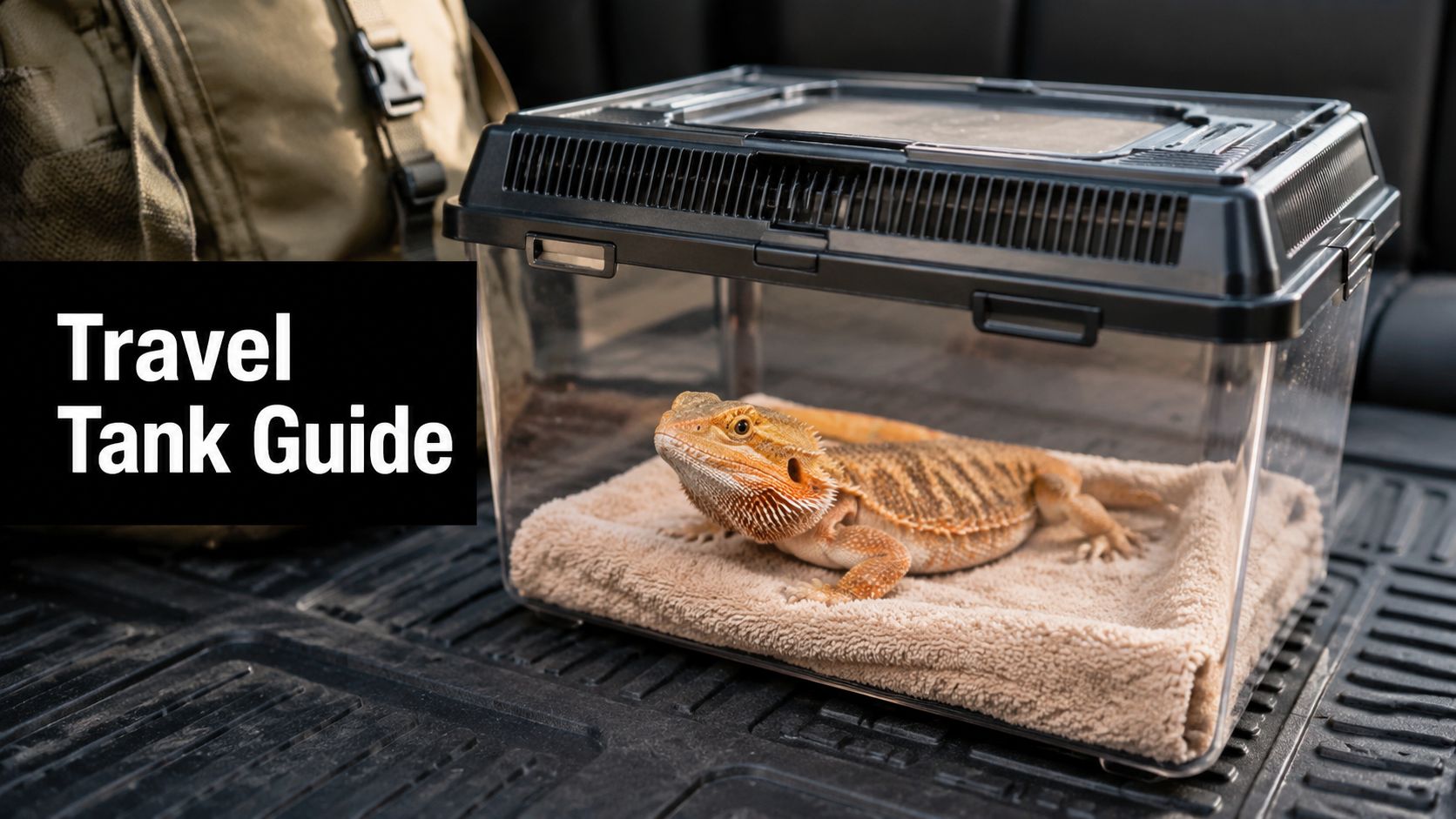
You're standing beside a fully furnished 120-gallon bearded dragon enclosure, trying to work out how it's supposed to fit into a car. The answer is that it isn't. For moving day, a dedicated carrier must keep your dragon contained, level, ventilated, and protected from the vehicle's vibration without pretending to be a replacement habitat.
A travel tank is a temporary transport zone. Its job is narrower than a permanent enclosure, and that difference matters. Adult care guidance has moved from the older 75-gallon standard toward a 120-gallon minimum, with many current guides specifying at least 48 x 24 x 24 inches, or 4 x 2 x 2 feet, for an adult enclosure. Some welfare-focused recommendations go further, suggesting 6 x 2 x 2 feet or at least 24 cubic feet for one adult, as summarized by Reptile Wise's bearded dragon tank-size guide. A carrier can't provide that space safely during a drive, and it shouldn't try.
Table of Contents
- Why Your Bearded Dragon Needs a Dedicated Travel Tank
- Choosing the Right Travel Tank Size and Construction
- Setting Up the Interior for Safe Transport
- Monitoring Temperature and Humidity During Transit
- Vehicle Placement and Driving Adjustments
- Legal Requirements and Professional Transport Options
Why Your Bearded Dragon Needs a Dedicated Travel Tank
Moving day exposes the weakness of improvised transport. A storage bin may look roomy, but a smooth interior gives your dragon little traction when the vehicle brakes. A soft-sided carrier may fold around the animal, collapse ventilation openings, or allow the walls to flex with every turn. An open cardboard box offers even less control and can become damp, unstable, or difficult to secure.
Bearded dragons experience transport through their whole body. Road vibration travels through the floor and carrier, while acceleration, cornering, and braking repeatedly shift the animal's weight. A dragon that can't brace its feet may slide into a wall, catch a claw in fabric, or remain tense for the entire journey. The psychological stress also comes from the changing visual environment, unfamiliar movement, and lack of a stable resting surface.

The carrier has one job
A suitable bearded dragon travel tank creates a secure boundary around the animal while reducing opportunities for sliding, tipping, climbing, and impact. It should be rigid enough to hold its shape, fitted with a dependable latch, and ventilated on more than one side. The carrier also needs to remain level when placed in the vehicle.
The enclosure doesn't need branches, basking décor, loose substrate, or a full temperature gradient during the drive. Those items create movement and snag hazards. A familiar-smelling towel can help provide continuity, but anything inside must stay exactly where you put it.
Practical rule: During transport, stability matters more than habitat enrichment. Rebuild the full enclosure as soon as you arrive.
Keep the trip itself as short and controlled as practical. Handle the dragon only for the transfer into and out of the carrier, support the body fully, and avoid repeatedly opening the lid to check on it. A carrier that looks plain may be safer than one filled with objects that shift every time the car moves.
Choosing the Right Travel Tank Size and Construction
A carrier that is too large lets a bearded dragon slide, brace against the walls, and build momentum during braking. One that is too small restricts turning and limb movement. Choose by body fit, construction, and restraint potential. The dragon should turn around, settle naturally, and reposition without compression, while the floor remains compact enough to limit movement.
Start with the shell
A rigid plastic reptile carrier or small-animal enclosure generally handles vehicle vibration better than fabric. Choose a solid base, smooth edges, a lid that cannot flex inward, and latches that close positively. Zippers and friction-fit lids can open under pressure or fail when the carrier is squeezed against another item. A front-opening door can also reduce handling stress because the dragon can walk or be guided inside without reaching down from above.
Vehicle air conditioning creates shifting thermal zones, and a carrier with one large opening may receive a direct cold or hot stream. Ventilation should exchange air steadily without blowing straight across the animal. Openings on opposing sides usually distribute airflow better than a single vented lid. Check that holes cannot catch toes or claws. Do not drill first. Confirm the existing airflow, then smooth and cover any modified edges so exposed plastic cannot cut the dragon.
Match the dimensions to the journey
For a short transfer, use the smallest carrier that lets the dragon lie naturally, adjust its limbs, and turn without pressure. A longer relocation needs enough floor area for a secure hide and limited repositioning, while the interior stays free of loose objects. The permanent enclosure dimensions described in current bearded dragon housing guidance are for home housing, not a vehicle carrier.

Use this screening list before buying:
- Reject soft walls: Fabric can sag, compress, and catch claws.
- Test every latch: Pull against the closed door and inspect the hinge side.
- Check the floor: The base must accept a towel liner without curled edges.
- Inspect the corners: Avoid exposed screws, seams, wire ends, and rough molded plastic.
- Assess the weight: The shell should stay rigid when lifted with the dragon inside.
- Plan vehicle restraint: Handles help with carrying, but they do not secure the carrier in the car.
A commercial reptile carrier is usually the simplest option. A modified small-animal enclosure can work when its door, mesh, floor, and hardware meet the same standards. Compare the design with these international pet travel kennel requirements before a cross-border trip, since carrier construction and ventilation may receive closer attention. If dogs or cats are traveling too, Spot Pet Insurance offers accident and illness coverage for those species, with flexible reimbursement options, multi-pet discounts, and access to any licensed veterinarian.
Setting Up the Interior for Safe Transport
The safest interior is deliberately boring. Start with a non-slip towel liner that lies flat across the base. A folded cotton towel or similar washable liner gives the dragon traction and cushions minor vibration, while loose sand, wood chips, pellets, and other particulate substrates can shift under the body or enter the mouth.
Do a test run with the empty carrier. Push it gently from side to side, then lift and set it down. If the liner bunches, add a second layer beneath it or trim the material so it fits the floor. The dragon shouldn't be able to burrow beneath the liner or pull a corner loose.
Add security without creating obstacles
A low, lightweight hide can reduce visual exposure, but it must be stable and leave ventilation openings clear. A small cardboard hide can work for a brief trip if it fits tightly and stays dry. For a longer journey, use a smooth, rigid hide that can't collapse or slide into the dragon.
Don't place rocks, branches, heavy décor, or a basking platform inside the carrier. They may be safe in a stationary enclosure, but the same objects become projectiles when the vehicle stops. Avoid fastening the dragon with improvised straps. A reptile-safe restraint should only be used when recommended for the individual animal and fitted by someone who understands how to prevent chest compression.
Food and water need restraint
For a short trip, remove food that could spoil or scatter. A loose insect can crawl beneath the dragon, while leafy food can increase mess and moisture. If the journey requires water, use a shallow dish that sits flat and can't tip, then remove it if condensation or spills begin to raise humidity.
Transporting fragile enclosures also requires control of movement, and the same principles apply when learning how to move a fish tank safely. Keep the carrier dry, clean, and easy to inspect. A practical travel-gear checklist can also help you assemble recommended pet travel gear without adding unnecessary items.
Monitoring Temperature and Humidity During Transit
Vehicle conditions change faster than most owners expect. Sunlight through a side window can warm one wall while an air-conditioning vent chills another. A carrier placed near a footwell may sit in a different thermal pocket from the rest of the cabin, and a sealed container can accumulate moisture from a wet towel or spilled water.
Use a digital thermometer and probe hygrometer rather than judging conditions by touch. Husbandry guidance places a broader daytime gradient around 77–99°F, or 25–32°C, with humidity around 30–60% when measured by a probe hygrometer. Dry travel setups commonly target about 30–40% humidity, while post-arrival basking temperatures are commonly near 100–110°F, or 38–43°C, according to reptile travel-condition guidance.
Prepare the vehicle before loading
Run the vehicle long enough to establish a stable cabin temperature before bringing the dragon outside. Position the carrier away from direct sunlight, defroster outlets, floor-level heat sources, and strong air-conditioning streams. Don't cover the carrier with a thick blanket that blocks ventilation. If visual stimulation is a problem, use a light cover over part of the carrier while leaving the ventilation path open.
Check the readings every 15–30 minutes, especially during the first part of the journey and whenever the weather, route, or vehicle setting changes. Record the temperature and humidity so you can identify a trend instead of reacting to one isolated reading.
Act on drift early
A prolonged reading below about 29°C or exposure to extreme temperatures above or below the safe travel range requires immediate action, as outlined in the cited relocation guidance. Move the carrier away from the source of the problem, adjust the vehicle climate gradually, and stop in a safe location if you can't stabilize the cabin.
Avoid chemical heat packs inside an enclosed carrier. They can create hot spots, deliver no usable gradient, and raise the risk of burns or overheating. Your goal during transit is controlled, even conditions. Once you arrive, establish the normal enclosure gradient and verify the basking area with the probe before placing the dragon inside.
Vehicle Placement and Driving Adjustments
The vehicle floor is usually more stable than a raised seat, especially when the carrier is positioned behind the front seats and away from foot traffic. A seat can amplify movement, slide during braking, or allow the carrier to fall if a door opens or a passenger shifts it. The floor also lowers the center of gravity, which helps reduce tipping.
Place a firm, non-slip mat beneath the carrier, then brace it so it can't move forward, backward, or sideways. The carrier must remain level. Don't wedge it against a pedal, block an emergency exit, or place it where a passenger could kick it.
Adapt the setup to the vehicle
In a sedan, the rear floor behind the front passenger seat often provides a stable location, provided the carrier fits without pressing against the front seat. In an SUV, the flat cargo floor can work if the container is tied down or surrounded by fixed barriers, but don't place it loose among boxes. A moving truck is the least predictable option because of cabin noise, vibration, and temperature changes. If you must use one, keep the carrier in the climate-controlled passenger area and never in an unregulated cargo compartment.
Drive as though you're carrying a container of liquid. Accelerate smoothly, brake early, take turns at a controlled speed, and avoid rough shoulders and potholes where possible. Route planning matters because frequent stops, construction surfaces, and sudden lane changes create more physical disturbance than steady cruising.
The quietest carrier is still stressful if it slides across the floor at every stop.
Have another adult monitor the readings when possible. The driver shouldn't reach toward the carrier, adjust a towel, or open a latch while the vehicle is moving. Stop safely, inspect the dragon, confirm the carrier is still level, and then continue only after the setup is secure.
Legal Requirements and Professional Transport Options
A private road trip may be straightforward, but interstate and international reptile transport can involve destination rules, health documentation, import conditions, and carrier policies. Requirements vary by jurisdiction and can change based on the animal, route, and method of travel. Contact the relevant wildlife authority and the destination's official animal-import authority before finalizing plans.
Air travel adds another layer. Airlines may restrict live reptiles, require specific packaging, or refuse transport under particular weather and routing conditions. Never assume that a carrier accepted for a dog or cat will meet a reptile policy. Ask for the current rules in writing and confirm whether the animal travels in the cabin, as checked baggage, or through cargo handling.
Decide whether DIY transport is realistic
DIY ground transport makes sense when you can control the cabin, maintain stable readings, stop safely, and keep the dragon with you throughout the journey. Professional help becomes more attractive when the route is long, the move crosses borders, the owner must fly separately, or the animal's condition makes handling difficult.
A provider should explain who handles the animal, how the vehicle is climate-controlled, where the carrier travels, how often conditions are checked, and what happens if the route is delayed. Ask for licensing and insurance information, emergency procedures, and a clear handoff plan. A company that can't answer basic welfare questions isn't ready to manage a reptile relocation.
Owners moving from Virginia, Washington, D.C., Maryland, or nearby states for an international relocation should begin preparation early and coordinate documentation, timing, and destination requirements together. The practical steps in this pet travel preparation guide can help organize the animal's records and transport plan. For a door-to-door option, Precious Pets Transport Services, LLC provides domestic and international pet relocation, including ground transportation and coordination for international moves from those regions.
Precious Pets Transport Services, LLC can coordinate climate-controlled door-to-door pet relocation and help families organize the carrier, route, documentation, and handoff details for a bearded dragon move. Visit Precious Pets Transport Services, LLC to request an estimate and discuss the safest plan for your journey.
Leave a Reply