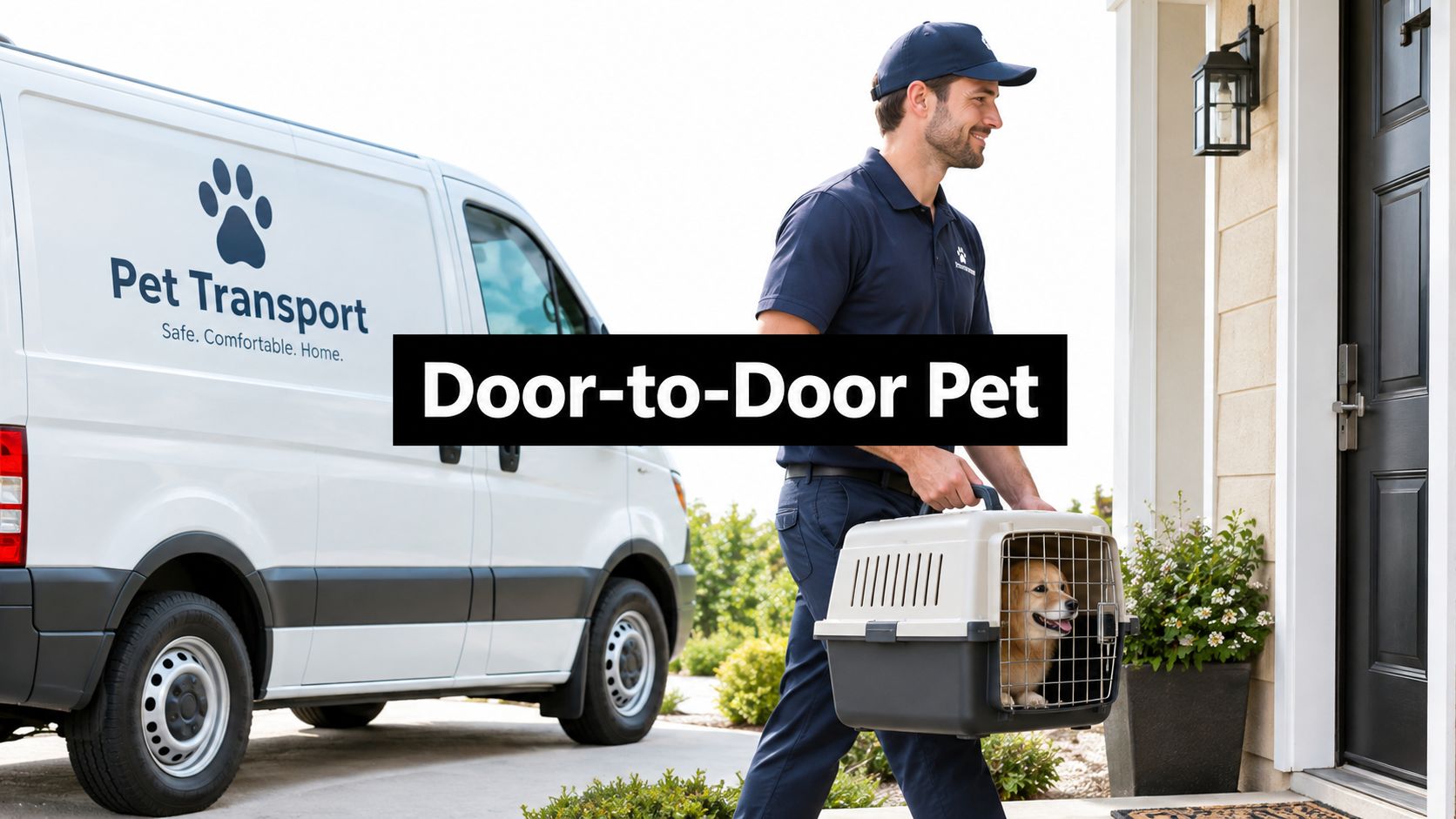
A cross-country move is already full of decisions. Then you remember that your dog cannot explain a noisy hotel, your cat may refuse an unfamiliar litter box, and an airline schedule rarely follows the feeding or medication routine that keeps an older animal settled. A door to door transport service can remove much of that uncertainty, but only if it provides more than a driver, a vehicle, and a kennel.
Professional pet relocation is a controlled handoff from one residence to another. The transporter assumes responsibility for the animal, follows documented care instructions, manages the travel environment, and records each change in custody. That standard matters because the United States includes approximately 59.8 million dog-owning households and 42.2 million cat-owning households, according to the American Veterinary Medical Association's pet ownership statistics. The need is broad, but every animal still requires an individual plan.
Table of Contents
- Understanding Door to Door Pet Relocation
- Core Components of Professional Ground Transport
- Managing the In-Transit Microclimate
- Navigating Legal Custody and Compliance Rules
- When to Choose Ground Transport Over Airline Cargo
- Preparing Your Pet for the Journey
- Selecting a Verified and Insured Transporter
Understanding Door to Door Pet Relocation
Consider a family leaving Maryland for a new home on the West Coast. One parent is driving a moving truck, another is flying ahead to begin work, and the dog becomes an awkward extra responsibility. The owner could attempt a long private road trip, ask a friend to drive, or place the dog on an itinerary involving airport handling and separate transfers. Each option creates its own exposure to delays, unfamiliar handlers, and disrupted routines.
A professional ground service creates a different arrangement. The driver collects the animal at the origin residence, maintains care throughout the route, and delivers the pet directly to the destination residence. The owner isn't just buying mileage. They're arranging a continuous period of supervision in which one accountable team knows the animal's identity, instructions, condition, and destination.
Practical rule: Treat the journey as a chain of custody, not as a ride.
That distinction separates a commercial transporter from a casual pet-sitting arrangement. A friend may be kind and careful, but may not have documented feeding instructions, climate monitoring, sanitation procedures, emergency escalation rules, or a plan for overnight care. A professional operation should be able to explain who handles the pet, where the animal rests, how updates are issued, and what happens if weather or traffic changes the itinerary.
The “door to door” label also deserves scrutiny. Ask whether pickup and delivery occur at the residence or only at a curb, terminal, depot, or meeting point. Confirm whether the same team remains responsible during rest stops and overnight periods. A service that reduces handoffs usually reduces opportunities for misidentification, lost instructions, and delayed care.
Owners often manage the move more effectively when they separate household logistics from animal logistics. Advice about storage-by-the-box moving advice can help reduce clutter and moving-day pressure, while the pet's transport plan should remain a separate document with care instructions, veterinary records, contacts, and handoff details.
Before booking, compare the promised service with the operational details in door-to-door transport reviews. Look for evidence of direct communication, route planning, welfare procedures, and clear responsibility from pickup through delivery.
Core Components of Professional Ground Transport
A professional vehicle is only one part of the service. The stronger model combines suitable equipment, trained handlers, repeatable care routines, and communication that gives the owner a reliable view of the journey.

Daily care must remain specific
Drivers should receive written instructions rather than relying on memory. Those instructions can cover food type, portion, timing, medication, allergies, exercise preferences, water habits, anxiety triggers, and the animal's response to unfamiliar people. Dogs may need scheduled walks, while cats require appropriate litter access and a quieter handling routine.
Enclosures should be secure, clean, ventilated, and appropriate for the animal's species, size, age, and condition. A kennel that is too small restricts movement and increases stress. An enclosure that is too large may allow an animal to slide or become injured during vehicle movement. Sanitation also matters because bedding, bowls, litter equipment, and kennel surfaces can carry contamination between stops if handlers don't clean them properly.
Overnight care exposes weak operations
A transporter should explain where animals stay when the vehicle stops. Leaving pets unattended in a parked vehicle creates avoidable risks, even when the driver expects to return quickly. A professional arrangement keeps the care team close enough to observe the animals, respond to changes, and maintain documented routines.
The wider market context supports this level of attention. The Insurance Information Institute's summary of pet ownership and spending reports that U.S. pet-industry expenditures reached $152 billion in 2024. That figure describes the broader pet economy, not the performance of any individual transporter, but it reflects how owners increasingly treat continuity of care as part of responsible pet ownership.
Equipment should match the route
Ground transport equipment should support safe restraint, ventilation, cleaning, and observation. For airline travel, the Petmate Sky Kennel is one option professional transporters may consider. When assembled with metal hardware and airline-compliant accessories, it is suitable for domestic and international flights, with durable construction and ventilation intended for that use.
Ground and airline requirements aren't identical, so owners should never assume that a kennel appropriate for one mode automatically satisfies the other. A transporter should inspect the enclosure before departure and confirm that fasteners, doors, bedding, labels, and attached documentation are secure.
For a broader look at vehicle routines and operational expectations, see ground pet transport. The useful question isn't whether a provider owns a van. It's whether every part of the service supports uninterrupted care.
Managing the In-Transit Microclimate
A vehicle thermostat measures the cabin, not necessarily the air surrounding an animal inside a kennel. Kennel height, airflow patterns, direct sunlight, insulation, humidity, and the position of other enclosures can create a different microclimate from the one shown on the dashboard.

The American Veterinary Medical Association's transport guidance recommends transport temperatures generally remain between 45°F and 85°F, with exposure beyond those limits limited to no more than four consecutive hours. It also recommends relative humidity between 30% and 70% and a temperature monitor positioned where handlers can readily see it. For short-haired, elderly, juvenile, or otherwise vulnerable animals, the lower threshold may need to rise to approximately 60°F.
What good monitoring looks like
A responsible operator should use continuous temperature and humidity logging, with sensors placed near kennel height rather than relying only on a dashboard reading. The team should know which readings trigger a stop, ventilation adjustment, relocation within the vehicle, veterinary consultation, or a change in route.
Ask direct questions before booking:
- Sensor placement: Are readings taken near the animals, or only at the front of the cabin?
- Logging: Are conditions recorded throughout loading, driving, fueling, rest stops, and overnight care?
- Escalation: What happens when temperature or humidity approaches an unsafe level?
- Vehicle failure: Is there a backup plan for mechanical or climate-control problems?
- Animal differences: How are vulnerable, elderly, juvenile, short-haired, brachycephalic, or medically fragile pets managed?
Poor ventilation and excessive heat or humidity interfere with thermoregulation. Cold exposure can affect animals with limited insulation or reduced physiological resilience more severely. That's why a comfortable driver's seat doesn't prove that every kennel is comfortable.
The practical standard is simple. A transporter should be able to show how environmental conditions are observed, documented, and acted upon. Owners arranging pet shipping ground transportation should ask for that process in plain language, not accept “the van is climate controlled” as the complete answer.
Navigating Legal Custody and Compliance Rules
Many owners assume interstate pet travel follows one universal rulebook. It doesn't. The requirements depend on how the animal travels, who has custody, and which state, territory, or country receives the pet.
The key distinction is between an animal traveling in its owner's custody and an animal handed to a business that transports animals for hire. The USDA APHIS guidance on transporting animals in commerce explains that the Animal Welfare Act doesn't regulate pets traveling in their owners' custody, while businesses taking custody and transporting animals for hire are regulated and must register with APHIS and follow federal transportation standards.
Build the route around custody
A commercial itinerary should answer these questions before the booking is final:
- Who has legal custody during each segment?
- Is the transporter registered with APHIS when registration applies?
- Which state or territory receives the animal?
- Does the route cross additional jurisdictions?
- Who obtains health certificates, endorsements, permits, or other documents?
- What happens if an authority changes the timing or rejects paperwork?
For regulated shipment, dogs and cats must be at least eight weeks old and weaned for at least five days. Older animals require food at least every 24 hours and water at least every 12 hours, and written feeding and watering instructions must accompany each animal. These are federal transportation requirements described in USDA animal welfare guidance, but they don't replace destination-specific rules.
Domestic requirements are largely determined by the receiving state or territory. Hawaii can impose additional requirements, and international destinations may require specific health documentation, endorsements, or quarantine procedures. A USDA-registered transporter can guide the process, but registration doesn't mean every destination requirement has automatically been satisfied.
Separate federal, state, and foreign rules
A useful compliance file should distinguish between:
- Federal transport obligations: Rules connected to commercial custody, feeding, watering, handling, and environmental exposure.
- Destination requirements: State, territorial, or foreign entry rules that determine certificates, vaccinations, permits, or quarantine.
- Veterinary documentation: Records issued by the veterinarian and, where required, endorsed through the appropriate authority.
- Operational records: Pickup notes, medication instructions, feeding confirmations, welfare checks, and delivery signatures.
Temperature exposure also has regulatory implications. USDA guidance limits cold exposure below 45°F unless a veterinarian certifies acclimation, and it sets terminal-related limits of four consecutive hours in holding areas and 45 minutes during certain transfers. These requirements show why a nonstop-looking itinerary can still contain risk at loading points, transfer locations, or overnight facilities.
The best transporter doesn't promise that paperwork is simple. They identify the responsible party for every document and verify the route before accepting custody.
When to Choose Ground Transport Over Airline Cargo
Air travel may be appropriate for some healthy, well-prepared animals and routes. It isn't automatically the fastest or safest answer for every pet. The decision should reflect the animal's health, age, temperament, breed characteristics, weather, number of pets, and the owner's ability to coordinate airport handling.
Professional ground transport often has an advantage when the owner values direct supervision and fewer transfers. Airline cargo may make sense when distance, timing, destination access, or airline-specific conditions favor air travel. Neither method should be chosen solely because it appears cheaper or faster on a booking screen.
Ground Transport vs Airline Cargo Decision Matrix
| Decision Factor | Professional Ground Transport | Airline Cargo |
|---|---|---|
| Handling | Can provide a continuous care team from residence to residence | Involves airport procedures and airline handling processes |
| Climate exposure | Allows the transporter to monitor the vehicle environment and adjust the route or stops | Depends on aircraft, terminal, loading, unloading, and airline procedures |
| Brachycephalic or vulnerable pets | May offer a more controlled alternative, subject to veterinary advice | May be restricted or unsuitable under airline policies and health conditions |
| Senior or anxious animals | Supports familiar routines, direct observation, and gradual handling | Can involve unfamiliar sounds, locations, and personnel |
| Multiple pets | Keeps household animals together when the vehicle and care plan allow | Requires coordination of separate airline requirements and carriers |
| Long distance | Requires more driving time and careful overnight planning | May shorten the travel segment but adds airport logistics |
| Destination access | Delivers directly to the residence | Usually requires owner coordination after airport arrival |
| Weather disruption | Route can be adjusted by the transport team | Flights may face embargoes, delays, or temperature restrictions |
Situations that deserve closer review
A brachycephalic breed, an elderly animal, or a pet with significant travel anxiety deserves a conversation with the veterinarian before either method is selected. The same applies to animals taking medication, recovering from illness, or unable to tolerate extended confinement without a detailed care plan.
Ground transport also works well for families moving several animals together, especially when keeping familiar companions in one coordinated itinerary reduces separate handoffs. It may be less practical when the destination is difficult to reach by road, when timing is extremely tight, or when the animal's veterinary condition requires specialized medical transport rather than ordinary relocation.
Air cargo isn't automatically careless, and ground transport isn't automatically professional. The deciding evidence is the provider's welfare plan, environmental controls, custody procedures, and ability to explain what happens at each stage.
Preparing Your Pet for the Journey
Owners influence the journey long before pickup. The most reliable preparation combines veterinary planning, gradual kennel acclimation, accurate instructions, and a handoff that gives the transporter usable information rather than a rushed verbal summary.

The scale of household variation makes standardization difficult. The AVMA reports approximately 59.8 million dog-owning households and 42.2 million cat-owning households in the United States, with different species, routines, ages, and care needs represented across those homes. A good transport plan turns that variation into written instructions.
Several weeks before departure
Schedule a veterinary review early enough to address health concerns, vaccinations, certificates, medication, and destination requirements. Ask the veterinarian which documents apply to the route and whether the animal needs a travel-specific assessment. For international movement, confirm whether endorsements, laboratory work, permits, or quarantine procedures affect the timetable.
Start kennel acclimation at home. Leave the enclosure open in a familiar room, add safe bedding, and reward voluntary entry. Increase the time spent inside gradually, rather than introducing the kennel for the first time on pickup day.
The final preparation period
Create a transport folder with:
- Veterinary records: Health certificates, vaccination records, prescriptions, and destination paperwork.
- Care instructions: Feeding amounts, timing, medication directions, allergies, behavioral triggers, and exercise needs.
- Emergency contacts: Owner contacts, veterinarian details, destination contact, and an alternate decision-maker.
- Identification details: Microchip information, photographs, collar details, and a clear description of markings.
- Supplies: Food, medication, familiar bedding, labeled bowls, waste supplies, and any approved comfort item.
Don't make major food changes immediately before departure. Give the transporter the animal's normal schedule and identify what can be adjusted if road conditions alter the routine.
Handoff day
Keep the departure calm. Follow the veterinarian's feeding and medication guidance, secure identification, and walk through the instructions with the driver. Ask the transporter to repeat the most important details so both sides know what has been recorded.
Avoid sedating an animal without veterinary direction. Medication can affect balance, breathing, temperature regulation, and behavior, so the transporter needs accurate instructions about any prescribed support. The final handoff should include a condition check, kennel inspection, document confirmation, and a clear update schedule.
Selecting a Verified and Insured Transporter
Online reviews can reveal communication problems, but reviews alone don't establish legal status, insurance, vehicle practices, or custody procedures. A transporter should provide verifiable answers about registration, insurance, driver screening, training, climate monitoring, sanitation, emergency planning, and overnight care.
Verify the operation, not just the advertisement
Ask for the company's APHIS registration information when commercial transport rules apply. Confirm what the registration covers, because federal registration doesn't replace state, territorial, or foreign-entry requirements. Request a written explanation of the route, pickup and delivery points, expected handoffs, and responsibility for documents.
Insurance also needs precise questions. Ask whether coverage addresses cargo or animal-related risks, whether policy limits apply to the route, and what documentation the owner receives. For general background on the insurance considerations facing trucking operations, the Select Insurance Group trucking experts provide useful context, though owners should still request the transporter's own policy details.
Questions that reveal operating quality
A serious provider should answer clearly:
- Driver standards: Are drivers background checked and trained in animal handling and first aid?
- Vehicle controls: Are kennels secured, sanitized, ventilated, and monitored near animal height?
- Care continuity: Who walks dogs, provides litter access, administers medication, and remains present overnight?
- Communication: How often do owners receive updates, and who is the emergency contact?
- Contingencies: What happens during a mechanical failure, severe weather event, illness, or missed delivery window?
- Documentation: Are pickup condition, feeding, medication, welfare checks, and final handoff recorded?
Be cautious when a provider avoids direct answers, asks for a curbside handoff despite advertising residence delivery, or cannot explain who has custody after the driver stops for the night. Low-cost informal rides may appear convenient, but the missing systems become the owner's risk.
Professional pet relocation should feel methodical before departure. The transporter should understand the animal, the route, the paperwork, the environmental controls, and the owner's expectations. Precious Pets Transport Services, LLC offers domestic and international door-to-door ground transportation, climate-controlled vans with sanitized kennels, routine dog walks and cat litter access, feeding according to home schedules, overnight supervision, and driver screening and pet first-aid training. The company also coordinates international moves for families in Virginia, Washington, D.C., Maryland, and nearby areas.
If your pet's move requires documented custody, climate-controlled ground travel, routine-based care, and clear updates from pickup to delivery, review the service details and request an estimate from Precious Pets Transport Services, LLC. Share the route, animal's needs, timing, and paperwork status so the team can help build a practical relocation plan.
Leave a Reply