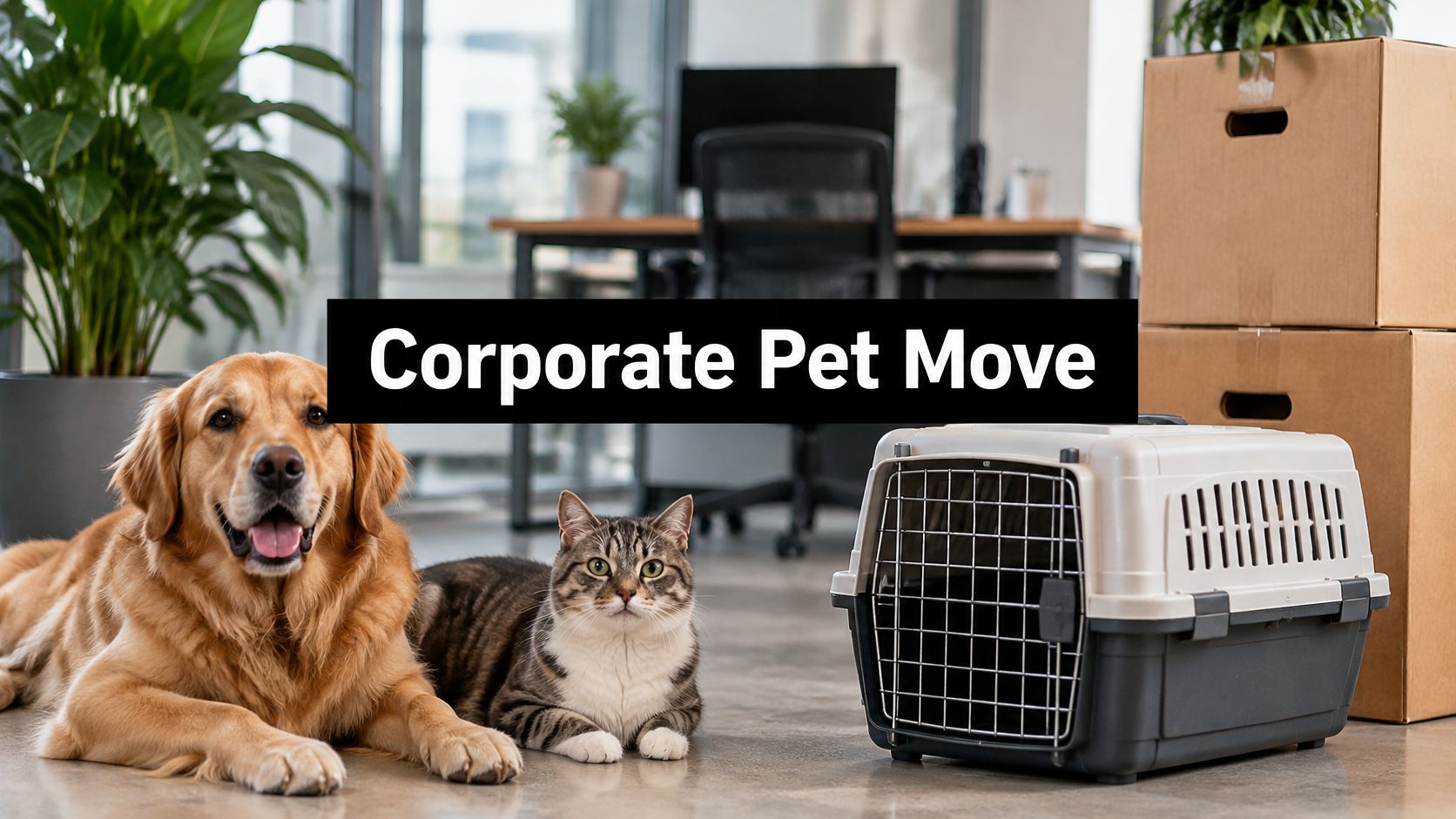
Corporate employees seeking professional pet-relocation assistance rose from 1,163 inquiries in 2019 to 4,545 in 2024, a rise of nearly 300%, according to Starwood Pet Travel client data reported by PR Newswire. That jump changes the assignment conversation. The dog, the cat, or the pair of both can decide whether a transfer is accepted long before furniture is booked.
Corporate pet relocation is the employer-supported planning, funding, and coordination of moving an employee's pets during a transfer, assignment, or new-hire relocation, domestic or international. Pet benefits look more normal on a benefits menu, while the dollars that move a household have gotten tighter. The gap between those two trends is where moves get approved, capped, or declined.
Table of Contents
- Why Corporate Pet Relocation Is Now a Mobility Priority
- What Employer Pet Relocation Benefits Cover
- How to Plan a Corporate Pet Move Step by Step
- Choosing Between Ground and Air Transport
- International Moves and Compliance Timelines
- Real-World Corporate Pet Relocation Scenarios
- Request a Corporate Pet Relocation Estimate
Why Corporate Pet Relocation Is Now a Mobility Priority
Say a software lead in Maryland accepts a two-year assignment, then opens the mobility packet and finds a house-hunting trip plus a lump sum, with the dogs filed under "personal." The offer still looks generous. The household math doesn't. Corporate pet relocation is the employer-supported planning, funding, and coordination of moving an employee's pets during a transfer, assignment, or new-hire relocation, domestic or international.

HR feels this because pets have moved from a niche perk toward a normal part of employee benefits. SHRM's 2024 benefits reporting found that 22% of responding organizations offered pet health insurance, compared with 14% in 2022, and a later SHRM survey put pet health insurance at 27% of employers, as summarized in a Seyfarth podcast transcript. Those milestones don't mean employers routinely pay for pet transport. They do mean an unresolved kennel, flight, or quarantine question can tip someone away from the assignment. Workplace access stayed uncommon while portable benefits grew, so support usually arrives through a mobility policy, a flexible allowance, or a negotiated reimbursement, not a universal pet desk.
The rest of this guide is the sequence teams and transferring employees need: what employers cover and where caps bite, a six-step planning sequence, ground versus air transport, international compliance timelines, real scenarios, and the next step for employees and HR.
What Employer Pet Relocation Benefits Cover
Recent 2025 figures show that 49% of surveyed employers offered some form of pet-shipment assistance, up from 37% in 2022, yet among employers offering assistance, 43% limited the number of pets, 29% imposed a cash cap, and 20% restricted eligible pet types, as reported by Yahoo Finance. A benefit that exists on a slide can still stop at one animal, a dollar ceiling, or "dogs and cats only."
That assistance usually sits inside broader mobility budgets that have thinned. SHRM's 2013 Employee Benefits survey found that 32% of organizations offered a relocation lump-sum payment and 20% reimbursed shipping fees. By 2025 those shares were 27% and 11%, a 5-point drop in lump sums and a 9-point drop in shipping reimbursement, in the SHRM benefits surveys. Coverage follows seniority, destination, and documentation. It isn't a universal entitlement, which is why teams comparing corporate relocation services should read the pet lines before they read the furniture lines.
Four funding models side by side
| Support model | How it works | Best fit | Watch out for |
|---|---|---|---|
| Direct billing to employer | Provider invoices the company; employee handles approvals and paperwork | Executive moves and international assignments | Needs a named policy owner and pre-approval |
| Receipt-based reimbursement | Employee pays, then claims itemized receipts under the mobility policy | Standard transfers with a broad moving allowance | Caps, eligible expenses, and claim deadlines vary |
| Lump-sum relocation payment | One payment covers the whole move; employee sets priorities | Flexible domestic relocations | Pet costs compete with shipping, housing, and travel |
| Pet-specific allowance | A set dollar or per-pet budget for transport, boarding, and compliance | Companies with formal pet-shipment assistance | Cash caps and pet-count limits can sit below real cost |
Expense buckets policies split apart
Transport is only one line. Policies often treat these buckets differently, and employees lose money when they assume one approval covers all of them.
- Transport itself: The van, the cargo space, or the cabin fee.
- Veterinary visits and certificates: Exams, vaccines, lab work, and the paperwork that has to match the travel date.
- Import permits: Destination paperwork that can sit outside the moving allowance entirely.
- Quarantine: Lodging and care after arrival, sometimes for weeks.
- Temporary boarding: Origin or destination kennels when the employee flies ahead.
- Pet-friendly temporary housing: A deposit or nightly premium the housing vendor treats as personal.
Employees ask the same four questions. Does reimbursement cover multiple pets, or only the first? Are cats, large dogs, and exotic animals treated differently? Is transport paid directly, or reimbursed after arrival? What happens when the approved allowance falls below the actual invoice? The honest answers live in the written policy, not in a recruiter's verbal "we'll take care of the pets."
Practical rule: A cap set below the real cost of a two-dog international move leaves the employee funding the difference. Policy design, not the existence of a benefit, decides whether the move is affordable.
Companies that are adding pet coverage to benefits packages still need a separate mobility rule for the trip itself. Insurance helps with illness. It doesn't book the crate, the border exam, or the second animal.
How to Plan a Corporate Pet Move Step by Step
Treat the move like a project with a reporting date at the end, not like a reservation you make the week you pack. Government guidance notes that destination rules may include documentation, quarantine, vaccinations, tests, and carrier rules that sit on top of those government rules. Airlines typically want health certificates no older than 10 days, and the U.S. Fish and Wildlife Service tells applicants to allow at least 60 days for two digitized permit applications covering international relocation and repeat travel with personally owned exotic pets, per the State Department's pet travel guidance. Ordinary dogs and cats don't follow that exotic path. Birds, reptiles, and other regulated pets can, including CITES or Wild Bird Conservation Act reviews.

Six steps, in the order that prevents disputes
Confirm the benefit in writing. This is the failure point behind most later fights. Get, in one email or policy excerpt, what is covered, the cash or per-pet cap, whether the company direct-bills or reimburses, and who approves exceptions. An undocumented promise from a recruiter isn't a policy. If you skip this step, every later invoice becomes a negotiation.
Build the pet file before anyone quotes the trip. We ask for each pet's age, breed, size, mobility, medical conditions, and medications before booking, plus vaccination records, microchip numbers, and recent photos. A missing chip number or an unlisted heart medication changes both the route and the price.
Work backward from the reporting date. For a domestic move, sequence vet visits, crate fitting, transport booking, and a backup date across roughly two to three months. For an international move, start from the destination calendar instead. Dogs and cats often need four to six months or more, and exotic permits need the longer processing window above. Booking the flight first, then hunting the titer, is how people miss start dates.
Collect written estimates for the same route and dates. Compare ground and air quotes side by side, and mark what the employer will prepay. We provide a written estimate for each pet's trip so the allowance and the invoice can be reconciled before anyone pays a deposit.
Book transport and temporary care together. Size the crate, reserve boarding at origin and destination, and hold a backup pickup date. If the employee flies on Sunday and the pets can't leave until the certificate is signed, the kennel is part of the move, not an afterthought.
Prepare travel day and the first week. Lock the feeding schedule, the handoff documents, and a settling-in plan for the new home. A pet that arrives to an empty apartment and a new food brand has a harder first week than the drive or the flight required.
An undocumented "we'll cover the pets" is the sentence employees later regret. Get the cap, the payer, and the approver in writing before you spend a dollar.
Choosing Between Ground and Air Transport
For a corporate move, the transport choice affects both the pet's welfare and the relocation budget. Ground and air each solve different problems, so compare the route, handling needs, and service limits before approving a mode.
| Option | Best for | Cost drivers | Welfare and handling notes |
|---|---|---|---|
| Private ground transport | Door-to-door domestic moves, multiple pets, senior or anxious animals | Route length, pet count, vehicle and care stops | Pickup, routing, care stops, and delivery are planned for the trip |
| Shared ground transport | Budget-sensitive domestic moves with flexible dates | Distance and shared routing | Routing and timing are shared with other animals on board |
| Air cargo | Long domestic legs and international flights, large dogs | Crate size, weight, route, season | Hold conditions, crate posture rules, and heat restrictions affect suitability |
| In-cabin air | Small pets that meet airline cabin limits on shorter flights | Airline pet fee and carrier size | Under-seat space, boarding access, and breed restrictions affect suitability |
Three rules that pick the mode
Start with the route and handoffs. A cross-country move with two dogs and a cat may be easier to coordinate by private ground than through separate cargo bookings. Precious Pets Transport Services provides door-to-door ground travel for dogs and cats across the continental United States, planning pickup, routing, care stops, and delivery.
Fit the container to the pet. IATA's live-animal program identifies temperature, ventilation, hydration, journey duration, container dimensions, handling, and monitoring as welfare considerations. The crate should allow the animal to turn normally while standing, stand or sit erect, and lie in a natural position. For air travel, a Petmate Sky Kennel is durable, well ventilated, and suitable for domestic and international flights. Follow airline requirements for assembly and accessories; too much empty space can also make the ride less stable for the pet.
Compare timing, cost, and handling together. Shared ground rides can cost less, with dates shaped by shared routing. Air cargo can shorten a long journey, while adding airport handling at both ends. In-cabin travel depends on the pet, carrier dimensions, and airline rules all fitting together. For guidance on flying with dogs, compare ground and air for the same route and travel dates before choosing.
Ground travel reduces airport handoffs, but the journey still needs attention to heat, ventilation, hydration, and duration. Care stops and overnight arrangements should account for the animals' needs.
Hot weather adds another constraint for brachycephalic dogs, including pugs, bulldogs, boxers, and Pekinese, which can have difficulty maintaining normal body temperature. Treat season as a hard gate for air routing: a hot-weather hold can make the faster option riskier. For a snub-nosed dog traveling in hot weather, discuss air travel with a veterinarian and consider ground transport as an alternative.
International Moves and Compliance Timelines
There is no universal pet passport. International corporate pet relocation is a destination-specific compliance project, and the control that keeps it honest is a document matrix for each pet and each itinerary.

USDA APHIS states that each destination country sets its own requirements, which may include microchipping, rabies vaccination, laboratory testing, import permits, and a time-limited international health certificate. A USDA-accredited veterinarian completes the certificate, and it may need USDA endorsement through the Veterinary Export Health Certification System (VEHCS). Validity windows can apply to both the exam and the endorsed certificate. Start with the destination's official rules, then build the calendar backward through chip sequence, vaccines, lab lead times, certificate issuance, endorsement, airline or border booking, and any transit country.
For EU-bound pets, APHIS specifies that the microchip must be implanted and scanned before the rabies vaccination. Some routes also require a veterinary inspection within 48 hours of U.S. departure. A chip placed after the vaccine doesn't get "fixed" by a letter. The sequence has to be redone, and the employee's start date doesn't move with it.
Lead times that set the reverse calendar
| Move type or rule | Lead time or validity window | Planning note |
|---|---|---|
| Domestic move | Roughly 2-3 months runway | Book transport and boarding early |
| International dog or cat move | Roughly 4-6 months or more | Build the calendar from destination rules |
| Exotic-pet import or repeat travel permit | At least 60 days processing | Digital FWS application; allow buffer |
| Airline health certificate | Typically no older than 10 days at flight | Time issuance to the flight, not the itinerary |
| EU-bound microchip and rabies vaccine | Chip implanted and scanned before rabies vaccine | Sequence, not calendar, sets the order |
| EU-bound veterinary inspection (some routes) | Within 48 hours of U.S. departure | Confirm the route-specific rule |
The pre-dispatch check
A documentation error can mean denied boarding, border refusal, quarantine, or a costly rebooking. Before anyone dispatches the pet, a second person, not the person who booked the flight, verifies the file.
Check, in this order: chip number against the certificate, vaccine dates against the destination rule, laboratory results and their validity, certificate dates against the flight, USDA endorsement status, and every transit-country rule. If one line fails, the pet doesn't leave.
For international moves, we help coordinate the selected services, which may include flight arrangements, travel kennels, veterinary paperwork, and destination assistance. The fuller international logistics process is worth reading before you promise a reporting date to a hiring manager. Customs doesn't negotiate with a start date.
Real-World Corporate Pet Relocation Scenarios
Three households show how the same rules behave under pressure.
Virginia to Colorado, employee flies first. A project manager starts in Denver on Monday. Two dogs and a cat stay in Virginia until she has keys and a fenced yard. Private ground transport picks them up midweek, with planned care stops and an overnight, and delivers once the house is livable. The lesson sits inside the timing. Pet arrival should follow the employee's start date, not race it. Our founders started a ground service after a family's pets were turned away at an airport and three dogs still needed a ride to a new home. Jill White and Linda Allison have spent 22 years traveling across the United States, caring for hundreds of pets, which is why a midweek road plan beats a same-day cargo gamble when the employee is already in the air.

One cat, bound for Germany. The family implants and scans the microchip before the rabies vaccine, waits out the titer, then files for USDA endorsement through VEHCS. The health certificate is issued inside the airline's short window, not when the household goods leave. The lesson is that the calendar runs on the most restrictive document, not on the date that feels convenient.
A capped allowance and a large dog in July. The approved budget covers neither a summer heat reroute nor the second pet. The employee brings an itemized quote, asks HR for a named exception, and shifts travel to fall. The lesson is to surface the cap gap before anyone pays a nonrefundable booking. Waiting until the airline rejects the breed in hot weather turns a policy problem into a welfare emergency.
Request a Corporate Pet Relocation Estimate
Employees and HR don't need the same next step.
If you're the employee, read the relocation policy before you accept dates. Assemble the pet file, then request a written estimate that itemizes transport, kennels, veterinary paperwork, and boarding. Reconcile that total against the employer cap before you book. A quote you can't compare to the allowance is just a surprise with a logo on it.
If you run HR or mobility, benchmark current caps against real quotes, define which expense buckets are eligible, and name an exception approver before peak moving season. A policy with no approver becomes a chain of "let me check" emails while certificate windows close.
An accurate quote needs pickup and delivery locations, preferred travel dates, each pet's age, breed, size, mobility, medical conditions, and medications, and the service level you want. Pricing depends on the route, travel dates, the number and size of pets, and the service requested. We've provided ground pet transportation since 2004, and the site includes a pet transport estimate tool so you can price the trip while the policy is still editable.
Late bookings shrink flight options, boarding slots, and certificate windows at the same time. The cost of waiting isn't abstract. It's a start date with no legal way to bring the animal.
Precious Pets Transport Services, LLC plans door-to-door ground trips for dogs and cats and coordinates international moves when the paperwork, the crate, and the route all have to line up. If a transfer, assignment, or new-hire relocation includes animals, start with a written estimate before dates are locked. Visit Precious Pets Transport Services, LLC to request that estimate and see how the trip would run.
Leave a Reply