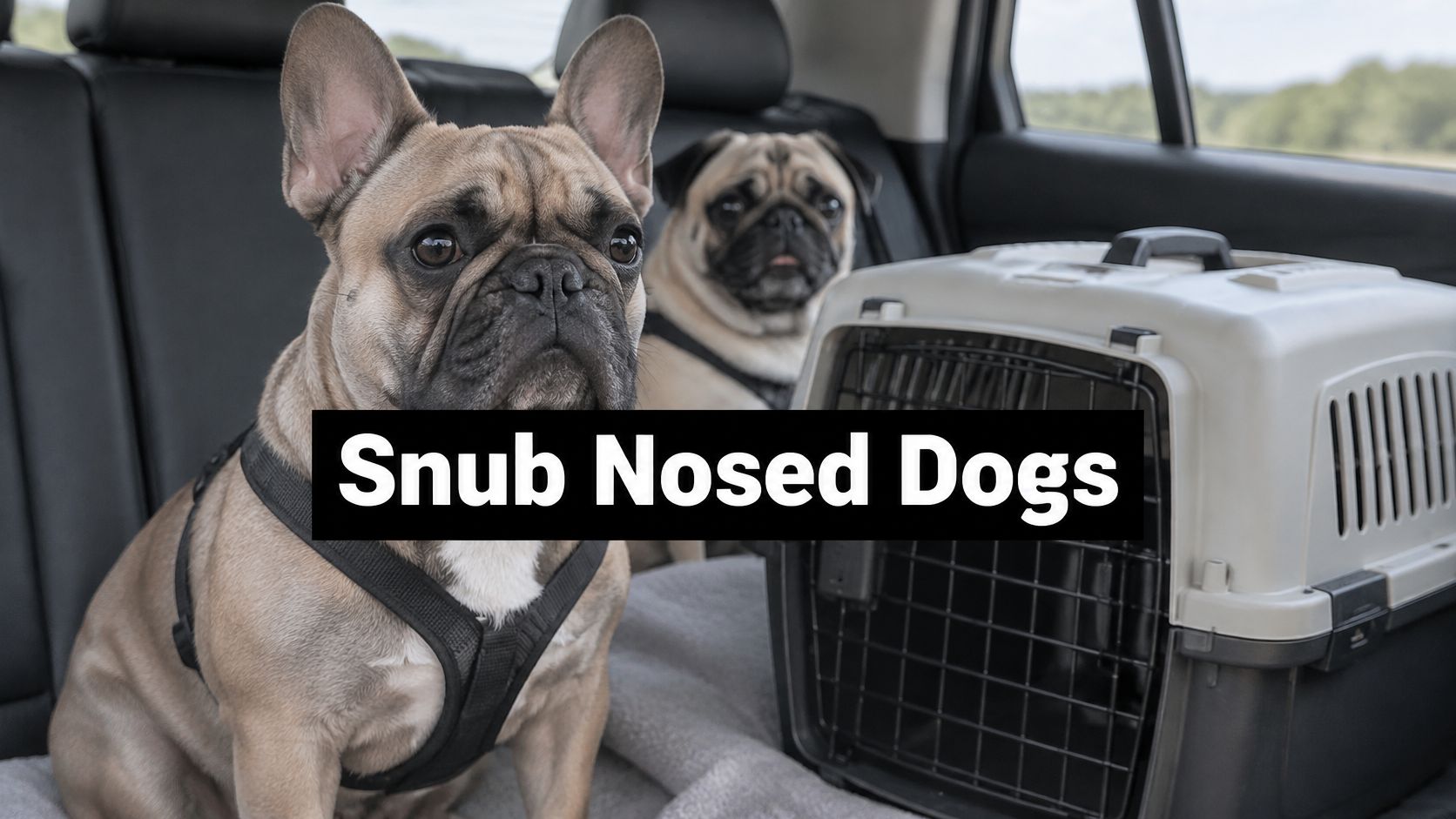
French Bulldog Kennel Club registrations rose by 3,104% in the decade through 2017, according to the British Veterinary Association's position on brachycephalic dogs. That historical registration surge reflects the appeal of flat-faced companions, but their distinctive appearance also deserves a closer look at breathing, cooling, and everyday comfort.
For families moving with snub-nosed dogs, the question isn't whether an airline accepts the breed. Start with the individual dog's health, choose a suitable mode of transport, then plan every loading point, rest stop, and handoff as a possible heat exposure. Caring for these dogs means understanding their limits without assuming that every flat face carries the same risk.
Table of Contents
- Which Dogs Count as Snub-Nosed Breeds
- Why a Short Muzzle Makes Breathing Harder
- Lifespan and Everyday Health Risks
- Anesthesia Risks and Vet Clearance Before Booking
- Matching Air, Ground and Cabin Travel to Your Dog
- Heat Risk Across the Whole Journey
Which Dogs Count as Snub-Nosed Breeds
Snub-nosed dogs, called brachycephalic dogs in veterinary terms, have shortened skulls and flattened faces. Their noses and upper jaws sit closer to the rest of the head than they do in longer-muzzled dogs. Think of a familiar room made shallower without all its contents becoming proportionately smaller.
The trait comes in degrees. A Boxer's moderately shortened muzzle doesn't look like a Pug's extremely flat face, and dogs within the same breed can differ noticeably. The degree of shortening and the dog's actual breathing function matter more than the label alone.
Common snub-nosed breeds and their airway concerns
The table describes characteristic muzzle shapes and concerns worth discussing with a veterinarian. It isn't a diagnosis or a ranking of which breed is safest.
| Breed | Muzzle Type | Typical Airway Concern |
|---|---|---|
| Pug | Extremely short, flat | Narrow nostrils and long soft palate |
| French Bulldog | Extremely short, flat | Narrow nostrils and heat intolerance |
| English Bulldog | Very short, broad | Narrow airways and exercise intolerance |
| Boston Terrier | Short, moderately flat | Airway narrowing and heat sensitivity |
| Pekingese | Short, flat | Airway narrowing and heat sensitivity |
| Shih Tzu | Short, moderately flat | Airway narrowing and heat sensitivity |
| Boxer | Short, moderately flat | Airway narrowing and heat sensitivity |
Pugs, French Bulldogs, and English Bulldogs are among the most recognisable examples. However, a mixed-breed dog can also inherit a shortened face, so an unfamiliar breed description shouldn't end the assessment.
External wrinkles aren't a reliable measure of what's happening inside the airway. Our guide to dogs with lots of skin addresses another visible feature owners may notice, but skin folds and muzzle length need separate attention.
A practical check at home
Look at your dog from the side and front, then observe them rather than encouraging activity to test their limits.
- Facial profile: Notice a very short muzzle or nose set well back toward the forehead.
- Mouth and eyes: Crowded teeth and prominent, wide-set eyes can accompany the shortened head shape.
- Resting sound: Listen for snorting, rasping, or other noisy breathing when your dog isn't exercising.
These observations help you describe your dog accurately to a veterinarian. They don't establish airway disease, and a quiet dog isn't automatically free of obstruction.
Why a Short Muzzle Makes Breathing Harder
A shortened muzzle can work like a narrowed garden hose: moving the same amount through a tighter passage requires more pressure. For a dog, that means more effort with each breath, particularly when heat or activity increases the demand for airflow.
The restriction can occur at several points. Shortened facial bones compress the nasal space, narrowed nostrils limit air entering the nose, and an elongated or thickened soft palate can crowd the back of the throat. These features can occur together rather than acting as separate problems.

Why warmth increases breathing effort
Dogs lose heat through evaporation as they pant. When the airway is restricted, increasing airflow becomes harder just when the dog needs it most.
The sequence is straightforward:
- The surroundings become warmer, so the dog pants more to release heat.
- Air must pass through restricted openings, increasing breathing effort.
- That extra muscular effort produces more heat, while airway obstruction limits effective cooling.
In a controlled heat-stress study summarised in Veterinary Evidence's review of brachycephaly and thermoregulation, 5 of 52 brachycephalic dogs were withdrawn because of respiratory distress, compared with 0 of 53 non-brachycephalic dogs. That observation helps explain why temperature is a health variable, not merely a comfort preference.
Body condition also matters. Excess weight can make heat regulation more difficult, so ask your vet to assess your dog's condition rather than judging it from appearance or breed expectations. A lean condition can improve heat tolerance, although it can't remove an anatomical obstruction.
Recognising effort before a crisis
Pay attention to noise at rest, panting that continues after mild activity, and unusually slow recovery. Watch the effort involved as well as the sound: a dog working hard through the chest and abdomen needs attention even if they aren't especially loud.
Practical rule: Don't use a longer walk or a warmer room to find your dog's limit. Stop activity when breathing becomes harder, and seek veterinary guidance.
Severe difficulty breathing, collapse, or a blue or grey tongue calls for emergency veterinary care. Don't wait for a planned appointment or continue a journey hoping the problem will pass.
Lifespan and Everyday Health Risks
A peer-reviewed review of brachycephalic health and welfare reports a median lifespan of 8.6 years for extreme brachycephalic dogs, compared with 12.7 years for moderate or non-brachycephalic dogs, a difference of approximately 4.1 years. This is a group comparison, not a forecast for an individual pet.
A median describes the middle of a population's recorded lifespans. It doesn't tell you how long your dog will live, whether they need surgery, or whether they can manage a particular move. Those decisions require an examination and a history of how your dog functions.
Notice what your dog can comfortably do
Breathing trouble doesn't always look dramatic. A dog might repeatedly stop during a short walk, struggle to settle in a warm room, or sleep noisily enough that the household treats it as part of their personality.
Brachycephalic obstructive airway syndrome, commonly shortened to BOAS, describes airway obstruction associated with this head shape. Owners may also notice gagging or regurgitation alongside breathing difficulties, so apparently separate digestive complaints belong in the same veterinary conversation.
Keep a brief home record:
- Sleep: Note snoring, repeated waking, unusual sleeping positions, or apparent breathing interruptions.
- Walks: Record the activity, weather, and point at which your dog slows down or stops.
- Warm rooms: Describe whether your dog becomes restless or pants while other household conditions remain unchanged.
- Meals: Log regurgitation, gagging, or vomiting, including when it happens relative to eating.
Make the observations useful
A short video taken without disturbing your dog can help your vet understand an episode that doesn't occur during the appointment. Include context, such as whether your dog had just eaten, walked, or become excited.
Familiar doesn't necessarily mean comfortable. A sound you've heard since puppyhood can still deserve a medical assessment.
The aim isn't to interpret every snore as severe disease. It's to recognise patterns early, when you can arrange an assessment calmly rather than making decisions during an emergency or immediately before departure.
Anesthesia Risks and Vet Clearance Before Booking
A quiet dog in a crate can still be working hard to breathe.
Sedation and anesthesia are different tools, and both need planning when the airway is already tight. A short muzzle leaves less open space for air. Medication that relaxes the dog can also relax the muscles holding that passage open, much like a soft tube that folds when its walls go slack. Sleepiness is not the same as safe breathing, and less activity does not by itself make a journey safer.
Brachycephalic dogs face increased anesthesia-related complications and need an individualized veterinary assessment before travel. For relocation by air, IATA's pet travel guidance cautions against sedation because of potential adverse effects during air transport.
Separate treatment decisions from travel convenience
Potential complications around anesthesia include upper-airway obstruction, prolonged recovery, vomiting, regurgitation, and aspiration-related illness. Aspiration means stomach contents or other material enter the airway and can cause serious respiratory illness.
Necessary treatment still goes ahead with an airway plan and supervised recovery. The owner then needs clear instructions about when travel can resume. Previous corrective airway surgery belongs in the history. It is not automatic clearance for a trip.

Veterinary clearance answers whether this dog can travel. A mode is chosen only after that answer. Heat risk is then planned as a chain of events on that route: loading, waiting, the moving vehicle or aircraft, rest stops, and arrival. A comfortable temperature at the front door does not describe the whole chain.
Follow a clear pre-booking sequence
- Arrange veterinary clearance early. Bring the proposed origin, destination, travel mode, and likely season. Ask whether your dog needs further assessment or treatment before you commit to the itinerary.
- Disclose the full breathing history. Include previous airway surgery, collapse, difficult recoveries, heat-related episodes, and regurgitation. Bring records from other clinics where possible.
- Avoid nonessential sedatives. Do not use leftover medication or an over-the-counter calming product without veterinary approval. If medication is prescribed, obtain written instructions that match the actual journey.
- Choose a plan that permits observation and intervention. Identify emergency veterinary facilities along the proposed route and explain who can authorise treatment if you cannot be reached.
To organise your history and concerns, The Companion Project's resource can help you prepare for your dog's vet appointment. Arrive with a medication list and recordings of concerning episodes, rather than relying on memory during the consultation.
At Precious Pets Transport Services, LLC, we ask before booking for your pet's age, breed, size, mobility, medical conditions, and medications. We also ask about behaviour around people and other animals, feeding instructions, and any history of anxiety, biting, or escape attempts. Those details support a discussion of the proposed arrangements. A breed name is not a complete health history.
Questions before any sedation
Ask your veterinarian:
- Airway assessment: How will you evaluate my dog's breathing risk before administering medication?
- Recovery supervision: What monitoring will continue afterward, and what must be normal before discharge or travel?
- Overnight help: Who should I contact if breathing changes after the clinic closes?
Keep written clearance covering the planned travel with the medical records and travel documents. Ground pet transportation at Precious Pets Transport Services, LLC covers dogs and cats across the continental United States. Veterinary clearance still decides whether a medical condition is stable enough for departure.
Matching Air, Ground and Cabin Travel to Your Dog
Carrier permission and veterinary fitness answer different questions. A snub-nosed dog can be accepted by an airline and still be a poor match for that route, season, or level of help along the way.
IATA's guidance and airline variations advise against hot-weather transport for brachycephalic dogs. One airline-specific variation in that guidance requires a crate one size larger, ventilation on all four sides, an indemnity letter, and temperatures below 27°C. That example is not a universal temperature limit, and it is not a rule shared by every airline.
Transport options and the conditions to verify
| Transport Option | Main Heat Exposure | Requirement to Verify |
|---|---|---|
| Air cabin | Cabin heat and tarmac waits | Airline acceptance plus a separate veterinary fitness check |
| Air cargo hold | Hold temperature and transfer delays | Airline crate, ventilation, indemnity and temperature rules |
| Climate-controlled ground van | Loading, rest stops and waiting time | Continuous climate control and frequent observation |
| Unplanned car journey | Vehicle heat and rest-stop exposure | Temperature alerts and breaks scheduled in cooler hours |
| Combined ground and air | Multiple transitions and tarmac waits | Clearance for each leg and carrier rules for every segment |
Cabin travel keeps a pet near their owner. Carrier dimensions, where the carrier may sit, and airline rules still need checking before you buy a ticket. Cargo uses different handling and limits who can reach the dog in transit. A guide to flying with dogs can help you organise those checks.
Ground travel can skip airport transfers. A longer road itinerary still needs its own care plan. Compare the actual vehicle, stops, and supervision, not only the labels “air” and “ground.”
Decide the mode before designing the stops
Choosing a mode before mapping the stops works like choosing a hiking trail before deciding where to carry water. Shade, rest, and backup help only make sense once you know the path.
Build a decision sheet with these details:
- The dog: Breed or mix, age, body condition, mobility, previous breathing episodes, and exercise tolerance.
- The environment: Season, destination climate, and suitable accommodation along the route.
- The itinerary: Every air segment, ground transfer, carrier change, and expected handoff.
- The contingency: What happens if weather, a cancellation, or a medical concern interrupts travel.
Keep household logistics separate from the pet's fitness decision. For an Australian relocation, Home Removals Sydney's guide can help you plan your Sydney to Perth move, while your veterinarian and pet carriers assess the animal's itinerary independently.
Select the mode only after the medical assessment and the carrier checks. Then treat the chosen journey as a chain of heat-risk events, and build the cooling plan around each handoff, wait, and transfer.
Heat Risk Across the Whole Journey
An air-conditioned vehicle doesn't make every part of a journey safe. A dog can become overheated while waiting outside for pickup, walking at a rest stop, or entering a warm destination home, even if the driving portion is comfortable.
Compared with mesocephalic dogs, brachycephalic dogs had 1.32 times the odds of exertional heat-related illness, 2.36 times the odds of environmental heat-related illness, and 3.07 times the odds of vehicular heat-related illness in the evidence discussed by the veterinary review of heat-related risk. These are comparisons of odds, not predictions that a particular dog will become ill.

Check each transition
Once the transport mode is selected, write down how your dog will stay cool through the entire itinerary.
- Loading at pickup. Cool the vehicle before bringing your dog out. Complete paperwork indoors and arrange a direct transfer instead of leaving the carrier waiting on the pavement.
- Walks and rest stops. Schedule toilet walks during cooler periods where possible. Check that breathing returns toward your dog's normal resting pattern before continuing, and avoid play or excited greetings.
- Waiting in a vehicle. Maintain climate control and use a temperature sensor with an alert near the kennel, not just the dashboard display. An alert supplements supervision; it doesn't replace it.
- Overnight stops. Confirm that the sleeping space is cool before unloading. Keep the kennel away from direct sunlight and observe your dog after the transfer.
- Destination handoff. Have a cool room ready before arrival. Skip the welcome crowd, house tour, and energetic introductions until your dog has settled.
Dense coats and excess body weight can add to heat-management difficulties, so tailor the plan to the individual rather than the weather forecast alone. Our guide to what temperature is unsafe for dogs offers context for discussing conditions with your vet.
Stop criterion: Worsening respiratory effort means stop the activity and assess the dog, not shorten the next break.
Keep the arrival calm
Prepare a quiet, cool room, offer water, and keep exercise gentle. Continue checking breathing, appetite, and recovery from activity over the following days, and contact your veterinarian if your dog isn't returning to their usual pattern.
A successful handoff isn't the end of care. Your dog still needs time to recover from the excitement and settle into unfamiliar surroundings.
Precious Pets Transport Services, LLC offers private and shared door-to-door ground transportation for dogs and cats across the continental United States. If you're relocating with a snub-nosed dog, visit Precious Pets Transport Services, LLC to request an estimate and share your pet's medical history, care requirements, and proposed route so travel arrangements can be considered alongside your veterinarian's advice.
Leave a Reply