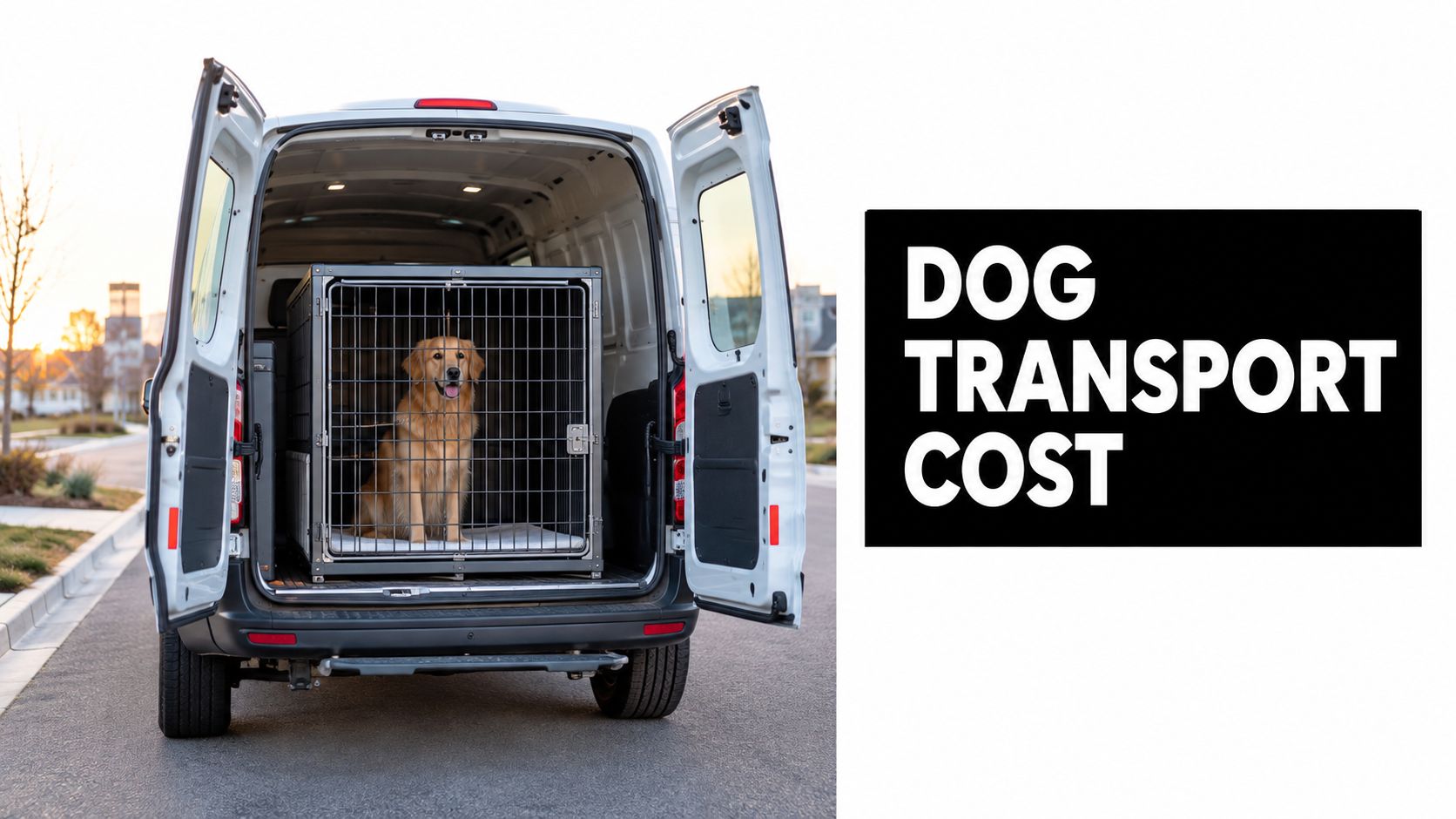
Dog ground transport commonly costs about $0.50 to $1.60 per mile, with 100 to 500 mile trips typically running $200 to $600 and cross-country moves reaching $800 to $2,500 or more. A shared ride may sit near the lower end, while private, door-to-door care can push the same route much higher.
You may be staring at three estimates for the same relocation and wondering whether one company made a mistake. One quote looks surprisingly low, another includes a long list of fees, and the third promises private care but costs far more. The difference usually comes from how the carrier defines the trip, not from mileage alone.
Dog ground transport cost reflects the route, the vehicle space your dog needs, the level of supervision, pickup arrangements, and the paperwork required. Once you separate those pieces, a quote becomes much easier to evaluate.
Table of Contents
- Why Dog Ground Transport Quotes Vary So Much
- How Transport Companies Price a Dog Move
- What Drives the Price of Ground Transport
- Sample Price Ranges and Hypothetical Quotes
- Ground Transport Versus Flying Your Dog
- Getting Accurate Estimates and Vetted Carriers
- Your Next Step to a Confident Transport Decision
Why Dog Ground Transport Quotes Vary So Much
A family moving with a dog from one state to another may receive three very different estimates for the same door-to-door route. One carrier may have space on a shared vehicle already traveling nearby. Another may send a driver specifically for that dog. A third may include overnight care, rural pickup, and more frequent updates in the base quote.
The broad 2026 benchmark is about $0.50 to $1.60 per mile for dog and pet ground transport. Many owners pay $300 to $800 for trips under 500 miles, while a New York to Los Angeles move may reach $2,000 to $3,500, depending on the service arrangement and the dog's needs, according to this 2026 market summary of pet transport costs.
That range gives you orientation, but it isn't a quote. A 1,000-mile journey doesn't have one universal price because the carrier may be selling a place in a group shuttle, a dedicated vehicle, or a more involved relocation service. The mileage is the same, but the number of animals, driver time, route efficiency, and care obligations can all change.
Practical rule: Treat a per-mile figure as the starting point of a quote, not the full definition of the service.
The same route can represent different products
A shared ride works much like a group shuttle. Your dog travels with other pets, and the carrier spreads vehicle and driver costs across the trip. The route may take longer or require a pickup arrangement that fits the carrier's schedule, but the shared structure can lower the price.
A private ride is closer to booking the whole vehicle for one passenger. You pay for greater control over timing, routing, space, and attention. That can make sense for a dog with medical needs, a highly anxious temperament, or a deadline that doesn't match a shared route.
The service level matters just as much. Terminal-style pickup, where you meet the driver at an agreed location, may cost less than door-to-door collection from a rural address. Overnight supervision, climate-controlled transport, and individualized care can also move the estimate upward.
A useful estimate should tell you what you're buying. Ask whether the price includes pickup, delivery, fuel adjustments, lodging or overnight supervision, feeding, medication administration, updates, and required preparation. You're not just comparing numbers. You're comparing journeys.
How Transport Companies Price a Dog Move
Carriers commonly present prices through per-mile, flat-rate, or zone-based models. Think of these as three different ways to package the same road journey. Your first job is to identify the model before judging whether the estimate is affordable.
Per-mile pricing
Per-mile pricing works like a taxi meter. The route distance is multiplied by a stated rate, then the carrier adds any services or surcharges that aren't included in that rate.
For an illustrative 700-mile journey, a rate of $0.50 per mile produces a mileage component of $350, while a rate of $1.00 per mile produces $700. Both calculations sit within published shared-ride and broader ground-transport benchmarks, but neither figure automatically includes door-to-door service, special care, or fuel adjustments. The cited market ranges for shared and private rides are explained in this pet transport pricing guide.
Ask three questions about a per-mile quote:
- Which miles count: Is the carrier charging only loaded miles, or does the estimate account for empty travel to reach your pickup?
- What the rate includes: Does it cover food, walks, updates, overnight care, and delivery?
- What changes the rate: Can fuel, rural access, short notice, or special handling add to the total?
A low number on the meter can become expensive if the carrier adds separate charges afterward.
Flat-rate pricing
Flat-rate pricing resembles a fixed-price package tour. The carrier gives you one agreed amount for a defined service, often based on the route, dog size, timing, and care requirements rather than a visible mileage calculation.
The useful worked example is not a made-up dollar figure. Suppose your 700-mile estimate says one fixed price for private door-to-door transport. You then compare that package with a shared per-mile offer calculated from the same route. The flat-rate option may cost more upfront, but it can include services that the per-mile quote lists separately.
Read the inclusions carefully. A flat rate is only predictable when the carrier defines the boundaries. Confirm whether a change in pickup address, waiting time, additional animal, overnight stop, or requested delivery window changes the agreement.
Zone-based pricing
Zone-based pricing works like postal zones. The carrier groups locations into distance bands or regions and assigns a price to the band instead of calculating every mile. A 700-mile route might fall into one zone, even if two addresses within that zone are not equally convenient to reach.
This model can be easy to understand when your addresses are near major routes. It can be less transparent when you live far from the carrier's normal corridor. Ask which zone applies, whether the quote covers both endpoints, and whether rural access creates an added charge.
Your dog's travel crate also belongs in the planning conversation. If air transport is an alternative, the Petmate Sky Kennel is one airline-travel option that, when properly assembled with metal hardware and airline-compliant accessories, is suitable for domestic and international flights.

What Drives the Price of Ground Transport
Mileage gives you the outline of a move, but operational details fill in the bill. Two dogs can travel along the same highway while requiring very different amounts of vehicle space, driver attention, and planning.

Route and vehicle time
Longer routes require more fuel, driver time, scheduling coordination, and possible rest or overnight arrangements. A carrier also considers whether the route follows an established corridor or requires a detour to reach your address.
Fuel changes can appear as a separate line item. One provider publicly listed a $0.10 per mile fuel surcharge in addition to base mileage pricing. Shared rides can reduce the cost per pet because several customers share the vehicle and driver expense, while rural pickups, short-notice bookings, medical needs, and breed-specific care can increase it, as described by this ground pet transport provider.
Dog size, temperament, and care
A large dog may need more crate or floor space than a small dog. An anxious, reactive, or medically fragile dog may also require a private arrangement or more careful scheduling. Those needs affect how many pets a carrier can safely transport and how much attention the driver must provide.
Tell the carrier about medication, mobility limitations, feeding routines, car sickness, reactivity, and previous travel behavior. Hiding a concern may produce a lower preliminary quote, but it can lead to a revised price or an unsafe plan later.
Pickup, delivery, and supervision
Door-to-door service requires the driver to reach both addresses, coordinate handoffs, and manage access at each location. A terminal-style meeting point can be more economical if you're able to bring your dog to a convenient hub.
Long journeys may require overnight supervision, feeding, walks, cleaning, and schedule adjustments. Ask whether the same driver stays with your dog and whether overnight care is part of the base price or arranged through another facility.
For a practical overview of how ground routes, vehicle arrangements, and care responsibilities fit together, review this guide to pet shipping ground transportation.
Paperwork and risk management
Domestic interstate moves may require current veterinary documentation, vaccinations, and health records. International relocations can add destination-specific rules, endorsements, import documents, and timing requirements. The carrier may coordinate some of this work, but you need to know which tasks remain yours.
Insurance coverage, driver screening, first-aid preparation, and vehicle sanitation also support the service. They may not appear as separate fees, but they form part of what you're paying for when you choose a professional carrier.
Before requesting an estimate, list the factors that apply to your move:
- Route: distance, major cities, rural addresses, and preferred dates.
- Dog profile: size, breed, temperament, health, and medication.
- Service level: shared or private, terminal or door-to-door, and update preferences.
- Care needs: feeding, walking, overnight supervision, and special handling.
- Compliance: domestic documentation or international travel requirements.
That list lets a carrier price the actual job instead of giving you a generic mileage figure.
Sample Price Ranges and Hypothetical Quotes
The ranges below are planning examples, not guaranteed offers. The lower end generally aligns with simpler routes, shared space, flexible scheduling, or convenient pickup points. The higher end becomes more likely when you request private transport, door-to-door handling, special care, or a time-sensitive departure.
| Trip Length | Typical Price Range | What Raises the Price |
|---|---|---|
| About 300 miles | $200 to $600, based on the published range for 100 to 500 miles | Private vehicle use, door-to-door pickup, a large or anxious dog, rural addresses, or short notice |
| About 1,000 miles | $500 to $1,200, based on the published range for 500 to 1,500 miles | Exclusive routing, overnight supervision, special-care protocols, fuel adjustments, or limited scheduling flexibility |
| Cross-country move of 3,000 miles or more | $800 to $2,500 or more, depending on dog size and care level | Private transport, multiple overnight arrangements, remote pickup, a fixed deadline, or intensive care |
These planning ranges come from a 2026 guide to pet transportation costs. Use them to identify an order of magnitude, then request an itemized estimate based on your exact addresses and dog profile.
Reading the regional example
For a 300-mile move, a shared carrier with convenient handoff points may sit closer to the lower part of the range. Door-to-door service can push the estimate higher because the driver must handle both residential addresses and any access challenges.
The key question is whether the quote includes the entire trip. A mileage figure may exclude a pickup fee, fuel surcharge, or care charge. Ask for one total and a separate list of optional or conditional fees.
Reading the 1,000-mile example
A 1,000-mile relocation often exposes the difference between a group shuttle and a private route. A shared service may align your dog with an existing itinerary, while private transport assigns vehicle capacity and driver time to your move.
A cheap per-mile rate can mislead you. Compare the final total, the delivery window, the number of overnight stops, and the amount of direct care. A lower rate isn't a bargain if the quote excludes the services you need.
Reading the private cross-country example
Private long-haul transport can move well beyond ordinary shared-ride planning. One provider lists 10-hour drives at $2,200 to $2,400 and cross-country ground moves around $6,000 to $6,400, illustrating that private service can reach the thousands, as shown on this pet transport marketplace pricing page.
That doesn't mean every cross-country move costs those amounts. It means “cheap ground transport” usually describes a short or shared route, not an exclusive trip with maximum scheduling control. If your dog needs a private vehicle, ask why, and make sure the price reflects the safety and care reason rather than an unexplained premium.
Ground Transport Versus Flying Your Dog
Choosing ground or air transport isn't only a contest between two price tags. The right option depends on your dog's temperament, the route, the destination's rules, your schedule, and how much hands-on coordination you want to manage.
Ground transport often fits short-to-mid-distance domestic moves. Your dog can travel through a planned route with regular care, and door-to-door delivery can remove the need for airport handoffs. Ground service may also suit dogs that become distressed by airports, air travel, or cargo handling.
Flying can make more sense across extreme distances, especially when ground travel would require a lengthy route with multiple care arrangements. International destinations may require air cargo or other specific travel procedures, so the destination country's rules should guide the decision rather than preference alone.
| Decision factor | Ground transport | Air transport |
|---|---|---|
| Route fit | Often practical for domestic short-to-mid-distance moves | Often faster over very long distances |
| Pet experience | More direct supervision and planned road care | Airport and airline procedures can be more restrictive |
| Pickup | Door-to-door service may be available | Airport handoffs are usually part of the process |
| Scheduling | Shared routes may limit dates, while private service offers more control | Flight schedules, airline rules, and weather can affect availability |
| Preparation | Still requires appropriate records and travel preparation | Crate and airline requirements can be stricter |

Match the mode to the dog
A dog that settles well in a vehicle may handle a ground journey comfortably, particularly when the carrier explains rest, feeding, and supervision procedures. A dog with significant travel anxiety, medical needs, or a temperament that makes shared transport unsuitable may require a private ground plan or veterinary guidance before departure.
Air travel can shorten the time in transit, but it brings its own preparation steps. Confirm crate specifications, airline acceptance, connection handling, documentation, and responsibility for the dog during each stage.
Owners considering alternatives can also review practical guidance about travel with pets on private planes, particularly when ordinary commercial scheduling doesn't fit their circumstances. Private aviation is a distinct option, so compare its logistics separately from a standard commercial flight or ground quote.
A broader overview of available providers and service formats appears in this guide to pet transport services. The best choice is the one that provides a safe, workable plan for your dog and your actual route, not just the mode that looks cheapest before preparation and handling are included.
Getting Accurate Estimates and Vetted Carriers
You can often reduce unnecessary cost without reducing care. The first step is to decide which parts of the service are essential and which parts are flexible.
Flexible dates may help a carrier place your dog on an existing route. Shared transport can lower the cost when your dog's needs and timing allow it. A terminal-style meeting point may also cost less than two residential stops, especially when the addresses sit away from a major route.
Summer and holiday periods can bring higher demand and prices. Preparation costs also matter. Health certificates, vaccinations, crates, and other travel preparation can add about $50 to $300 or more, while one 2026 guide cites average ground transport around $0.63 per mile. Review that guide to dog ground transport costs when building your initial budget, then confirm current charges with the carrier.

Lower the avoidable parts of the bill
- Offer date flexibility: Tell carriers which dates work rather than insisting on one departure day.
- Ask about shared routing: Find out whether your dog can travel with other pets without compromising required care.
- Consider a meeting point: Compare terminal-style pickup with full door-to-door service.
- Prepare documents early: Missing records can create delays, rescheduling, and additional coordination.
- Describe your dog accurately: Accurate information prevents a quote from changing after booking.
- Compare the final total: Don't choose based only on the mileage rate.
Pet insurance can also provide sensible pre-travel protection for a dog being relocated. Coverage terms differ, so review exclusions, reimbursement rules, waiting periods, and eligibility before relying on a policy. If your work involves caring for animals rather than transporting your own, this resource on how to find dog walker liability coverage addresses a separate type of protection.
Vet the carrier, not just the estimate
Ask for evidence of USDA licensing or registration, insurance coverage, and the carrier's operating credentials. A professional company should be willing to explain who drives, how drivers are screened, what training they receive, and where your dog stays during overnight portions of the trip.
Confirm the vehicle arrangement. Ask whether it is climate-controlled, how crates are secured, how often dogs receive care, and whether the driver remains with the animals overnight or uses an outside facility. The answer should be specific enough for you to understand the chain of responsibility.
Recent customer feedback can reveal whether a carrier communicates clearly when routes change. Look for comments about pickup coordination, updates, condition on arrival, and how the company handled questions before the booking.
Request an itemized estimate
Send the carrier the same information each time:
- Pickup and delivery addresses
- Preferred dates and deadline
- Dog's size, breed, age, temperament, and health needs
- Shared or private preference
- Terminal or door-to-door preference
- Medication, feeding, walking, or overnight requirements
- Domestic or international destination
Then ask these questions directly:
- What is the expected timeline from pickup to delivery?
- Which services are included in the quoted total?
- Are fuel, rural pickup, short-notice, waiting, or special-care surcharges possible?
- Who supervises my dog overnight?
- What documents must I provide, and which tasks does the carrier handle?
- What happens if the route or delivery date changes?
- What is the cancellation and refund policy?
- Can you provide licensing and insurance information in writing?
You can use an estimate request form for pet transport to organize those details before contacting carriers. Written, itemized estimates make it easier to compare equivalent services rather than comparing a bare mileage rate with a full-service package.
Your Next Step to a Confident Transport Decision
A reliable dog ground transport cost estimate connects three things: the pricing model, the actual demands of the route, and the carrier's ability to provide safe care. A shared per-mile quote may be appropriate for one move, while a private flat-rate plan may be more sensible for a dog with special needs or a firm delivery deadline.
Use this short process before you book:
- Define the move: Record the route length, addresses, preferred dates, and whether you need shared, private, terminal, or door-to-door service.
- Describe the dog: Include size, temperament, health needs, medications, feeding routine, and previous travel experience.
- Request written estimates: Ask at least two carriers for itemized totals using the same information.
- Question the conditions: Confirm fuel, rural, short-notice, overnight, preparation, and cancellation charges.
- Verify the provider: Review licensing, insurance, driver screening, first-aid preparation, vehicle conditions, and overnight supervision.
- Choose the complete plan: Compare the final cost, care arrangements, timing, communication, and compliance support together.
An informed owner is less likely to mistake a low mileage rate for a low total price. You're also better positioned to spot a quote that excludes the very care your dog needs. Experienced, licensed door-to-door providers should be able to explain the route and supply a clear written estimate before you commit.
If you're moving a dog within the United States or coordinating an international relocation from Virginia, Washington, D.C., Maryland, or nearby areas, Precious Pets Transport Services, LLC provides domestic and international pet relocation, including door-to-door ground transport and guidance with travel requirements. Visit the site to request an estimate that reflects your route, service level, and dog's care needs.
Leave a Reply