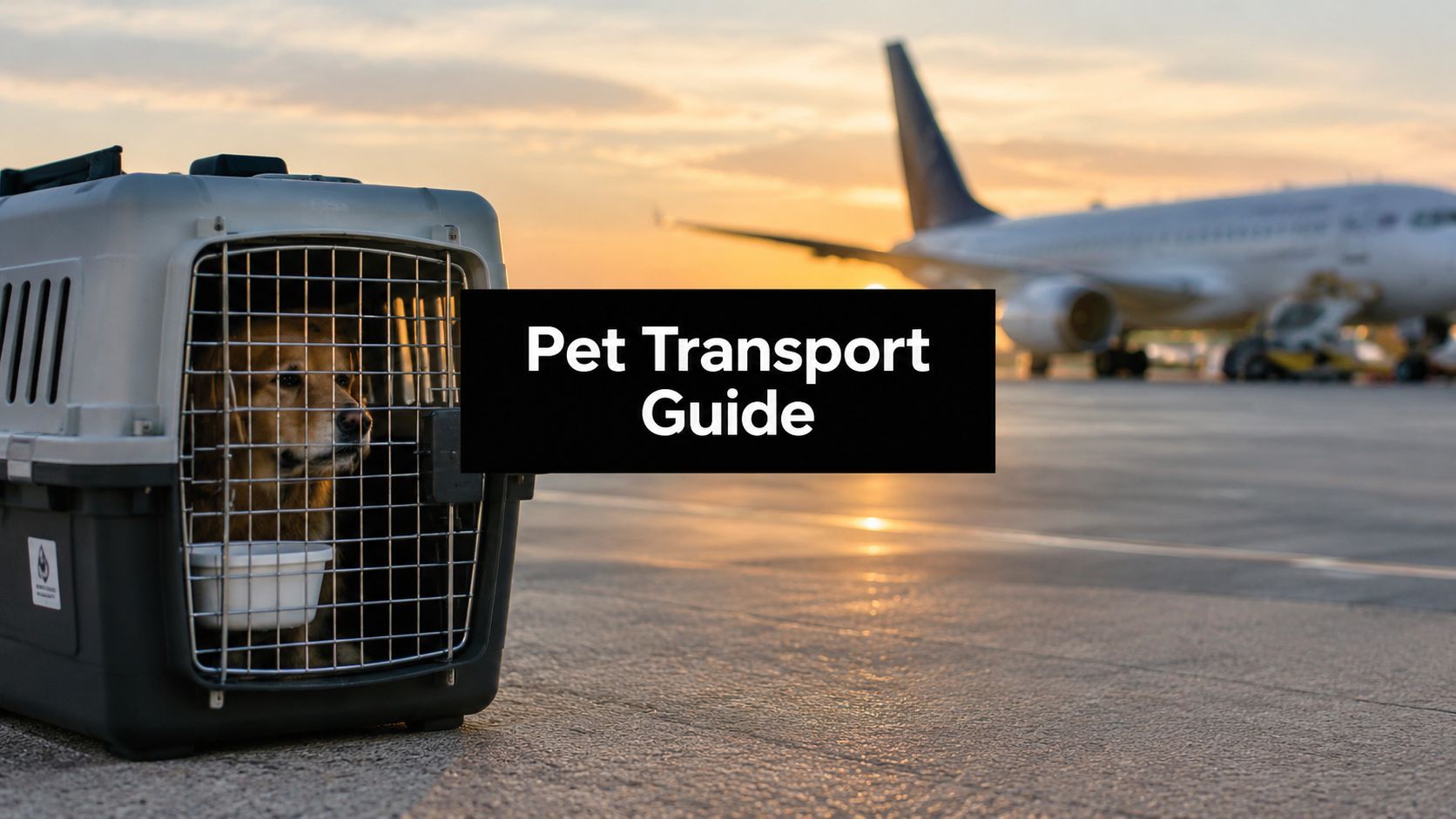
You've accepted a new posting overseas, booked the movers, and started sorting vaccination records. Then someone asks whether your dog's rabies certificate matches the destination's current form, whether your cat's microchip was recorded before vaccination, and whether the airline will accept the kennel you already own. Suddenly, the flight is the easiest part of the move.
An international pet transportation company exists to manage the details that can stop an otherwise well-planned relocation. The work combines veterinary coordination, government compliance, airline cargo planning, ground transportation, crate preparation, and arrival logistics. For families leaving Virginia, Maryland, or Washington, D.C., the right provider can turn a confusing sequence of deadlines into a controlled travel plan.
Table of Contents
- What an International Pet Transportation Company Actually Does
- The International Pet Relocation Timeline and Process
- Documentation and Health Requirements by Destination
- How to Evaluate and Choose a Pet Transport Provider
- Understanding the Cost of International Pet Relocation
- Your Pre-Departure Preparation Checklist
- Common Misconceptions About International Pet Shipping
What an International Pet Transportation Company Actually Does
Consider a family moving from the DC metro area to Europe with a Labrador and an older cat. The family knows the departure date and has chosen a destination city. They may even have airline miles ready. What they don't yet know is whether the pets can enter under non-commercial rules, which health certificate applies, when government endorsement must occur, or whether both animals can travel on the same routing.
A professional coordinator starts by building that answer. The provider checks the destination requirements, reviews each pet's vaccination and identification history, discusses the animals' health and temperament with the family, and identifies an airline and route that fit the pets rather than just matching the cheapest available ticket.

The work behind the booking
The visible service may look like a reservation. The actual work includes:
- Route planning: Reviewing airline policies, transfer points, seasonal operating limits, transit-country rules, and the number of times the pets will be handled.
- Crate specification: Measuring each animal and selecting a container that meets airline and species requirements.
- Veterinary coordination: Scheduling examinations, vaccinations, blood tests, and health certificates in the correct order.
- Document control: Comparing names, microchip numbers, dates, certificate versions, and destination requirements before submission.
- Airport execution: Coordinating check-in, cargo acceptance, ground handling, and updates during the journey.
- Arrival support: Arranging customs clearance, local delivery, and communication when the pets are released.
The IATA Live Animals Regulations are the worldwide standard for transporting live animals by commercial airlines. They require containers for dogs and cats to provide enough room for the animal to stand, turn around, and lie down naturally, while also preventing escape and injury. The rules also address ventilation, construction, labeling, and water and food provisions.
Practical rule: A flight reservation isn't proof that a pet is ready to fly. The pet, crate, documents, route, and acceptance process must all align.
DIY travel versus managed relocation
DIY travel can work for a straightforward trip when the owner has time to verify every requirement and manage each handoff. International relocation becomes harder when the move involves multiple pets, a connection, a strict destination, a military reporting date, or a certificate that must be endorsed within a narrow window.
The market reflects that complexity. The global pet travel services market was valued at USD 2.4 billion in 2024 and is projected to reach USD 3.9 billion by 2030, with a projected 8.9% CAGR from 2025 to 2030, according to Grand View Research's pet travel services market analysis. A separate estimate places the sector at USD 1.32 billion in 2025 and projects growth to USD 2.60 billion by 2034 at a 7% CAGR, reinforcing that cross-border pet relocation is a structured logistics category, not an occasional concierge service.
The International Pet Relocation Timeline and Process
Start with the departure date, then work backward. A practical international move often needs a 60-to-90-day planning window, and some destinations require more time because testing and waiting periods can't be compressed. The coordinator's job is to place every veterinary, documentation, airline, and delivery task on one calendar.

Start with the compliance calendar
Initial consultation: Provide the destination, intended travel date, pet species, breed, age, medical history, origin address, and final delivery address. The provider should identify whether the move is commercial or non-commercial, whether transit countries impose additional rules, and whether the airline accepts the animal and route.
Veterinary preparation: Confirm the microchip number and ensure it can be read consistently. Review rabies vaccination records and determine whether the destination requires a rabies antibody test, an import permit, parasite treatment, or a specific examination interval.
Documentation and endorsement: The accredited veterinarian completes the required certificate. For U.S.-origin moves, the USDA APHIS International Regulations for Animal Exports should be checked because APHIS states that requirements can change by country and date. The coordinator then tracks signatures, submission, endorsement, and return of the final documents.
Prepare the animal and the ground movement
Crate acclimation should begin well before travel day. The crate needs to become a familiar resting place, not a new object introduced at the airport. Feed normal meals, maintain ordinary exercise, and use calm practice sessions rather than forcing the pet inside for long periods.
Airline booking follows the compliance review, not the other way around. From Virginia, Maryland, and Washington, D.C., a ground provider may take the pets to the selected international departure airport, coordinate timing around cargo acceptance, and manage the final handoff. The route should account for the pets' welfare, airline restrictions, connection handling, and weather-related operational changes.
The Petmate Sky Kennel is one kennel option used for airline travel. When properly assembled with metal hardware and airline-compliant accessories, it is suitable for domestic and international flights, and its ventilation and construction make it familiar to professional pet transporters.
Departure, arrival, and delivery
On departure day, the coordinator confirms the crate, labels, documents, water provisions, feeding instructions, and airline acceptance. After the flight, customs and destination authorities review the shipment before the pets can be released. A door-to-door plan continues through local delivery, not merely the aircraft arrival.
The widely cited industry benchmark is that more than 4 million pets travel by air worldwide each year, according to STTAS's overview of air cargo's animal passengers. That scale doesn't make every move automatic. It makes disciplined sequencing more important, because airlines and authorities process each animal against its own documents and destination rules.
Documentation and Health Requirements by Destination
Border control usually exposes paperwork mistakes before anyone notices a problem with the pet. A healthy animal, an accepted crate, and available airline space do not overcome an incorrect certificate date or a microchip record that does not match the vaccination documents.
A working file should contain readable microchip identification, rabies vaccination records, a destination-specific health certificate, and any required import permit or rabies antibody test. Requirements vary with the destination, country of origin, travel purpose, and routing. EU, UK, Australian, and Middle Eastern rules must be handled as separate checklists.

Why the EU changes matter
The EU demonstrates why an old online guide can create a failed shipment. The EU replaced earlier pet-travel rules with Commission Delegated Regulation (EU) 2026/131, effective April 22, 2026, and introduced standardized document models through Implementing Regulations (EU) 2026/705 and 2026/636, according to the European Commission's current EU pet-entry guidance.
That guidance says new health certificates for non-commercial dogs, cats, ferrets, and birds are scheduled to take effect October 1, 2026, while commercial certificates are scheduled for October 17, 2026. The coordinator must match the certificate to the planned departure date and travel category. A form saved from an earlier relocation may no longer be accepted.
A certificate isn't “almost right.” If the destination requires a new model, the old version can be unusable.
Build document version control
Use a destination rule set as the controlling file, then compare every document against it before finalization. Track the pet's legal name, owner details, microchip number, vaccination dates, examination date, endorsement requirements, transit permissions, and certificate validity. This is the operational control that prevents a correct document from being paired with outdated supporting records.
Owners can use this guide to moving with pets overseas to organize questions for the relocation coordinator and veterinarian. Crate measurements, ventilation, fasteners, labeling, and airline acceptance require their own review. See the international pet travel kennel requirements before the cargo appointment, because valid paperwork will not resolve a container rejection.
Set the final veterinary appointment only after confirming the certificate window, endorsement path, and travel date. Work backward from departure so the veterinarian, USDA APHIS, airline, and customs agent use the same current requirements. That sequence catches rule changes before they become an airport problem.
How to Evaluate and Choose a Pet Transport Provider
Choose a provider by asking how the work gets done, not by judging the polish of its website. A credible international pet transportation company should explain who checks destination rules, who communicates with the veterinarian, how the airline accepts the shipment, and what happens when the itinerary changes.
Credentials that deserve verification
| Credential | What It Means | Why It Matters |
|---|---|---|
| USDA license or authorization | The provider operates within applicable U.S. animal transportation requirements | It gives you a concrete regulatory credential to verify |
| IPATA membership | The company participates in an international pet and animal transportation network | It supports access to established relocation contacts and industry practices |
| IATA LAR knowledge | Staff understand container, labeling, handling, feeding, and routing requirements | It reduces avoidable airline acceptance and welfare problems |
| Insurance coverage | The company carries stated business coverage | It clarifies how operational incidents are addressed |
| Verifiable references | Previous clients or professional partners can confirm the service experience | It tests whether promises match execution |
Ask direct questions during the consultation:
- Delay response: Who contacts the airline and family if a flight is delayed or canceled?
- Crate process: Does the company measure the pet, inspect the assembled kennel, and confirm accessories before departure?
- Document workflow: Who checks the certificate version and endorsement timing?
- Tracking: What updates will the owner receive, and at which handoffs?
- Arrival plan: Who handles customs coordination and final delivery?
A provider that promises zero stress, guaranteed entry, or no possible quarantine is overselling control. No coordinator controls every airline, government, medical, or weather variable. A sound provider explains the risk, documents the decision, and gives you a contingency plan.
For a broader look at service models and provider questions, see this pet transportation company resource. Precious Pets Transport Services, LLC is one example of a USDA-licensed, insured provider and IPATA member that coordinates domestic and international relocation, including ground movements from Virginia, Washington, D.C., Maryland, and nearby states.
Understanding the Cost of International Pet Relocation
A quote for international pet relocation isn't one fee for “shipping a pet.” It combines charges created by the animal, the route, the airline, the government paperwork, the departure location, and the amount of hands-on coordination required.
The main categories usually include:
- Airline cargo: The airline's charge is influenced by shipment dimensions, weight, route, and service type.
- Crate: The owner may need to purchase a compliant kennel or replace one that doesn't meet the airline's requirements.
- Veterinary work: Exams, vaccinations, blood testing, and certificate preparation are separate clinical services.
- Government endorsement: U.S.-origin moves may require USDA APHIS processing or endorsement according to destination rules.
- Ground transport: A pet taxi or door-to-door vehicle connects the home to the departure airport and, when arranged, the arrival airport to the new residence.
- Customs and delivery: Destination handling, clearance, inspection, and local delivery can create additional charges.
- Coordination: The provider's fee pays for research, scheduling, document review, airline communication, and journey management.

Why quotes differ
A large dog may need a bigger crate and create different airline charges than a cat. Breed restrictions can reduce routing options. A direct itinerary may cost more than a complex connection, but fewer transfers can reduce handling exposure and simplify the journey. Seasonal weather restrictions can also affect which flights are practical.
Ask for an itemized quote. The cheapest proposal may omit customs handling, document review, ground delivery, or contingency support. That isn't a bargain if the family must solve those gaps at the airport.
Pet insurance can address a different part of the risk. Spot Pet Insurance offers customizable accident and illness coverage for dogs and cats, with reimbursement options and access to any licensed veterinarian, according to the provided product information. Treat it as a veterinary financial-planning decision, not a substitute for airline compliance or transport insurance, and review the policy terms before relying on it during a move.
Your Pre-Departure Preparation Checklist
Use the departure date as the anchor and keep one shared file for veterinary records, destination instructions, airline correspondence, receipts, and final documents. Every adult involved in the move should know where the current version lives.
At least 90 days before departure
- Confirm the destination rules: Identify entry requirements, transit-country conditions, certificate models, and whether the move is commercial or non-commercial.
- Verify identification: Have the veterinarian scan the microchip and compare the number with every existing record.
- Review rabies history: Determine whether the vaccination is valid for the destination and whether a titer or waiting period applies.
- Choose the provider: Compare credentials, insurance, route planning, communication standards, and the scope of the quote.
About 60 days before departure
Schedule the veterinary work that has lead time. Ask the veterinarian which tests and certificates are needed, then give the clinic the current destination instructions rather than an old form from a previous move.
Begin crate acclimation immediately. Leave the kennel open in a familiar area, add safe bedding if permitted, and reward calm behavior. Don't wait until the week of departure to teach a pet that the crate is safe.
The preparing a pet for travel checklist can help structure home preparation alongside the regulatory calendar.
About 30 days before departure
- Confirm the itinerary: Verify flight acceptance, connection handling, temperature policies, crate dimensions, and check-in instructions.
- Reconcile documents: Match names, microchip details, vaccination dates, and owner information across every record.
- Arrange ground transport: Set pickup timing with enough margin for airport cargo acceptance and any required examination.
- Practice normal routines: Keep feeding, exercise, sleep, and medication schedules stable.
About 14 days before departure
Reconfirm the certificate window and endorsement process. Ask the coordinator to identify the exact document version being used and what must happen after the veterinarian signs it.
Inspect the kennel. Check fasteners, ventilation, absorbent material, labels, water provisions, and the animal's ability to stand, turn, and lie naturally. Airline requirements control the final configuration, so don't improvise accessories at the airport.
During the final 48 hours
Feed according to the veterinarian's and airline's instructions, avoid introducing new foods, and maintain ordinary exercise. Pack copies of records, contact information, medication instructions, and a familiar comfort item if the airline permits it.
On departure day, bring the pet to the handoff calm, hydrated, and properly identified. Keep the coordinator's contact details accessible, and ask when the next journey update will arrive.
Common Misconceptions About International Pet Shipping
Cargo travel is always unsafe. Commercial airline animal transport follows the IATA Live Animals Regulations, including requirements for appropriate containers, ventilation, labeling, water, and food provisions. The critical question is whether the airline, route, crate, weather plan, and handling process are appropriate for the individual pet.
Every airline treats pets the same. They don't. Airlines differ in acceptance policies, routing, breed restrictions, temperature procedures, booking channels, and handling practices. A coordinator must evaluate the actual itinerary, not rely on a general statement that an airline “accepts pets.”
My pet can travel on my passport. Your passport identifies you. It doesn't replace the animal's microchip record, vaccination evidence, health certificate, import permit, or other destination documents. Authorities assess the pet against their entry rules.
A transport company can guarantee no quarantine. A provider can prepare documents, identify deadlines, and reduce preventable mistakes. It can't override a government inspection, a medical finding, a rule change, or a document discrepancy.
IATA released new operational guidance in July 2026 covering in-cabin pet travel across booking, check-in, boarding, the onboard experience, and arrival, as described in IATA's announcement on clearer in-cabin pet travel. The guidance itself highlights why owners shouldn't assume every airline handles cabin pets identically.
The right expectation is practical: a professional provider minimizes avoidable risk, keeps the compliance file current, coordinates each handoff, and communicates when conditions change. It can't eliminate every variable, but it can prevent a manageable paperwork problem from becoming a crisis at the border.
Precious Pets Transport Services, LLC coordinates domestic and international pet relocation, including door-to-door ground transportation and guidance through airline, veterinary, and destination requirements. Visit Precious Pets Transport Services, LLC to request an estimate and discuss the logistics of your pet's move from Virginia, Washington, D.C., Maryland, or nearby states.
Leave a Reply