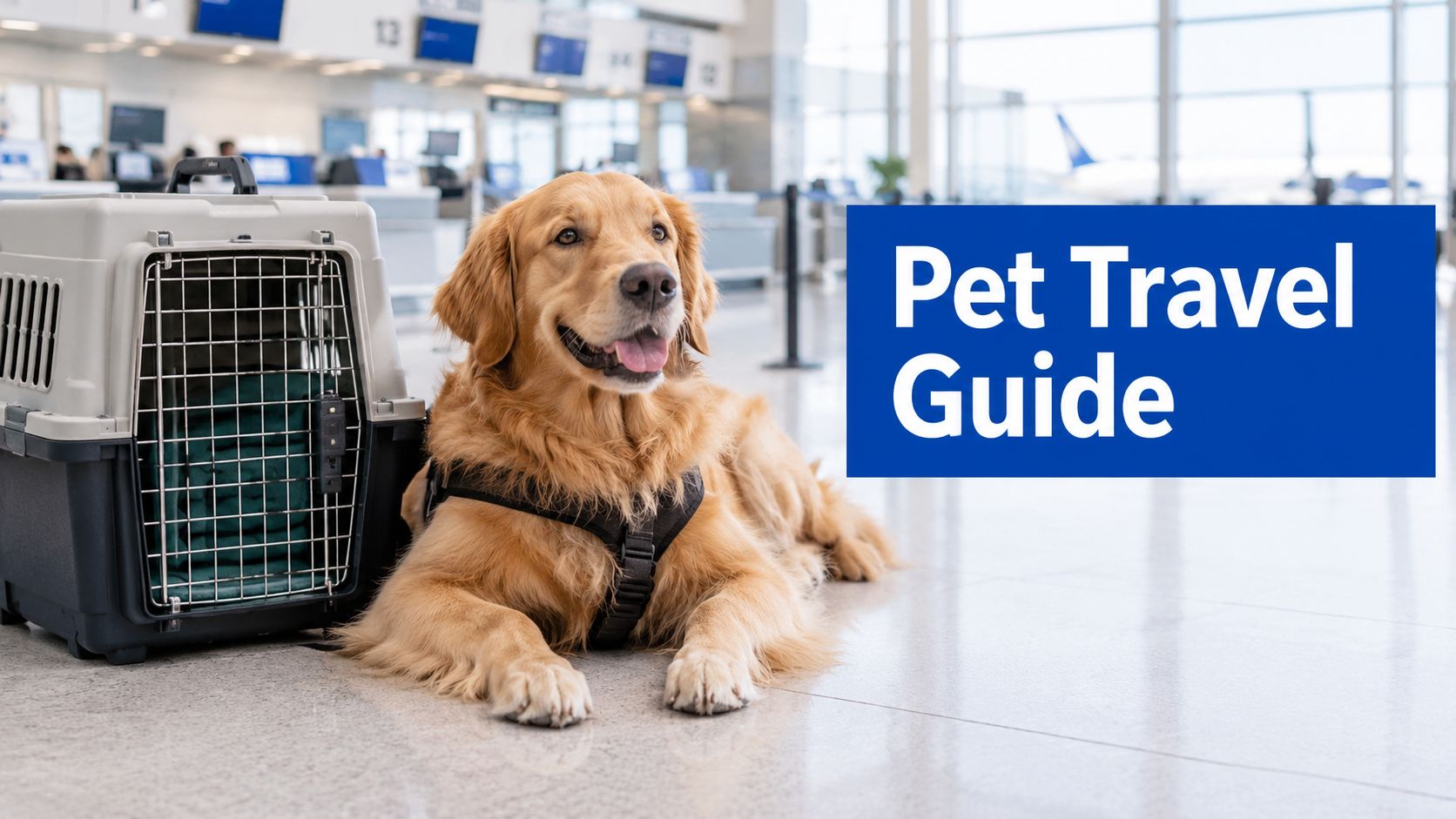
You've booked the overseas move, your departure date is getting closer, and one question keeps interrupting every packing list: how will your pet legally and safely get there? A flight reservation is only one piece of international pet travel. The main work involves veterinary sequencing, destination permits, airline acceptance, crate preparation, airport handoffs, and a backup plan when one document is rejected.
Families usually get into trouble because they treat the journey as a single booking. Treat it instead as a regulated relocation project with several parties responsible for different parts. Your veterinarian handles clinical requirements, government authorities control import rules, the airline controls transport acceptance, and a professional coordinator can connect the front-door pickup with the international cargo handoff.
Table of Contents
- Moving Pets Across Borders: What the Numbers Show
- Navigating the Two-Layer Compliance Model
- Health Certificates and Veterinary Timelines
- Choosing the Safest Airline Transport Mode
- The Role of IPATA Coordination and Ground Logistics
- Protecting Your Pet with Travel Insurance
- Your Six-Month Relocation Action Plan
Moving Pets Across Borders: What the Numbers Show
A family relocating from Maryland to Europe can have flights, housing, and school arrangements ready, then discover that the dog's microchip was entered incorrectly or the health certificate uses the wrong format. A cat leaving Virginia may be healthy and accepted by the airline, yet face a delay because the destination requires an import permit or a test completed within a narrow window. The flight is only one part of the move. Every document must reach the right checkpoint, in the right sequence, before the pet does.
International pet transport is a substantial mobility channel. The International Air Transport Association has been cited as saying that more than 4 million pets travel by air each year on passenger and cargo flights. Emirates SkyCargo reported transporting more than 14,600 pets in 2025, or roughly 40 pets per day across its network, according to STAT Times' overview of air cargo pet transport. The volume reflects recurring relocation work, not an occasional travel exception.
From quarantine barriers to precise paperwork
International entry has become more accessible along many routes, but the paperwork has become more exacting. The United Kingdom's Pet Passport Travel Scheme began in February 2000 and expanded in January 2001, reducing quarantine barriers for eligible dogs and cats traveling from Europe and later from additional countries. The same historical account notes that Brazil, Denmark, France, Germany, Spain, Switzerland, Mexico, and Turkey had eliminated quarantine requirements for dogs and cats by the early 2000s. That shift made cross-border movement more standardized, not informal.
Today, a missed treatment date, incorrect microchip record, or outdated certificate can stop a move that otherwise appears fully arranged. DIY planning often fails at the handoffs, when a veterinarian, government office, airline, cargo terminal, and local transporter each rely on different documents and timing rules. An IPATA-coordinated plan assigns responsibility across the ground-to-air chain, gives each party the documents it needs, and creates a response when one checkpoint rejects a submission.
Practical rule: Give your pet a separate calendar, document folder, route plan, and named person responsible for every handoff.
The scale is global. A 2026 report covering 41,114 international pet relocation records recorded more than 30,000 dog transportation requests and more than 15,000 cat requests, with an average of 1.43 pets per relocation. The report also found that pets moved to 38 countries in 2025. Destination data based on 16,104 inquiries across 129 countries showed that the top 10 destinations represented 75.6% of inquiries, with the United States, United Kingdom, Australia, Spain, and Germany among the leading destinations, according to Starwood Pet Travel's 2026 global report. Popular routes have established procedures, but each still requires route-specific verification.
Navigating the Two-Layer Compliance Model
A pet can clear the airline's booking process and still be refused at the border. The reverse also happens: government paperwork may be correct, while the carrier rejects the crate, route, or operating conditions. Treat these as two separate compliance decisions from the start.
The first layer is airline handling. Airlines set operational rules for crate construction, animal age, breed restrictions, aircraft type, temperature limits, documentation, and cargo capacity. The International Air Transport Association's Live Animals Regulations provide the worldwide commercial-airline handling standard, but each carrier decides which animals, routes, and equipment it will accept under its own policies (IATA Live Animals Regulations).
The second layer is government import compliance. The destination country determines whether your pet may enter, which conditions apply, and which documents officials must see. Airline acceptance does not override an import permit, quarantine rule, inspection requirement, or veterinary certificate problem.
What each layer controls
| Compliance layer | Decision maker | What you must verify |
|---|---|---|
| Airline transport | Carrier and ground handling team | Route acceptance, crate standards, age limits, breed rules, temperature restrictions, and paperwork |
| Destination entry | Government veterinary and border authorities | Microchip, vaccinations, tests, treatments, certificates, translations, permits, and inspection requirements |
Check both layers before paying for a nonrefundable itinerary. A carrier may accept a large dog as manifest cargo while the destination still requires an import permit that has not been issued. A government may accept the certificate format while the airline rejects the crate because its fasteners or accessories fail carrier rules.
The CDC's guidance for traveling with pets and service animals explains that destination rules can require a USDA-accredited veterinarian, USDA endorsement, microchipping, specific vaccinations, parasite treatments, serologic titer tests, or certified translations. As the CDC guidance notes, Mexico introduced an August 2026 screwworm inspection certificate requirement and EU certificate changes are scheduled for October 2026, so an old checklist can create a current problem.

The document audit that prevents a denial
Before booking, compare these items side by side:
- Destination rules: Confirm official import conditions for the exact country and, when relevant, its region or territory.
- Veterinary sequence: Identify which treatments or tests must occur before another step can begin.
- Airline rules: Confirm whether the pet will travel in the cabin, as checked baggage, or as manifest cargo.
- Return requirements: Treat the journey home as a separate compliance exercise. Its entry rules may differ from the outbound route.
- Handoff responsibility: Name the person carrying original documents and presenting them at each airport or border inspection.
An IPATA-coordinated move adds structure at the ground-to-air handoff. The coordinator can align the veterinarian, government paperwork, airline cargo team, and local transporter, then check that the same pet details appear across every document. DIY arrangements leave these gaps for the family to catch under pressure.
For a plain-language introduction to documents commonly associated with pet passports and international movement, Get Pet Vet travel advice explains the terminology. Confirm every point against the destination authority's current requirements.
Crate selection belongs in the same audit. The Petmate Sky Kennel, assembled with metal hardware and airline-compliant accessories, is suitable for domestic and international flights and is used by professional pet transporters.
Health Certificates and Veterinary Timelines
The most common timing mistake is doing the right task in the wrong order. A rabies vaccination may be valid clinically but unusable for a route if the microchip was implanted afterward. A blood test may be completed, but the result may not satisfy the destination's required interval. A health certificate may be accurate, but its endorsement window may close before departure.
Start by obtaining the destination's current requirements and booking a USDA-accredited veterinarian if you're exporting from the United States. The veterinarian should review the route before administering or documenting anything, because the required sequence depends on the destination.

Build the sequence before the departure date
Confirm the destination rules. Identify import permits, microchip standards, vaccinations, testing, parasite treatments, translations, inspection certificates, and certificate formats. Don't rely on a generic international checklist.
Verify the microchip. If the destination requires an ISO-compliant microchip, confirm the format and make sure the number appears consistently in the veterinary record, laboratory paperwork, permit, and health certificate.
Complete required vaccinations. Some destinations require the microchip to be implanted before a rabies vaccination counts. That order matters, so ask the veterinarian to document the microchip number directly in the vaccination record.
Schedule laboratory work. If the route requires a rabies antibody or serologic titer test, arrange the blood draw and approved laboratory process early enough to accommodate the destination's waiting period. Don't book the flight until you understand how the result affects the legal travel date.
Complete treatments and inspections. Parasite treatment, screwworm inspection, or other destination-specific steps may have narrow timing windows. Ask which professional must perform each task and which document proves completion.
Issue and endorse the certificate. The accredited veterinarian prepares the health certificate, then the USDA endorsement process follows when required. Keep the final endorsed documents with the travel file, not buried in checked luggage.
A practical explanation of the USDA certificate process is available through this guide to USDA health certificates for dogs. Use educational guidance to prepare questions, but verify the live requirements for your route through official government channels and your accredited veterinarian.
Protect the date from small changes
Your flight date should be the final point on the veterinary calendar, not the starting point. If the laboratory result arrives late, the certificate needs correction, or the airline changes the routing, you may need to revise the entire sequence. Keep scanned copies for coordination, but assume that original or officially endorsed documents may be required at inspection.
Recent updates make this especially important. The CDC's current pet travel guidance notes that destination rules can require certified translations, ISO-compliant microchips, parasite treatment, or serologic testing, and that requirements may change by destination and carrier. Mexico's August 2026 screwworm inspection certificate requirement and EU certificate changes scheduled for October 2026 are reminders to check for updates close to travel, not just when you first research the move.
Timing principle: Never ask, “Does my pet have a health certificate?” Ask, “Does my pet have the correct certificate, issued and endorsed in the correct window, for this exact destination and airline?”
Choosing the Safest Airline Transport Mode
The safest transport mode depends on the pet, the aircraft route, and the destination's rules. Cabin travel sounds reassuring, but it's usually available only to small dogs and cats that fit the carrier and airline requirements. A large dog, a short-nosed breed, or a pet traveling on a complex itinerary may need a different plan.
IATA's traveler guidance states that only small dogs and cats can usually travel in the cabin, while some airlines and destinations require cargo transport. It also notes that pets generally need to be at least eight weeks old and fully weaned, with additional airline-specific age limits (IATA guidance for travelers with pets).
Airline Transport Modes Compared
| Transport Mode | Size/Breed Limits | Best Use Case |
|---|---|---|
| Cabin | Usually limited to small dogs and cats that fit the carrier and airline rules | A small, healthy pet on a route where the carrier and destination permit cabin travel |
| Checked baggage | Availability depends on the airline, aircraft, route, weather, and pet restrictions | A qualifying pet traveling with an eligible passenger on a permitted itinerary |
| Manifest cargo | Suitable for pets that don't qualify for cabin or checked travel, subject to carrier and government rules | Larger dogs, complex international moves, and routes requiring specialized cargo handling |
Cabin travel gives the owner proximity, but it doesn't automatically make a route safer. Transfers, airport noise, carrier dimensions, and destination restrictions still apply. Checked baggage can appear convenient, yet availability is often more limited than families expect, particularly on international routes or during temperature restrictions.
Breed, size, and routing change the decision
Brachycephalic breeds deserve a conservative assessment because their breathing anatomy can make air travel more challenging. Some airlines restrict or refuse these breeds, and others impose special conditions. Don't assume that a veterinarian's general fitness-to-fly opinion overrides a carrier's breed policy.
Cargo can be the correct option for a large dog because the airline's manifest cargo process is designed for animals that can't travel in the cabin. The carrier still controls acceptance, and the route must be checked for aircraft changes, temperature limitations, and layover handling. A direct route or a carefully managed connection usually reduces unnecessary handling, but never choose a route solely because it has the fewest flight segments. The ground arrangements at each end matter too.
For a detailed review of crate dimensions, ventilation, fasteners, and airline compliance, consult these international pet travel kennel requirements. The crate must allow the pet to stand, turn, and lie down naturally while remaining secure during handling.
Air travel outcomes are generally safe, but risk isn't zero. U.S. carrier reporting showed no losses, injuries, or deaths in April 2026, followed by one reported death in July 2026, as summarized in the IATA traveler guidance above. That's why I recommend a health assessment, no unnecessary sedation, a properly fitted crate, and a route designed around the pet rather than the cheapest available seat.
The Role of IPATA Coordination and Ground Logistics
International pet relocation starts at the front door. The airport is only one handoff in a longer chain that may include a home pickup, a domestic drive, an airline cargo terminal, a destination handler, customs or veterinary inspection, and final delivery.
A poorly planned ground leg can undermine a carefully prepared flight. Long unstructured drives, missed cargo acceptance windows, poor temperature management, or unclear document custody can leave a pet tired and the owner scrambling before the aircraft departure. The ground team needs to know the flight plan, the airline's acceptance window, the crate details, feeding instructions, medication instructions, and the location of every original document.
Why coordinated handoffs matter
An IPATA-connected network gives the relocation coordinator a framework for working with professional transporters and international partners. Membership itself isn't a substitute for checking the individual company, but it helps connect specialists who understand animal transportation, airline procedures, and cross-border handoffs.
The strongest plan assigns one coordinator to the complete journey. That person confirms the pickup time, checks that the driver can reach the cargo terminal within the airline's acceptance window, and ensures the receiving partner knows when and where to collect the pet. Families should receive clear updates at each major handoff rather than having to call several unrelated parties.

The ground-to-air checklist
- Home preparation: Feed, walk, and prepare the pet according to the coordinator's instructions and normal routine.
- Vehicle suitability: Use a climate-controlled vehicle with secure kennels and enough room for safe handling.
- Terminal timing: Build the drive around the airline's cargo acceptance deadline, not the scheduled takeoff.
- Document custody: Keep the health certificate, permits, and identification records organized and accessible.
- Receiving handoff: Confirm who meets the aircraft or cargo facility and how the pet reaches the new residence.
Families considering a door-to-door provider can review the practical scope of pet transport services, including how ground transport and air arrangements fit together. The right service should explain what it handles, what the airline handles, and what remains the owner's responsibility.
A safe handoff is planned before the pet leaves home. It shouldn't be improvised beside the cargo terminal.
Ask for the driver's contact details, the estimated pickup window, the cargo terminal instructions, and the destination contact before travel day. You should also know what happens if the flight is canceled, the airline refuses acceptance, or customs releases the pet later than expected.
Protecting Your Pet with Travel Insurance
Insurance won't correct an invalid import permit or force an airline to accept a pet. It can, however, help you manage the veterinary and financial consequences of an unexpected problem. International relocation brings exposure to flight disruption, urgent treatment, illness before departure, and veterinary care after arrival.
Start by reviewing your existing policy before buying a travel-specific product. Many policies limit coverage by country, waiting period, pre-existing condition, treatment location, or type of incident. Ask direct questions about international treatment, emergency care during transit, cancellation or interruption, and whether reimbursement requires a local licensed veterinarian or specific documentation.
Choose coverage that matches the move
Spot Pet Insurance offers customizable accident and illness coverage for dogs and cats, flexible reimbursement options, and access to any licensed veterinarian. Those features may be useful for a family preparing for relocation, but you must confirm the policy's current terms and whether the benefits apply to the countries and circumstances involved in your journey.
Don't confuse wellness benefits with emergency protection. Routine preventive care, travel preparation, and an accident during transport are different categories, and they may be handled differently by an insurer. Read the exclusions before departure, especially for breed-related conditions, pre-existing problems, sedation, quarantine, and treatment outside the policy's service area.
Create a financial fallback
Keep a separate emergency reserve for veterinary care, an extra night of accommodation, rebooking, ground transport, or a delayed release at the destination. You don't need to predict the exact problem. You need a plan that prevents a stressful border or airline event from becoming a medical and financial crisis at the same time.
Give your relocation coordinator the pet's medical summary and emergency contact details, while keeping the insurer's claim instructions available offline. If your pet takes medication, carry enough for the planned journey and a reasonable disruption, but confirm transport and import rules with your veterinarian and destination authorities.
The sensible position is simple: insurance is a backup layer, not a compliance strategy. Complete the veterinary and import work first, then use coverage and contingency funds to protect the parts of the journey that regulations can't control.
Your Six-Month Relocation Action Plan
A six-month plan gives you room to discover a destination requirement before it becomes a crisis. It also lets you separate tasks that need a veterinarian from tasks that need an airline, government authority, moving company, or ground transporter.

Six months before departure
- Research the destination: Check official import requirements, permit rules, microchip standards, testing, treatments, inspection requirements, and return-trip obligations.
- Choose the veterinary team: Confirm that your veterinarian is USDA-accredited when exporting from the United States and ask for a written sequence of required steps.
- Assess the pet: Discuss age, breed, health, anxiety, crate tolerance, and whether cabin, checked baggage, or manifest cargo is appropriate.
- Review logistics providers: Compare IPATA-connected coordination options, door-to-door ground services, and destination handling arrangements.
- Coordinate the household move: If you're relocating furniture and personal belongings separately, a moving provider such as Webster Moving Co. relocation services may help organize the human side of the move while your pet's transport plan runs in parallel.
Four to three months before departure
Confirm the airline's acceptance rules and identify whether the route is cargo-only for your pet. Reserve the crate, begin calm crate acclimation, and make sure the pet's identification records use the same name and microchip number everywhere.
If the destination requires testing with a waiting period, complete the early veterinary steps now. Don't postpone document review until the health certificate appointment. The certificate is the final expression of compliance, not a substitute for the earlier work.
Two months to several weeks before departure
Book the international route only after the airline and destination requirements align. Confirm the cargo acceptance window, ground pickup plan, receiving contact, and the procedure for a delay or canceled flight.
Recheck the destination's official guidance for changes. Ask the veterinarian to confirm the correct certificate version, treatment window, endorsement process, and document copies. Send the coordinator the pet's records and your emergency contacts, then ask them to confirm what they'll carry and what you must bring.
The final week and departure day
Complete the final examination, certificate, treatments, and endorsement according to the destination's timing rules. Check the crate, labels, fasteners, absorbent bedding, water arrangement, and required airline accessories. Follow veterinary advice about feeding and medication, and don't sedate your pet unless the veterinarian has specifically directed it.
On departure day, keep the originals in a document pouch and arrive according to the cargo or passenger instructions, not your own estimate. Confirm the pet's acceptance before leaving the terminal, then stay available for calls from the airline or coordinator.
Communication rule: Ask for confirmation at pickup, airline acceptance, departure, arrival, customs release, and final delivery.
After arrival, keep the pet's routine familiar, provide water and a quiet space, and arrange veterinary care if anything seems abnormal. Save every document for the return journey. A successful outbound move doesn't automatically satisfy the requirements for coming home.
Precious Pets Transport Services, LLC coordinates domestic and international pet relocation, including climate-controlled ground transportation and IPATA-connected logistics for families moving from Virginia, Washington, D.C., Maryland, and nearby areas. Visit Precious Pets Transport Services, LLC to request an estimate and discuss a door-to-door plan for your pet's route, documents, airline handoffs, and arrival.
Leave a Reply