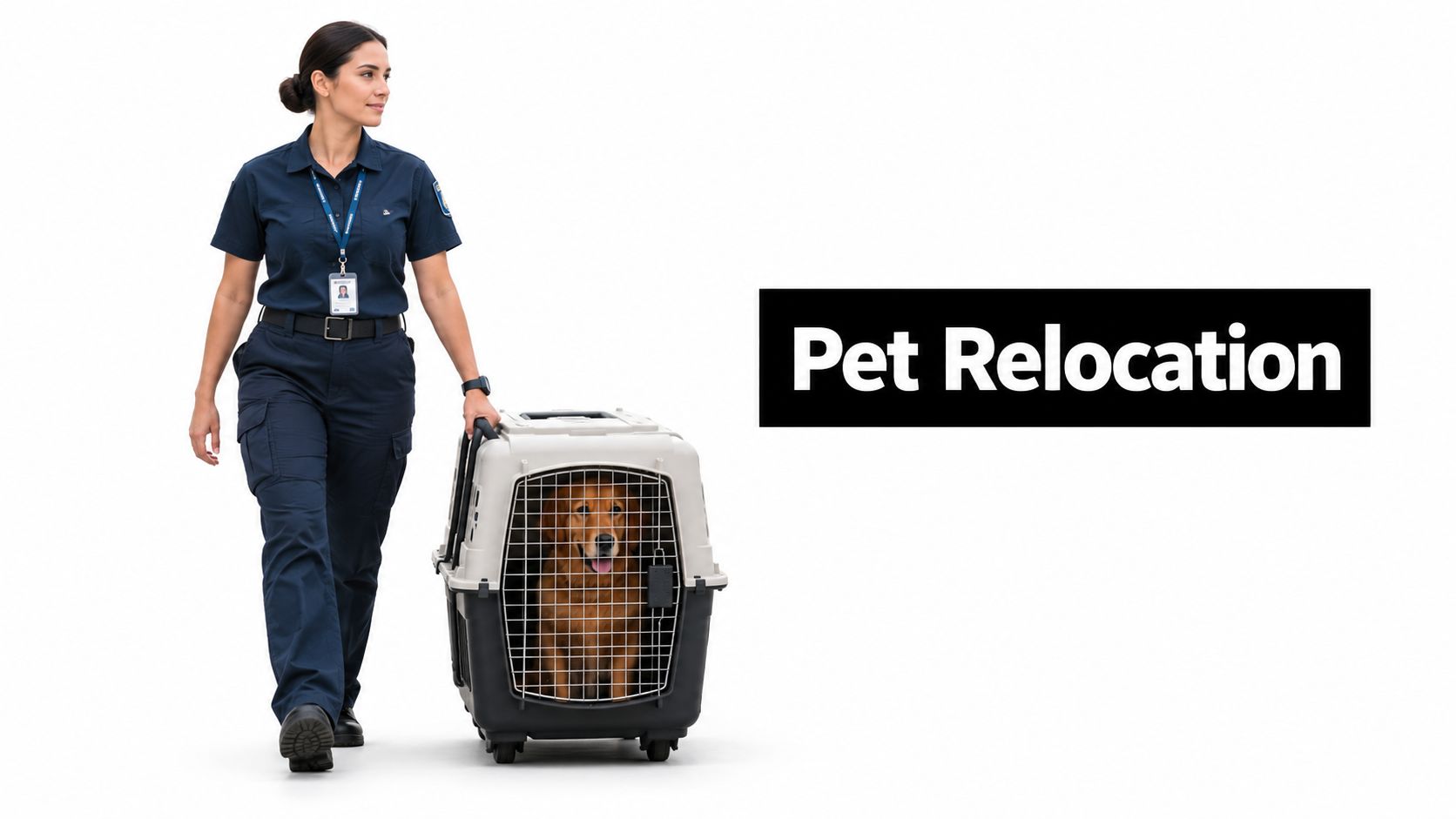
Orders arrive, the household goods schedule fills up, and everyone starts talking about passports, housing, schools, and flights. Then someone asks, “What about the dog?” or “How are we getting the cat overseas?” Suddenly, your pet's journey is competing with every other PCS deadline, and the cheapest available option may already be gone.
Pets are family, but pet transport is also a logistics project with its own rules, receipts, approvals, and destination requirements. Military pet relocation assistance can reduce the financial pressure, but it doesn't automatically arrange the trip or make every expense reimbursable. You'll need to connect the entitlement, any supplemental aid, and the transport plan before money starts changing hands.
Table of Contents
- Why PCS Moves Are Harder With Pets
- What Assistance You Actually Qualify For
- Reimbursement Caps and What They Cover
- Required Paperwork and How to Document Eligibility
- Coordinating With Transport Providers Including Ground Options
- Pitfalls That Make Pet Expenses Unreimbursable
- Your PCS Pet Move Starts Now
Why PCS Moves Are Harder With Pets
A PCS move can feel organized from the outside. Orders are in hand, movers are scheduled, and the family has a rough departure plan. Inside the household, though, the pet's move often stays unresolved because the right option depends on factors people don't control, including transport availability, destination rules, housing restrictions, and the timing of veterinary paperwork.
A family moving from one stateside duty station to another might compare driving, commercial air travel, and professional ground transport. A family headed overseas may need to coordinate government transportation, commercial pet capacity, health documentation, and import requirements at the same time. A missed document or unavailable pet slot can create costs that arrive before reimbursement is even considered.
Practical rule: Treat the pet's travel plan as a separate PCS workstream, not as an item to add after the family's tickets are booked.
The financial side has two distinct parts. The Department of Defense now provides a formal reimbursement framework for eligible pet transportation during qualifying PCS moves. Army Emergency Relief also announced a Pet Transportation Assistance program in 2022 that offers no-interest loans of up to $5,500 for eligible Soldiers and Families, as described by Army Emergency Relief's pet assistance program.
Those tools solve different problems. Reimbursement helps recover eligible costs after the move, while a loan can help a family pay a provider, veterinarian, or transport company before departure. Neither one removes the need to confirm eligibility, preserve documentation, or choose a provider whose services match the approved travel plan.
By the time you finish planning, you should know which assistance may apply, what must be documented, which transport route fits your orders, and where families most often lose reimbursement eligibility.
What Assistance You Actually Qualify For
The most important distinction is between an entitlement and a loan. They may both support a PCS pet move, but they work differently and should be planned separately.
The DoD reimbursement policy took effect on January 1, 2024, authorizing reimbursement for one household cat or dog during a permanent change of station move. The initial framework established reimbursement limits for moves within the continental United States and moves to or from locations outside the continental United States, as described in the Department of Defense pet expense reimbursement guidance.
This is not a general pet-moving fund. The move must be connected to official PCS travel, and the household generally needs to show that the expense was necessary, permitted, and properly documented. The policy also recognizes more than an airline ticket. Depending on the circumstances, eligible expenses can include required microchipping, boarding, hotel service charges, licensing at the new duty station, shipping fees when the service member flies instead of drives, and certain quarantine costs.
The framework was later updated so eligible service members may seek reimbursement when they cannot take the pet to the next permanent duty station. That matters in real PCS situations where government transport, commercial pet capacity, or destination restrictions prevent the pet from traveling alongside the service member.
Two forms of help with different timing
DoD reimbursement is generally a claim-after-payment process. You arrange the approved service, pay the expense, retain itemized records, and submit the claim through the required channel. It may offset the cost, but you still need enough cash or credit to complete the move first.
Army Emergency Relief's Pet Transportation Assistance program addresses that cash-flow problem differently. Its announced program offers eligible Soldiers and Families no-interest loans up to $5,500, subject to program requirements. A loan isn't the same as reimbursement, and it creates a repayment obligation. It can nevertheless be useful when a provider requires payment before the pet travels or when veterinary and transport costs arrive together.
| Assistance type | What it does | What it does not do |
|---|---|---|
| DoD reimbursement | Helps recover eligible, documented PCS pet transport expenses | Guarantee approval for every pet, route, or invoice |
| Army Emergency Relief assistance | Provides potential upfront financing through a no-interest loan | Forgive the expense or replace PCS documentation |

The one-pet limit changes the household budget
The DoD framework covers one household dog or cat per PCS move. If you have two pets, the second animal may create a separate personal expense even when both animals travel on the same itinerary. Multi-pet households should therefore ask providers for an itemized estimate that separates the potentially reimbursable pet from additional animals.
That separation helps in two ways. It makes the claim easier to review, and it shows the family exactly which costs must come from personal funds, a loan, or another assistance source.
Reimbursement Caps and What They Cover
The current DoD benchmark is straightforward, but the conditions around it are not. For eligible service members, the maximum reimbursement is $550 for a CONUS move, $2,000 for an OCONUS move, and up to $4,000 for certain high-risk-country moves when both Patriot Express capacity and scheduled commercial pet service are unavailable. The current framework and eligibility conditions are set out in the DoD guidance on new pet transportation reimbursement.
The higher high-risk-country amount is conditional, not automatic. An expensive itinerary alone doesn't qualify a family for the higher cap. The required transport alternatives must be unavailable, and the family needs the appropriate documentation to show why another route was necessary.
The policy can also cover expenses beyond the basic movement of the animal. Official guidance identifies items such as mandatory microchipping, boarding fees, hotel service charges, licensing fees at the new duty station, shipping fees when the service member flies instead of drives, and quarantine fees in some circumstances. Eligibility still depends on the specific move, destination, authorization, and supporting records.
PCS pet reimbursement caps at a glance
| Move type | Max reimbursement | Key conditions |
|---|---|---|
| Within the continental United States | $550 | Eligible PCS move, one household cat or dog, documented expenses |
| Outside the continental United States | $2,000 | Destination compliance, eligible transport, and required records |
| Certain high-risk-country moves | Up to $4,000 | Patriot Express and regular commercial pet service unavailable, with supporting documentation |
These figures are caps, not promises that the government will cover the invoice. A door-to-door provider may quote a total that includes transport, handoffs, boarding, and destination services. Ask the provider to separate those components before booking so you can compare the estimate with the reimbursement rules. A practical overview of the broader expense categories is available in this guide to pet transport costs.
For airline travel, equipment can also affect whether the itinerary works. The Petmate Sky Kennel is one option used for airline pet travel. When properly assembled with metal hardware and airline-compliant accessories, it's suitable for domestic and international flights, with durable construction and ventilation that professional pet transporters commonly look for.
The best way to use the allowance is to treat it as a partial offset. Price the entire move first, identify the likely reimbursable components, and plan for costs that exceed the cap or fall outside the approved category.
Required Paperwork and How to Document Eligibility
A reimbursement claim is easier to defend when every expense has a clear connection to the PCS, the pet, the destination, and the approved transport plan. The work starts when orders arrive, not when the pet is handed to the driver.
Begin by confirming that the move qualifies under official PCS orders. Ask the transportation office or the appropriate installation contact what approval is required before you commit to a provider. If government transportation is directed and available, use it as required. If it isn't available, obtain a written note from the Traffic Management Office or Installation Transportation Office confirming that limitation.
Build the file before booking the trip
Create one digital and one physical file for the move. Keep the PCS orders, pet ownership records, estimates, approvals, invoices, receipts, and communications together. Save the original itemized documents rather than relying on a credit card statement that only shows a total.
Your records should distinguish between services. A provider invoice should identify transport, boarding, handling, crate-related charges, and other services separately where possible. For veterinary work, retain vaccination records, microchip confirmation, health certificates, and any destination-specific paperwork. If quarantine applies, keep the official documentation and the invoice showing what was charged.
Destination rules can change the entire sequence. For example, a required veterinary certificate may need to be issued within a particular validity window, while an import process may require earlier preparation. Use the destination's official instructions and review a practical guide to the USDA health certificate for dogs as part of your planning, then confirm the current requirements with the responsible authorities.
Coordinate the approval trail
The safest sequence is to verify eligibility, identify the required transport channel, obtain written guidance when government transport is unavailable, and only then finalize the provider and itinerary. Ask the provider to send a written estimate that names the pet, origin, destination, travel dates, service type, and each charge.
Keep emails and written messages that explain why a particular route was chosen. If commercial pet capacity is unavailable, save the provider's response. If a government flight cannot accommodate the pet, retain the transportation office's written confirmation. These records help connect the expense to the reason the approved alternative was necessary.
Documentation habit: Every receipt should answer three questions: whose pet was moved, why the service was needed for the PCS, and what exactly the payment covered.

Keep health and protection records separate
Veterinary paperwork proves travel compliance, but it isn't the same as reimbursement approval. Store both files. If you use Spot Pet Insurance, its customizable accident and illness coverage for dogs and cats is separate from PCS reimbursement, though the company describes flexible reimbursement options, multi-pet discounts, and access to any licensed veterinarian.
Do not wait until arrival to reconstruct the claim. Request receipts as services occur, confirm that the final invoice matches the estimate, and submit through the correct finance channel within the applicable deadline.
Coordinating With Transport Providers Including Ground Options
The right transport method depends on the route, the pet, the installation, and what the transportation office requires. There isn't one universal answer. The practical choice is the option that satisfies destination rules, gives the family a reliable handoff plan, and produces documentation that matches the approved expense.
Government transport and commercial air
Patriot Express may be relevant for some overseas assignments, particularly where official channels are required or commercial pet capacity is limited. An OCONUS family should ask about pet space as soon as orders allow, because a family's passenger reservation doesn't automatically guarantee a pet reservation. Confirm the pet's acceptance, crate requirements, check-in process, and what happens if the family's travel date changes.
Commercial air can work for pets accepted through an airline's pet program or cargo service, but capacity and routing vary. A family traveling within the United States may compare the stress of air cargo with a long drive, especially if the pet is elderly, anxious, or too large for cabin travel. Ask who handles the animal at each handoff, where the pet waits between legs, and which documents the airline requires at acceptance.
The airline route can look cheaper until you add a compliant kennel, airport handling, boarding caused by schedule changes, and the risk of a missed connection. A written estimate should show those assumptions before you authorize payment.
Door-to-door ground transport
Ground transport can be a strong fit for a CONUS move or for one leg of a larger international plan. Door-to-door service reduces the number of family-managed handoffs, but only if the provider explains the route, care schedule, overnight arrangements, and delivery process clearly.
Ask whether the company uses climate-controlled vehicles, sanitized kennels, trained drivers, regular exercise breaks, and written status updates. For example, a professional provider may describe dogs being walked at least four times daily, cats receiving litter box access, and drivers trained in pet first aid. Those are service details to verify in writing, not assumptions to make from a company name.
A transporter with international experience can also coordinate the domestic leg before an overseas flight. IPATA-member pet transporters may help families organize documentation, airline coordination, and handoffs across more than one provider.

Compare providers by accountability
Request estimates from providers that can state exactly what they'll do. The estimate should identify pickup and delivery locations, dates or scheduling assumptions, care during transit, required supplies, cancellation terms, and the person responsible for updates.
Ask one final question before booking: “Which part of this invoice can you document for a PCS reimbursement claim?” A provider can't approve your claim, but an itemized answer can prevent a vague invoice from becoming a paperwork problem later.
Pitfalls That Make Pet Expenses Unreimbursable
An authorized PCS doesn't make every pet expense eligible. The claim can fail because the pet can't enter the destination, can't live in government housing, can't board the selected flight, or traveled through a route that wasn't properly documented.
Breed restrictions deserve early attention. Check installation and destination rules before signing a lease or reserving transport. Government housing may have its own restrictions, and a commercial carrier may refuse a pet even when the family's PCS orders are valid.
Airline capacity creates a different problem. If the family waits until the last moment and books a private alternative after official or commercial options disappear, the reimbursement file may not show why that expense was necessary. Ask for written capacity responses and keep them with the claim.
Quarantine rules can also affect both timing and cost. Verify destination requirements before booking human travel, then ask the veterinarian and transporter how the pet will move through the required process. A missed quarantine condition can lead to delays or charges that the family didn't anticipate.

Keep the handoff calm. Send familiar bedding or a safe comfort item, preserve normal feeding instructions, and ask the transporter for written updates at agreed points. Those steps won't change reimbursement eligibility, but they can reduce confusion and help you spot a delay before it becomes a crisis.
Your PCS Pet Move Starts Now
Start with your orders and destination rules. Confirm whether your move and pet qualify for DoD reimbursement, ask whether Army Emergency Relief assistance applies, and contact the transportation office before committing to a provider.
Then choose the route, request an itemized estimate, and create a file for approvals, veterinary records, transport messages, and receipts. If government transportation is unavailable or commercial capacity is limited, obtain written confirmation before booking an alternative.
Early planning won't make every PCS pet move simple, but it turns a last-minute scramble into a managed process. When you reunite with your dog or cat at the new duty station, the paperwork will feel worthwhile.
Precious Pets Transport Services, LLC provides door-to-door ground transportation across the United States and coordinates international pet relocations for families, including military households managing PCS logistics. Visit Precious Pets Transport Services, LLC to request an estimate and discuss a documented transport plan for your pet.
Leave a Reply