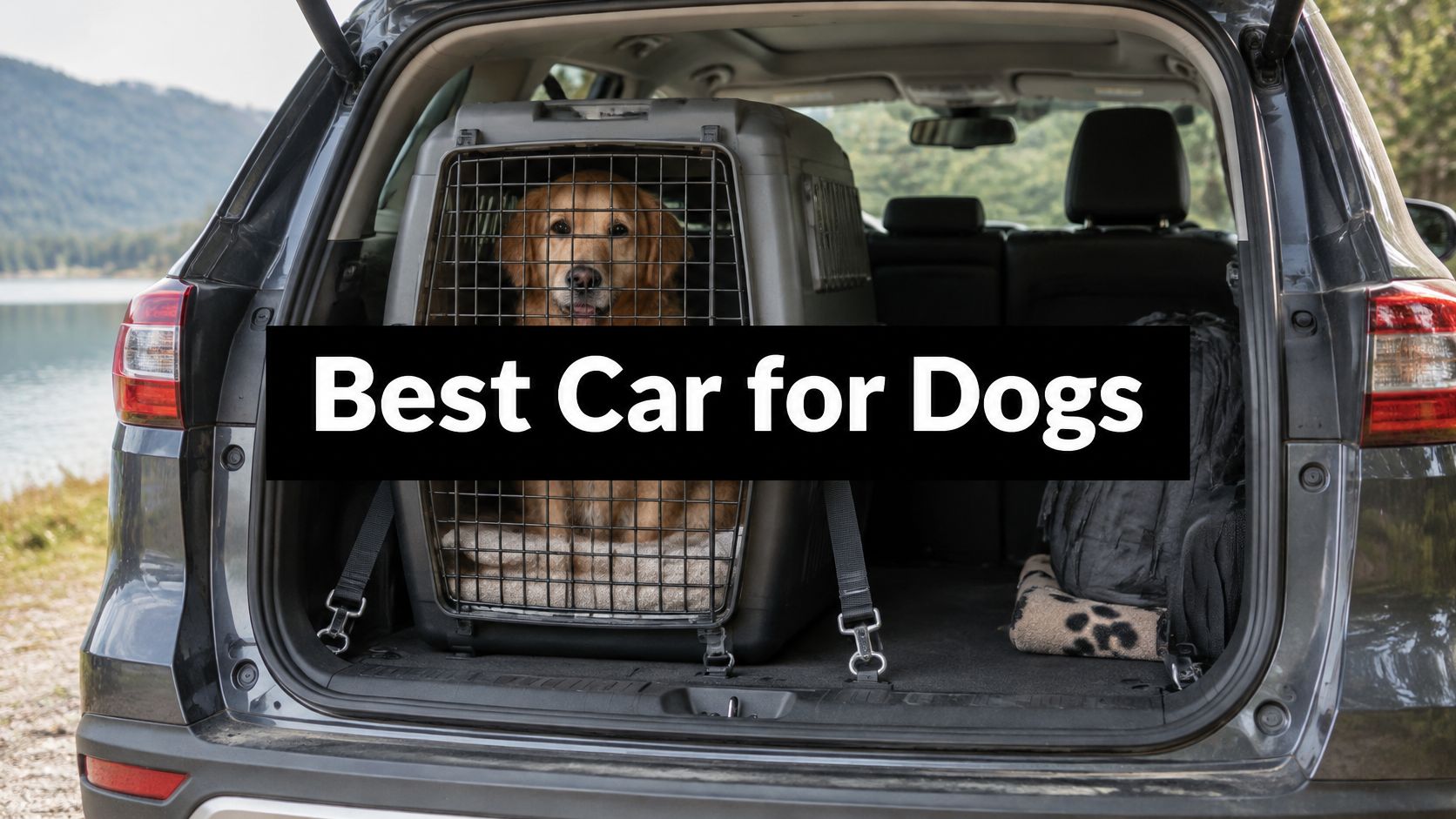
The crate is in the driveway and the hatch is open, and that's where the decision gets made. Not on the spec sheet with its cargo volume printed in cubic feet. The crate either slides through the opening, sits flat on the load floor, and reaches a tie-down with a short strap, or it doesn't, and no amount of leather trim fixes that.
Most shopping advice for dog owners stops at space. Roomy is easy to advertise and easy to compare. Anchored is harder, because it forces you to measure your own dog, your own crate, and the actual geometry of one specific vehicle before you sign anything.
I rank vehicles by whether a dog's restraint fits and stays put, and that single test reorders the usual list. A smaller crossover with four solid tie-downs and a flat floor beats a full-size SUV with a deep carpeted well and nothing to strap to. Once you treat restraint compatibility as a buying criterion instead of an accessory you'll sort out later, the best car for a dog gets much easier to identify.
Table of Contents
- Match Your Dog's Size to the Right Vehicle Type
- Restraint Options and How Much Protection Each Gives
- How Vehicle Types Compare on Daily Dog Needs
- How to Measure Cargo Space Against Your Crate
- Choosing by Travel Frequency and Trip Length
- Confirm Your Setup Before You Buy or Travel
Match Your Dog's Size to the Right Vehicle Type
Four bands cover most households, and each one points to a different starting vehicle. Use the table as a first filter, then let the crate dimensions overrule the weight.
| Dog size | Starting vehicle type | Restraint that matches | Cargo need |
|---|---|---|---|
| Small, under about 20 lb | Compact crossover or SUV with a rear seat or cargo area | Fully contained carrier secured to anchors | Compact floor with room for the carrier |
| Medium, 20 to 50 lb | Mid-size SUV or hatchback with a flat rear floor | Crash-tested harness on the seat belt, or a secured crate | Flat floor with room for a crate behind the rear seat |
| Large, over 50 lb | Full-size SUV | Properly secured crate or certified harness | Flat cargo floor with tie-downs and height for a tall crate |
| Two or more dogs | Minivan or cargo van | Separate crate or harness for each dog | Multiple crate positions with aisle access |
Every row assumes the dog rides behind the front seats, in the back seat or the cargo area, never on a lap and never in the front passenger footwell where the airbag lives.
Small dogs go wrong in the opposite direction from big ones. A 12 lb terrier doesn't need a full-size SUV. It needs a carrier that can't slide, and a rear seat shallow enough that you can still reach the straps without climbing in. Medium dogs are where the harness works best, because a 35 lb dog fits a standard seat belt path without a booster. Large dogs force the crate decision, since a tall crate has to clear the hatch opening even before it touches the floor.
Where the weight bands break down
Weight is a proxy for crate size, and a poor one. A deep-chested 45 lb dog in a 28-inch-tall crate needs a load height that a low-slung hatchback can't give you, while a lean 45 lb dog in a harness fits the back seat of a compact crossover with room to spare.
Behaviour shifts the answer too. A dog that pants, paces, or chews at a barrier usually settles in a smaller contained space and gets worse in a wide open cargo area. Ask yourself which version of your dog you're transporting on a bad day, not the calm one.
Three measurements that filter the shortlist
- Crate length plus a hand's width at each end. That allowance covers airflow and the swing of the crate door. A crate wedged tight against the seat back traps warm air and makes loading a two-person job.
- Crate height against the load height. Measure from the ground to the cargo floor, then add the height of the opening. If the crate has to tilt to get through, it won't sit level once it's inside.
- A flat rear floor with the seats folded. Folding seats that leave a step, a lip, or a deep well will tilt the crate. A tilted crate loads unevenly on the straps and never sits the way the manufacturer intended.
A vehicle that clears all three earns a test drive. One that fails the height check is out, whatever the badge or the price. Everything else, from fuel economy to upholstery colour, is a preference you can negotiate after the crate fits.
Restraint Options and How Much Protection Each Gives
Owners agree on the danger, then leave the harness in the hall closet. In AAA's 2011 survey of 1,000 U.S. dog owners who had driven with their dogs during the previous year, 83% agreed that an unrestrained dog could be dangerous in a moving vehicle, yet only 16% used any pet-restraint system. The same survey found 31% had been distracted by their dog while driving, and 59% had engaged in at least one distracting behavior.
Among the minority who did restrain, the split tells you what your vehicle has to accommodate. 56% used a harness or safety belt, 30% a hard-sided travel crate, 10% a pet vehicle seat, and 8% a vehicle barrier. Those are the four products you're really shopping to fit.
The gap between belief and behavior is the entire argument for choosing a car around the restraint rather than around the boot size.

What the gap costs is measurable. AAA's guidance on keeping pets safe in the car reports that a 60 lb dog traveling at 35 mph can become a projectile exerting about 2,100 lb of force in a crash. That force arrives in the same cabin as your passengers, at head height, with no warning.
What each option does in a crash
| Restraint | Crash protection | Distraction control | Best for |
|---|---|---|---|
| Crash-tested harness on seat belt | Good when correctly sized and certified | Good | Medium and large dogs in the back seat |
| Hard-sided crate secured to cargo anchors | Strong when firmly anchored | Good | Medium and large dogs in cargo areas |
| Fully contained carrier secured to anchors | Strong when attached with short straps | Good | Small dogs |
| Pet vehicle seat | Generally not effective as crash protection | Limits movement | Small dogs where distraction is the main concern |
| Vehicle barrier | Limited on its own, the dog still moves freely behind it | Limits access to the front seats | Cargo areas needing separation from the driver |
Read the table by dog size first, then by anchor quality. A certified harness only performs when it's sized to the chest and routed through the seat belt as the maker specifies; a harness a size too big lets the dog rotate out. Pet seats keep a small dog off your lap, which is worth something, but they don't hold an animal through an impact.
The rule I apply to every vehicle: the restraint you chose must reach a solid anchor with a short, direct strap, and the dog must stay clear of every airbag in the cabin.
That standard rules out a lot of otherwise pleasant cars. Cargo hooks rated for a shopping bag won't hold a strapped crate, and a barrier clipped to flimsy seat backs flexes under load. Before you buy, get on your knees in the boot and look at what the anchors are bolted to. If you're still working out the handling side of things, these pet safety tips for car travel cover the routines that keep a dog calm once the setup is right.
How Vehicle Types Compare on Daily Dog Needs
Six body styles cover almost everything people buy, and the differences that decide the answer rarely appear on the window sticker. Compare them on access, airflow, cleaning and anchors.
| Vehicle type | Rear access | Climate and ventilation | Cleaning | Restraint anchors |
|---|---|---|---|---|
| Compact crossover | Hatch with moderate load height | Rear vents may be limited to the console | Carpet in most trims, so plan on a liner | Two to four tie-downs, confirm positions |
| Mid-size SUV | Hatch with mid load height | Rear climate vents common | Carpet with all-weather mats available | Usually four anchors, check under-floor storage |
| Full-size SUV | Hatch with tall load height | Often has its own rear controls | Carpet and power-folding seats to remove | Strong tie-downs, often four or more |
| Minivan | Sliding doors with a low load floor | Rear climate controls common | Seats lift out for a proper wash | Multiple anchors plus seat-base brackets |
| Cargo van | Large rear or side doors | Separate rear climate unit available | Hard floor or vinyl, easy to wipe | Floor tracks suit several crates |
| Pickup with cap | Tailgate, load height depends on the lift | Weak, the bed is sealed off from cabin air | Bed liner washes out with a hose | Limited unless you add bed tie-downs |

Advertised volume misleads more than any other number on the sheet. The Drive's review of the 2024 Chevrolet Trax lists 25.6 cubic feet of cargo space behind the second row and 54.1 cubic feet behind the first row. That's a compact crossover whose usable space more than doubles depending on whether the seats are folded and where inside the load area the crate sits.
Rear access changes how you load every single day
Hatches suit tall crates because the opening runs upward with the glass, but the load lip is often higher than a dog can step over unaided. Sliding minivan doors give you the lowest floor and a wide aperture at the side, which matters when you're lifting a dog or loading in a tight parking bay. Cargo vans win on door size outright, with openings wide enough to walk a crate in on a trolley.
Loading height is not a detail. A senior Labrador that can't step up 20 inches turns every trip into a lift, and a lift you can't do safely is a trip you skip.
Cleaning and ventilation are the costs you pay later
Carpet holds hair, mud and the particular smell of a wet dog, and no vacuum gets it out of a deep pile. Vinyl, rubberised load floors and removable second rows clean in minutes. Rear vents and separate climate controls earn their keep over years, not on the test drive, so check them at the exact trim level you're pricing.
The differentiator I'd weigh above all else: four solid anchor points beat the largest floor on the market.
How to Measure Cargo Space Against Your Crate
Measurement is the step almost everyone skips, and it's the one that prevents an expensive mistake. Work through it with a tape measure and the crate you own.

- Measure the crate, not the dog. Length, width and height, and confirm the crate lets the dog stand, turn around and lie down, which is what AVMA guidance on pets in vehicles recommends. If you're still between two sizes, use this guide to find the right travel kennel size before you measure the car, because the crate sets the target and the vehicle has to meet it.
- Add clearance for airflow and door swing. Two to four inches at each end stops a crate becoming an oven in summer and lets the door open fully when the dog is inside.
- Measure the usable floor, not the published volume. Interior-volume figures aren't uniformly required for SUVs, vans, pickups and other truck-class vehicles in the EPA's vehicle database, so verify published numbers against the crate yourself.
- Measure the opening the crate has to pass through. Rear door or hatch, at its narrowest point, plus the loading height from the ground.
- Locate every tie-down and test strap length. Short, direct runs to the crate; slack is a failure.
- Place the crate near the vehicle's centre, away from the front seats and away from luggage that could shift into it.
- Test-load with luggage and one passenger. Then check that nothing blocks ventilation and that the rear exit still opens.
Why the roomier vehicle can be the less safe setup
Take a Labrador loose in the back of a full-size SUV with a big carpeted load area and no anchors. He can brace, slide, get thrown against the tailgate, and wander into the second row while you're merging. Put the same dog in a crate strapped short and tight to anchors in a smaller crossover and he stays contained, which is safer despite the smaller boot.
That's the counterintuitive part of choosing the best car for a dog. Open space lets a large dog build momentum, and momentum is what hurts. A crate that stops him moving is worth more than an extra foot of floor.
Small dogs have their own trap. A wide rear seat looks generous, but it invites the dog onto the centre console, the passenger seat, or your lap, and a fully contained carrier kills that option cleanly. If your move crosses state lines or leaves the country, check carrier rules as well, since USDA-approved dog crate requirements are a separate test from whether the crate fits your car.
Measure the crate first. Every other decision, from body style to budget, follows from a number you can take with a tape measure in ten minutes.
One more measurement people forget: climate. The cargo area can run at a markedly different temperature from the passenger cabin, so a vehicle with independent rear climate control is worth paying for on long trips. Check it on a warm day with the air conditioning on and your hand on the load floor.
Choosing by Travel Frequency and Trip Length
Owners who drive with their dogs do it constantly, and routine errands carry the same physics as a cross-country move. Trip length changes the vehicle, not the need for restraint.
Center for Pet Safety's carrier test summary notes that no established federal dynamic-performance standard existed for pet carriers during its study period, so it tested products under conditions modeled on Federal Motor Vehicle Safety Standard 213, including a 30 mph crash condition, excursion limits and anchor-point assessment. The results split the market: some carrier connections released or let the product flip, while products meeting the criteria held containment and attachment. That's why I prioritise a vehicle with accessible tie-downs that accept short, direct straps to a crash-tested crate. A seat belt wrapped around a carrier shell is not the same thing.
Daily errands and the school run
Short trips are where restraint gets skipped, so the setup has to survive contact with a busy morning. A compact or mid-size vehicle with a harness that stays buckled to the seat belt, or a carrier that lives in the boot, wins here. Permanence beats perfection: a restraint you install in 20 seconds gets used four times a day.
Weekend trips and day hikes
A mid-size or full-size SUV with a flat rear floor covers a crate, a cool box and a change of clothes without stacking anything against the dog. Plan one rest stop each way, because a dog that has been still for two hours needs to move before the walk starts.
Long relocations and moves
This is minivan or cargo van territory. You want independent rear climate control, separation between the dog and the luggage, more than one crate position if you're moving several animals, and enough aisle access to check on everyone at a fuel stop without unpacking the boot.
The strap between crate and anchor tells you more about a vehicle than the boot capacity on the brochure.
Confirm Your Setup Before You Buy or Travel
Five checks stand between a good idea and a safe trip. Run them in order and don't skip ahead.
- Choose the restraint that matches your dog's size using the comparison earlier, then confirm the certification on the product itself rather than the listing.
- Measure the crate and the cargo opening the way the steps above describe, and write the numbers down so you can compare vehicles fairly.
- Test-load with luggage and one passenger. The dog should stay behind the front seats and the rear exit should still open freely.
- Check every tie-down with the straps you'll use, and confirm the loading height suits your dog's age and mobility on a bad day, not a good one.
- Take a short practice drive and watch for distraction, overheating and stress. A dog that arrives panting has told you something about the ventilation.
If a vehicle fails any of those, change the restraint or change the vehicle before the trip. For a long move, or when nothing in the driveway passes, compare professional transport against driving it yourself. Precious Pets Transport Services, LLC offers domestic ground pet travel as private or shared rides, door to door, from cross county to cross state line, with pickup and delivery included. Before booking, the team asks for your pet's age, breed, size, mobility, medical conditions, and medications, so have those details ready when you request a quote.
For a personal vehicle on short hops and routine travel, a well-set-up car is usually the simplest answer. Start this week by measuring your crate, then measure the opening of the car you already own. If you want to prepare the animal for the journey as well as the vehicle, this guide to preparing a pet for travel covers the days before you leave.
Precious Pets Transport Services, LLC has relocated dogs and cats across the continental United States since 2004, using climate-controlled vans, sanitized kennels, bottled water, and drivers trained in pet first aid who stay with the animals overnight. If your move is larger than your vehicle can handle, or the crate won't fit anything you own, request a written estimate with your pickup and delivery locations, preferred travel dates, and your pet's details. Visit Precious Pets Transport Services, LLC to start the conversation and get a plan that matches the animal, not just the route.
Leave a Reply